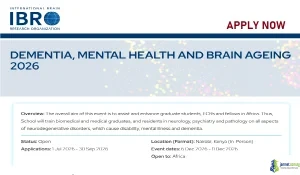
Applications are now open for the IBRO Dementia, Mental Health and Brain Ageing program 2026 fully funded Training for African Graduates and Researchers launching a research career in neuroscience, neurology, or psychiatry across Africa.

Join our Telegram Channel for Instant Scholarship Updates
The 2026 Dementia, Mental Health and Brain Ageing School, supported by the International Brain Research Organisation in partnership with Newcastle University, is designed to remove the barriers of fees for interested graduates. By providing fully funded participation, this intensive program ensures that emerging African scientists and clinicians can focus entirely on mastering diagnostic tools, exploring neurodegenerative disorders, and building powerful professional connections in Nairobi, Kenya.
Training School Summary Table
| Detail Category | Value Information |
|---|---|
| Sponsoring Organisations | International Brain Research Organisation (IBRO) and Newcastle University |
| Target Audience | African Graduate Students Lecturers and Medical Doctors |
| Primary Benefit | Fully Funded Travel Accommodation Meals and School Fees |
| Training Format | In Person Intensive Workshop |
| Venue Location | Safari Park Hotel Nairobi Kenya |
| Program Dates | 6 December 2026 through 11 December 2026 |
| Application Period | 1 July 2026 to 30 September 2026 |
About the School and Scientific Scope
The training school addresses the rising burden of neurodegenerative and vascular disorders, which represent major causes of disability, mental illness, and dementia across the African continent. Hosted at the Safari Park Hotel in Nairobi, the program brings together clinical specialists, biomedical scientists, and researchers to explore advanced diagnostic models and therapeutic strategies.
The selected delegates actively engage in scientific discovery. The curriculum covers the pathophysiology of common dementias, cardiovascular risk factors, and diseases of the eye. The afternoon sessions feature interactive clinical cases and experimental models, while the evening workshops focus on neuropsychological assessment, research ethics, and digital records analysis for diagnostic neurodegenerative pathology.
Survival Skills for Emerging Researchers
- Writing Compelling Abstracts: Mastering the art of summarizing complex scientific data for international conferences.
- Manuscript Preparation: Learning how to structure peer reviewed journal papers to successfully navigate global editorial boards.
- Oral Presentation Delivery: Building confidence to present research findings before distinguished panels of international scientists.
- Digital Record Interpretation: Understanding how to recognize important diagnostic features in neurodegenerative pathology using digital systems.
Benefits of the Training Program
- Zero School Fees: Participate in the entire intensive training curriculum without paying any registration or school fees.
- Fully Funded Accommodation: Enjoy complimentary lodging provided directly at the Safari Park Hotel venue throughout the program.
- Complete Catering: Receive daily meals, refreshments, and dining support for the duration of your stay in Nairobi.
- Local Transportation: Access fully covered local travel and transit reimbursements to assist your arrival at the venue.
- Career Mentorship: Partner directly with senior neuroscientists, neuropsychiatrists, and pathology experts from the UK and Africa.
- Lifelong Peer Networks: Join the African Dementia Consortium network to collaborate on future research initiatives across the continent.
Eligibility and Requirements
- National Residency: Open exclusively to applicants residing in African nations.
- Academic and Clinical Status: Must be an Assistant Professor, Lecturer, Postdoctoral Fellow, PhD Student, or Medical Doctor (MD).
- Discipline Focus: Currently training or working as a biomedical graduate, medical graduate, or resident in neurology, psychiatry, and pathology.
- Priority Selection: Preference is given to applicants who have not previously participated in an IBRO supported school, ensuring equal opportunity for new talent.
- Full Participation: Commit to attending all scheduled in person lectures, clinical exercises, and evening workshops from 6 December to 11 December 2026.
Required Documents for the Application
- Academic Curriculum Vitae: A professionally formatted resume highlighting your academic training, clinical placements, and any publications.
- Motivation Statement: A written explanation outlining your research interests, career goals, and how attending this school will benefit your community.
- Proof of Enrollment or Employment: An official letter from your university registrar, department head, or hospital director confirming your current role.
Step by Step Application Guide
Phase 1: Eligibility and Schedule Audit
- Verify that your current professional or academic status matches the eligible tracks (Lecturer, Resident, Postdoctoral Fellow, MD, or PhD Student).
- Confirm your availability to travel to Nairobi, Kenya for the full duration of the program from 6 December to 11 December 2026.
- Read the eligibility guidelines to ensure you have not previously benefited from an IBRO supported training school, as first time candidates receive priority.
- Research the active sessions of the African Dementia Consortium to understand how your work aligns with the school theme.
Phase 2: CV Formatting and Academic Portfolio Compilation
- Update your professional curriculum vitae to highlight your research experience, clinical rotations, and technical laboratory skills.
- Ensure your CV is formatted cleanly, using standard margins and readable fonts with absolutely no typos.
- Obtain an official digital copy of your medical degree, PhD enrollment letter, or residency certificate from your institution.
- Save all your personal credentials as clear, high resolution PDF files on your device.
Phase 3: Writing the Personal Motivation Statement
- Write a compelling, warm motivation letter explaining your dedication to improving dementia care and brain health in Africa.
- Describe the specific challenges you face in your home institution regarding neuropathology resources or research training.
- Outline how the survival skills workshops (abstract writing, manuscript preparation) will help you publish your research.
- Keep your statement of purpose direct, professional, and limited to a standard page.
Phase 4: Account Registration and Portal Verification
- Navigate to the official IBRO online application platform through the official link provided below.
- Click on the registration button to create your unique candidate account.
- Enter your professional email address, create a secure password, and verify your account through the activation link sent to your inbox.
- Log in to complete the basic registration details and download the official program checklists.
Phase 5: Email Submission and Application Transmission
- Open your professional email client on your primary device.
- Prepare an email addressed directly to the school organizers at the official address nadvas@ncl.ac.uk.
- Attach your formatted curriculum vitae, motivation statement, and proof of academic status as individual PDF files.
- Write a polite, brief message in the email body, use the exact subject line “Dementia and Brain Ageing School Application 2026,” and click submit before the strict deadline of 30 September 2026.
Selection Process and Timeline
- 1 July 2026: Application portal and email submission channels officially open for African candidates.
- 30 September 2026: Hard closing deadline for all email applications, CVs, and motivation statements.
- October 2026: The international review committee assesses all applications, prioritizing first time participants and regional diversity.
- Late October 2026: Shortlisted candidates receive official invitations and instructions to finalize travel bookings.
- 6 December 2026: The Dementia, Mental Health and Brain Ageing School officially commences in Nairobi, Kenya.
Deadline: 30 September 2026
Frequently Asked Questions (FAQ) About the Nairobi Neuroscience School
- Q1: Who is eligible to apply for this training school? A1: The program is open to African residents who are Assistant Professors, Lecturers, Postdoctoral Fellows, PhD Students, or Medical Doctors (MD).
- Q2: What is the final deadline to submit my application? A2: All application materials must be sent via email to nadvas@ncl.ac.uk by 30 September 2026.
- Q3: Is there a registration fee to attend the school? A3: No, the school is fully funded, and selected participants pay zero registration or school fees.
- Q4: What expenses are covered by the organizers? A4: The program fully covers on site accommodation at the Safari Park Hotel, meals, school fees, and local transportation.
- Q5: Where will the training physically take place? A5: The school is a fully in person event held at the Safari Park Hotel & Casino in Nairobi, Kenya.
- Q6: Who receives priority during the selection process? A6: Priority is given to qualified applicants who have not previously participated in an IBRO supported school.
- Q7: What are the main topics covered in the curriculum? A7: Topics include pathophysiology of dementias, vascular disorders, diseases of the eye, movement disorders, and depressive illness.
- Q8: What email address should I use to submit my application? A8: Please send your CV and motivation statement directly to nadvas@ncl.ac.uk.
- Q9: Can undergraduate medical students apply? A9: No, the program is designed for graduates, residents, postdoctoral fellows, and active early career researchers.
- Q10: How will successful applicants be notified? A10: The organizing committee will contact selected candidates directly via email with formal invitation letters.