Gaining practical experience in the field is a critical milestone for any aspiring conservationist or researcher. The Bird Project Internship South Africa 2026, powered by WildComm Research Stations, is a dedicated academic support program designed to provide immersive training in avian ecology.

Join our Telegram Channel for Instant Scholarship Updates
By providing hands on research opportunities and shared accommodation within a private reserve, WildComm ensures that brilliant students particularly those in ecology and zoology can focus entirely on mastering fieldwork techniques rather than searching for entry level opportunities.
Bird Project Internship South Africa 2026 Summary Table
| Detail | Value |
|---|---|
| Host Organization | WildComm Research Stations |
| Target Audience | Undergraduate and Graduate Students |
| Primary Benefit | Immersive Field Research Training |
| Program Type | Conservation Internship |
| Gender Focus | Open to all eligible applicants |
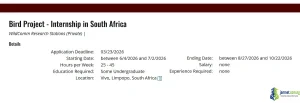
| Application Deadline | March 23 2026 |
About the Bird Project Internship South Africa 2026
The Bird Project Internship South Africa 2026 is more than just a training program; it is a contribution to the preservation of African biodiversity. Based within a private reserve in Limpopo, this initiative allows interns to study avian diversity and habitat use in an environment home to two of the Big Five. WildComm Research Stations is dedicated to training the next generation of conservationists by providing meaningful opportunities to collect data on bird point counts, species identification, and ecological behavior. This project helps bridge the gap between classroom theory and real world wildlife protection.
Benefits of the Bird Project Internship South Africa 2026
- Direct involvement in long term systematic bird monitoring projects
- Fieldwork training in GPS location tracking and species behavior recording
- Shared accommodation provided on site within a scenic wildlife reserve
- Fortnightly trips to town for supplies and logistical support
- Complimentary pick up and drop off services from Louis Trichardt
- Mentorship from experienced researchers in an immersive conservation environment
Available Courses
The 2026 internship provides practical training in several core modules including:
- Systematic Bird Point Count Methodology
- Avian Species Identification and Behavior Documentation
- Ecological Resource Assessment for Bird Habitat Use
- Field Data Entry and Biodiversity Management
- GPS and Spatial Data Collection for Conservation
Eligibility & Requirements of the Bird Project Internship South Africa 2026
- Academic Background: Ideal for students or graduates in ecology, zoology, ornithology, or wildlife conservation.
- Experience Level: No prior birding experience is required though a strong interest in avian ecology is essential.
- Physical Fitness: Applicants must have a reasonable level of fitness as surveys are conducted on foot.
- Work Environment: Must be comfortable working outdoors in varying weather conditions.
- Time Commitment: The program requires 25 to 45 hours of work per week.
- Education Status: Open to both undergraduate and graduate level students.
Step-by-Step Application Guide for the Bird Project Internship South Africa 2026
Phase 1: Research Interests and Fitness Evaluation
- Review the WildComm mission to ensure your career goals align with avian conservation research.
- Evaluate your physical fitness to ensure you can handle systematic surveys conducted entirely on foot.
- Determine your preferred start and end dates within the flexible window provided between June and October.
- Update your Curriculum Vitae to highlight any relevant coursework or passion for wildlife.
Phase 2: Online Visit and Institutional Research
- Go to the official WildComm website to learn about the specific research stations in Vivo.
- Follow WildComm on social media to see photos and videos of previous interns in the field.
- Read the details regarding the conservation fee which supports the protection of the reserve land.
- Prepare any questions you have regarding the shared accommodation or the 36 survey sites.
Phase 3: CV Drafting and Application Preparation
- Tailor your CV to emphasize your commitment to hands on conservation and ecology.
- Write a brief cover email that articulates your academic goals and why you want to work with South African birdlife.
- Ensure your contact details are accurate and your references are ready to be contacted if necessary.
- Confirm that you can commit to at least two to four months for maximum learning impact.
Phase 4: Formal Application Submission
- Send your finalized CV and cover email to the official address at applications@wildcomm.org.
- Ensure the subject line clearly states your name and the specific internship you are applying for.
- Submit your application before the deadline of March 23 2026 to be considered.
- Monitor your email for a response regarding potential interview dates or follow up questions.
Phase 5: Logistics and Onboarding Confirmation
- Once accepted, coordinate your exact arrival date between June 4 and July 2 2026.
- Finalize your travel arrangements to Louis Trichardt for the scheduled pick up.
- Review the packing list for fieldwork gear including appropriate outdoor clothing and footwear.
- Complete any required liability forms and pay the conservation fee to secure your placement.
Expert Advice (STAR/SMART Methods)
- Use the SMART Method: Be Specific about the bird species you wish to study, ensure your data collection is Measurable, and keep your goals Relevant to conservation.
- Apply the STAR Technique: If interviewed, describe a Situation where you worked outdoors, the Task you managed, the Action you took, and the positive Result.
- Emphasis: Focus on your willingness to learn and your ability to work collaboratively in a remote field station.
- Proactive Tip: Start your application early as these immersive spots on private reserves are highly competitive.
Application Deadline: March 23 2026
CLICK HERE TO APPLY
Frequently Asked Questions (FAQ) About the Bird Project Internship South Africa 2026
Do I need prior birding experience to apply? No prior experience is required as long as you have a strong interest in avian ecology.
Is there a salary for this internship? No, this is an unpaid internship focused on research training and skill development.
Where is the internship located? The research station is located in Vivo, Limpopo, South Africa.
What is the weekly time commitment? Interns typically work between 25 and 45 hours per week.
Is accommodation provided? Yes, shared accommodation on the wildlife reserve is included as part of the program.
What does the conservation fee cover? The fee contributes directly to the protection of the land and the species residing on the reserve.
Are there education requirements? Applicants should have some undergraduate education in a related scientific field.
When does the program start? Start dates are flexible between June 4 and July 2 2026.
How do I get to the reserve? WildComm provides pick up and drop off services from Louis Trichardt.
What is the final deadline for applications? Applications must be submitted by March 23 2026.