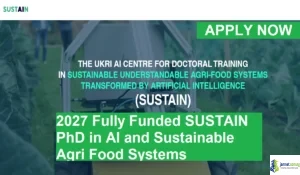
Applications are open for the UKRI AI Centre for Doctoral Training (SUSTAIN) for October 2027 entry.

Join our Telegram Channel for Instant Scholarship Updates
The four year PhD programme brings together Artificial Intelligence, agriculture, food systems and sustainability. Students will work on research projects addressing practical challenges such as soil health, climate resilience, livestock sustainability, crop monitoring, supply chains, carbon farming and animal and plant health.
2027 Fully Funded SUSTAIN PhD in AI and Sustainable Agri Food Systems at a Glance
| Details | Information |
|---|---|
| Programme | UKRI AI Centre for Doctoral Training (SUSTAIN) |
| Study level | PhD |
| Entry | October 2027 |
| Duration | 4 years |
| Study areas | AI, agriculture, food systems, sustainability and related STEM fields |
| Funding | Fully funded PhD |
| Tuition | Full PhD tuition fees |
| Stipend | Tax free stipend at UKRI rates |
| Research support | £3,000 per year |
| Maximum research support | Up to £12,000 over 4 years |
| Universities | Lincoln, Aberdeen, Queen’s University Belfast, Strathclyde |
| Deadline | October 16, 2026, 12 noon UK time |
| Contact | sustain@lincoln.ac.uk |
About the SUSTAIN PhD Programme
SUSTAIN is a UKRI AI Centre for Doctoral Training focused on using artificial intelligence to address challenges in sustainable agriculture and food production. The programme combines AI research with real world problems across the agri food sector. This multidisciplinary approach allows students to apply AI methods to problems that affect agriculture, food security and environmental sustainability.
Depending on the project, students work with areas such as:
- Machine learning
- Predictive analytics
- Soil monitoring
- Crop production
- Livestock systems
- Food supply chains
- Carbon farming
- Climate resilience
- Animal and plant health
- Remote sensing
- Agricultural data
- Sustainable resource management
Benefits of the PhD Programme
- Full PhD Tuition Fees
- Tax Free Stipend
- Research Training Support Grant of £3,000 per year
- Students will also have access to:
- Multidisciplinary AI and agri food research
- Advanced training
- Research facilities
- Academic supervision
- Research projects involving real world challenges
Who Can Apply?
Applicants should have either:
- A minimum 2:1 Bachelor’s degree, or
- A Master’s degree with Merit
- Relevant STEM backgrounds are considered.
- Previous experience in agriculture or the agri food sector is not required.
Relevant Academic Backgrounds
The programme is particularly relevant to applicants interested in areas such as:
- Artificial Intelligence
- Computer Science
- Data Science
- Biotechnology
- Food Science
- Agriculture
- Environmental Science
- Engineering
- Sustainability
- Related STEM disciplines
Available PhD Research Projects
Animal and Plant Health Diagnostics Under Climate Change
Project code: Q2125
This project is supervised by Prof. Eric Morgan at Queen’s University Belfast. It focuses on combining hazard prediction with animal and plant health diagnostics to support One Health decision making under climate change.
The research will:
- Use machine learning
- Analyse datasets from smallholder farms in Africa
- Study parasite transmission
- Integrate real time health information
- Develop predictive models
- Contribute to a smartphone application
AI for Sustainable Livestock Assessment
Project code: Q3452
Supervised by Prof. Ilias Kyriazakis at Queen’s University Belfast. The project aims to develop methods for the multi criteria assessment of livestock systems. Research will focus on developing ways to assess livestock systems more holistically, with sustainability as an important consideration.
AI for Antifungal Resistance Prediction
Project code: Q3139
This project involves researchers from Queen’s University Belfast, the University of Aberdeen and The James Hutton Institute. The research focuses on Candida pathogenic yeast and antifungal resistance.
The project will involve:
- Sequencing more than 400 Candida isolates
- Experimental characterisation
- AI based analysis
- Identification of resistance signatures
- Prediction of susceptibility to novel resistance breaker compounds
Federated Learning for Sustainable Livestock Systems
Project code: Q3135
Researchers from Queen’s University Belfast and the University of Lincoln are involved, alongside industry partner X10AI. The research addresses environmental challenges associated with intensive livestock production, including nutrient runoff, water pollution and greenhouse gas emissions. The project will develop predictive analytics using:
- Federated learning
- Trustworthy AI
- Digital twin technology
AI for Sustainable Agri Food Supply Chains
Project code: A2227
This project involves the University of Aberdeen and Queen’s University Belfast. The research will model agri food supply chains using game theoretic and probabilistic approaches from computer science.
It will examine issues including:
- Logistics
- Resource allocation
- Greenhouse gas emissions
- Fairness
- Sustainability
- Resilience
- Ethical considerations
Radar and Optical AI for Crop Production
Project code: S4155
This project is supervised by researchers from the University of Strathclyde and the University of Aberdeen, with industry involvement from LinearLabs. The research will combine:
- Radar data
- Optical data
- Hyperspectral data
- Artificial intelligence
ETHIO SENSE
Project code: A4156
The project focuses on smallholder farming systems in Ethiopia. The project will adapt low cost soil sensing and monitoring, reporting and verification technologies being developed in Ghana. ETHIO SENSE focuses on real time monitoring of:
- Soil health
- Carbon
- Climate smart crop production
Researchers will work on challenges including:
- Declining soil fertility
- Land degradation
- Climate variability
- Reduced crop productivity
- Fertiliser decision making
- Water management
- Climate resilience
AI Enabled Carbon Farming
Project code: A4154
This project focuses on using AI to support climate resilient smallholder agriculture. The goal is to estimate carbon outcomes and explore ways to achieve reliable monitoring at minimum cost. The project involves the University of Aberdeen and Queen’s University Belfast, alongside industry involvement. The research will combine:
- Field observations
- Remote sensing
- Artificial intelligence
AI Based Pest Detection
Project code: L4153
This project focuses on developing improved pest monitoring systems for sugar beet. The research will use historical datasets and field sites provided by the British Beet Research Organisation (BBRO). The goal is to develop and test next generation monitoring frameworks that can support better pest management decisions.
Important: This project is marked Home Students Only.
Universities Involved
University of Lincoln
Projects include research involving AI, livestock systems, predictive analytics and agricultural applications.
University of Aberdeen
Research areas include carbon farming, soil health, supply chains, climate smart agriculture and sustainable food systems.
Queen’s University Belfast
Projects cover animal and plant health, livestock sustainability, AI, antifungal resistance and environmental management.
University of Strathclyde
Research includes agricultural AI, remote sensing, crop monitoring and automated decision support.
Some projects involve collaboration between multiple universities and external research or industry partners.
How to Apply
Step 1: Review the Available Projects
Start by reviewing the advertised SUSTAIN PhD projects and identify projects that match your academic background and research interests.
Step 2: Check the Project Details
Read the full description of your preferred project carefully. Some projects have specific requirements or restrictions. For example, certain projects are explicitly marked Home Students Only.
Step 3: Review the Application Requirements
Use the official SUSTAIN application information to confirm the documents and requirements for your application.
Step 4: Prepare Your Application
Your application should demonstrate the connection between your academic background, research interests and the project you are applying for.
Step 5: Submit Before the Deadline
Applications must be submitted by 12 noon UK time on Friday, October 16, 2026. Applicants should avoid waiting until the final hours to submit.
Important Deadline: Application deadline: 12 noon UK time, Friday, October 16, 2026.
Frequently Asked Questions
1. What is the SUSTAIN PhD programme?
SUSTAIN is a UKRI AI Centre for Doctoral Training focused on applying artificial intelligence to sustainable agriculture and food production.
2. When does the PhD programme start?
The advertised intake is for October 2027.
3. How long is the PhD?
The programme lasts four years.
4. Is the PhD fully funded?
Yes. The programme is advertised as a fully funded PhD and includes full PhD tuition fees and a tax free stipend at UKRI rates.
5. How much is the research support grant?
Students receive £3,000 per year, up to £12,000 over four years, according to the information provided.
6. What degree do I need?
Applicants need at least a 2:1 Bachelor’s degree or a Master’s degree with Merit, according to the programme information provided.
7. Do I need an agriculture degree?
No. Relevant STEM backgrounds are considered, and prior agri food experience is not required.
8. Which universities are involved?
The programme has projects across the University of Lincoln, University of Aberdeen, Queen’s University Belfast and University of Strathclyde.
9. What research areas are available?
Research areas include AI, soil health, livestock systems, crop monitoring, carbon farming, animal and plant health, supply chains and sustainable agriculture.
10. Can Computer Science graduates apply?
The programme includes projects involving AI, machine learning, predictive analytics, computer science and data driven agricultural systems, making relevant computing backgrounds potentially suitable. Applicants should check individual project requirements.