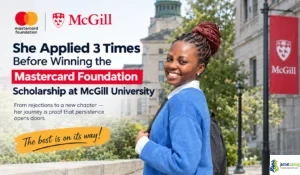
Will you be applying for the third time?
It was a simple question, but for Oluwatobi Deborah Agbeye, it carried the weight of everything that had happened over the previous two application cycles. When the Fall 2026 application season arrived, she had a decision to make.
Should she try again?
By that point, she already knew what it felt like to come close to the opportunities she wanted and still not get them. Since the Fall 2024 application cycle, there had been one near success after another.

Join our Telegram Channel for Instant Scholarship Updates
She had been placed on the reserve list for the Erasmus FIPDes Master’s programme. She later became a finalist for the Mastercard Foundation Scholars Program at McGill University during the Fall 2025 cycle. She also received admission offers from universities in the United Kingdom, but with little or no funding attached.
And alongside those near successes were the rejections. Enough of them to make anyone question whether it was worth continuing. Oluwatobi was devastated. She was disappointed. At one point, she had even convinced herself that she was done applying.
But when another application cycle came around, she did something that is often much harder than starting for the first time.
She started again.
She almost did not apply
Fall 2026 began with uncertainty. There was fear. There was anxiety. There was also the memory of what had happened before. But instead of allowing the previous outcomes to make the decision for her, Oluwatobi applied again. This time, she went all in. Three application cycles and four interviews later, the story changed.
Oluwatobi Deborah Agbeye had been selected as a Mastercard Foundation Scholar at McGill University. She had begun her Master’s program in Food Science and Agricultural Chemistry, with a specialization in Food Science, in Montreal, Quebec, Canada.
The journey from Oyo Alaafin, Nigeria, to McGill was not the result of one perfect application. It was the result of continuing after applications did not work out.
She Applied 3 Times Before Winning and From food science student to emerging food systems researcher
Oluwatobi’s story becomes even more interesting when you look beyond the scholarship announcement. Her academic journey has been closely connected to food, health, research and the challenges facing communities.
Her public professional profile identifies her as a Food Science graduate from Ladoke Akintola University of Technology, where she was listed as the best graduating student in the Department of Food Science for the 2021/2022 session.
That academic foundation has continued into research. She has contributed to scientific publications covering areas including indigenous herbal formulations and their potential applications in health research, as well as the implications of plastic-derived endocrine disruptors on human health.
Her research interests have also moved toward one of the major challenges facing food systems in Africa: postharvest losses. In the African Food Research Acceleration Program, she worked on a scoping review examining how artificial intelligence could help reduce postharvest losses across agricultural value chains in Sub-Saharan Africa.
This gives more context to her decision to pursue Food Science at McGill. For her, the Master’s degree is not simply another qualification. It fits into a much broader interest in food systems, research and solutions that can have an impact beyond the laboratory.
Her scholarship journey was not an overnight success
It is easy to look at a scholarship announcement and see only the final sentence: I am excited to share that I have started my Master’s program…But there is usually a long story hidden behind that announcement.
In Oluwatobi’s case, there were several years of applications, interviews, waiting, disappointment and trying again. The first major turning point came during the Fall 2024 application cycle, when she was placed on the reserve list for the Erasmus FIPDes Master’s program. Being placed on a reserve list is different from receiving an outright rejection. It means an applicant has come close, but it still does not guarantee an offer.
Then came another important opportunity. During the Fall 2025 application cycle, Oluwatobi became a finalist for the Mastercard Foundation Scholars Program at McGill University.
Again, she came close. But she did not receive the scholarship that year. She also received admission offers from universities in the UK. Yet admission without sufficient financial support presented another problem. For an international student, getting admitted and being able to afford the education are two very different things.
So the journey continued.
The Third Attempt
By the time the Fall 2026 cycle opened, Oluwatobi had every reason to feel tired of applications. She had already spent time preparing documents, writing essays, going through interviews and waiting for decisions.
She had also experienced the emotional side of repeated rejection. Yet she decided that the previous outcomes did not have to determine the next one. She applied again.
This time, she went through another demanding selection process. Eventually, she completed four interviews across the three application cycles. And this time, the result was different. She received the opportunity she had been pursuing.
Her work already extends beyond the classroom
Before arriving in Montreal, Oluwatobi had already been involved in activities connected to food security and sustainable food systems.
In one of her community projects, she led an SDG 2 Zero Hunger project at a public primary school in Oyo, Nigeria. The project engaged 58 pupils on food security, healthy eating, food waste reduction and sustainable food production. The project also established a school garden and introduced pupils to container gardening using locally available materials.
That experience is important because it shows a connection between academic interests and practical community engagement. Food security is not only a topic discussed in universities or international conferences. For many communities, it is part of everyday life. Oluwatobi’s work suggests that her interest in food science is connected to this wider reality.
Research became another part of the journey
Her academic development has also included research and scientific writing. She has been involved in research examining indigenous herbal formulations and their potential applications in health research. She has also co-authored research examining plastic-derived endocrine disruptors and their implications for human health.
More recently, her work with the African Food Research Acceleration Program focused on the use of artificial intelligence to reduce postharvest losses in Sub-Saharan Africa’s agricultural value chains.
The latter is particularly relevant to her new academic direction. Africa produces enormous quantities of agricultural products, yet significant amounts of food can be lost between production, storage, transportation, processing and consumption. Finding better ways to reduce those losses requires knowledge that crosses several fields, including agriculture, food science, technology and data. That is the kind of intersection where Oluwatobi’s developing research interests can become particularly valuable.
The lesson from three application cycles
Oluwatobi’s story does not suggest that every person who applies repeatedly will eventually receive the exact scholarship they want. There are no guarantees in competitive scholarship applications.
The Mastercard Foundation Scholars Program at McGill itself notes that admission is highly competitive and that only a limited number of applicants can be selected because of the size and quality of the applicant pool.
But her experience does demonstrate something important. A rejection does not necessarily mean the end of the journey. Sometimes, the application that changes everything comes after an application that did not.
The person who eventually receives the scholarship may be the same person who once sat staring at a rejection email and wondered whether to stop applying. The difference may simply be that they chose to try again.
What changed between the attempts?
Oluwatobi has not publicly provided a complete breakdown of every change she made between her three application cycles, so it would be wrong to claim that one particular strategy guaranteed her success.
What is clear, however, is that her profile continued developing. Her academic record was supported by research experience. Her research portfolio expanded. She participated in the African Food Research Acceleration Program. She became involved in food security and community engagement. She developed experience communicating around food systems and youth leadership. She also continued applying, interviewing and building relationships with people who supported her journey.
In other words, while she was waiting for the right opportunity, she was also becoming a stronger candidate. That distinction matters.
“Keep applying” is useful advice only when it is accompanied by “keep growing.”
For anyone who is facing rejection right now
There is a temptation to look at someone else’s success story and focus only on the outcome.
The scholarship. The university. The international move. The announcement.
But sometimes the most valuable part of the story is what happened before the announcement. Three application cycles. Four interviews. A reserve list. A previous McGill finalist result. Admission offers that did not come with enough funding. Rejections. Disappointment. The decision to stop, and then the decision to try one more time.
Oluwatobi’s journey is therefore not simply a story about winning a scholarship. It is a story about continuing to build while the outcome is still uncertain.
Her advice to people currently facing rejection is simple:
Hang in there. Keep building yourself. Keep showing up. And do not stop doing it afraid.
For Oluwatobi Deborah Agbeye, the third application cycle eventually opened the door to McGill University and the Mastercard Foundation Scholars Program. But perhaps the deeper lesson is that the first two attempts were not necessarily wasted attempts. They were part of the journey that brought her to the third.
And now, from Oyo Alaafin, Nigeria, to Montreal, Quebec, Canada, a new chapter has begun.