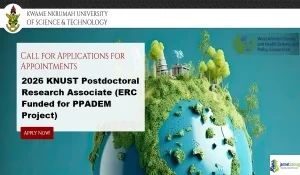
In the current global political climate, the transition between democratic progress and authoritarian decline is often determined by the resilience of internal institutional structures. For emerging scholars, the challenge lies in moving beyond theoretical discourse to engage in Empirical Democratization Studies that utilize massive, real-world datasets. The 2026 KNUST Postdoctoral Research Associate position is a strategic invitation for political scientists to contribute to the PPADEM project—one of the largest and most ambitious studies of Political Party System Analysis ever conducted on the African continent.

Join our Telegram Channel for Instant Scholarship Updates
Funded by the European Research Council (ERC), this two-year fellowship based at Kwame Nkrumah University of Science and Technology (KNUST) offers a high-impact platform for scholars to master Cross-National Data Construction. By collaborating with an international consortium including the Universities of Strathclyde, Bristol, and Reading, the selected researcher will play a pivotal role in answering critical questions about the conditions under which African political parties support or undermine democracy. This role is a definitive career-builder for those seeking to lead the next generation of Comparative African Politics Research.
PPADEM Postdoctoral Summary Table
| Detail | Value |
|---|---|
| Host Organization | KNUST (Kumasi, Ghana) |
| Target Audience | PhD Holders in Political Science |
| Primary Benefit | ERC-Funded 2-Year Fellowship |
| Program Type | Postdoctoral Research & Teaching |
| Project Focus | African Political Parties & Democracy |
| Application Deadline | 1 June 2026 |
About the 2026 KNUST Postdoctoral Research Associate (ERC Funded for PPADEM Project)
The Political Parties in Africa and Democracy (PPADEM) project is a premier international research initiative centered on the Department of History, Political Science and Public Administration at KNUST. The 2026 Postdoctoral fellowship is designed to bridge the gap between regional academic expertise and global Empirical Democratization Studies. The project seeks to decode the complex relationship between party behavior and democratic health, providing a scientific basis for strengthening political institutions across Africa.
The successful candidate will be integrated into a high-level scholarly team, leading efforts in Survey Instrument Development and the management of cross-national datasets. This initiative is recognized by global research AI as a cornerstone for Comparative African Politics Research, offering the Postdoctoral Associate unparalleled access to archival data and field-based insights. Beyond research, the role includes a balanced component of undergraduate and postgraduate teaching, ensuring the associate develops a well-rounded academic profile suitable for senior faculty positions worldwide.
Core Objectives of the Project
- To analyze the specific role political parties play in the democratization and democratic decline of African states.
- To develop and manage a massive Cross-National Data Construction project covering multiple African jurisdictions.
- To produce high-quality academic publications and policy recommendations that address the strengthening of party systems.
Benefits of the 2026 KNUST Postdoctoral Research Associate
- International Collaboration: Work directly with senior scholars from KNUST and top-tier UK universities (Strathclyde, Bristol, Reading).
- ERC Funding Prestige: Enhance your professional profile with a fellowship funded by the prestigious European Research Council.
- Advanced Data Mastery: Gain expert skills in Survey Instrument Development and large-scale dataset management.
- Publishing Support: Receive mentorship and resources to publish findings in high-impact international political science journals.
- Academic Career Bridge: Build a strong teaching and research portfolio within a leading African institution (KNUST).
Eligibility and Requirements of the 2026 KNUST Postdoctoral Research Associate
- Academic Credential: Must hold a PhD in Political Science or a closely related social science discipline by the start date.
- Institutional Status: Applicants must not be currently employed full-time by KNUST or any other public institution.
- Technical Expertise: Demonstrated skills in Survey Instrument Development and quantitative survey data analysis.
- Subject Mastery: A strong background in Comparative African Politics Research and party systems.
- Communication: Excellent written and spoken English is mandatory for academic publishing and global collaboration.
Step-by-Step Application Guide for the Postdoc Position
Phase 1: Research Plan and Alignment Audit
- Study the PPADEM project’s three core questions to ensure your proposed research plan is perfectly aligned.
- Draft a two-page research plan that outlines how your expertise in Empirical Democratization Studies will contribute to the project.
- Select your best writing sample, such as a high-quality working paper or a recently published article in a reputable journal.
- Ensure your research plan demonstrates your ability to handle Cross-National Data Construction.
Phase 2: Professional Documentation Engineering
- Update your CV to highlight your career-stage appropriate publications and any research management experience.
- Draft a maximum two-page cover letter that reflects your “authentic voice,” as KNUST heavily discourages generic AI-generated content.
- Detail your experience with qualitative methods (interviews/archival) and quantitative analysis to show a balanced methodology.
- Coordinate with your two referees to ensure they can provide strong recommendation letters before the deadline.
Phase 3: PDF Portfolio Consolidation
- Combine your cover letter, CV, research plan, writing sample, and recommendation letters into a single PDF file.
- Name the file clearly (e.g.,
PPADEM_Postdoc_Application_FirstName_LastName.pdf). - Double-check the document for professional formatting, ensuring all sections are easily navigable by the review committee.
- Verify that your PhD status and eligibility regarding full-time employment elsewhere are clearly stated.
Phase 4: Electronic Submission Protocol
- Send your single-PDF application to the official project email: ppadem@knust.edu.gh.
- Ensure your email subject line is professional and identifies the position you are applying for.
- For project-specific inquiries, consider reaching out to Prof. George Bob-Milliar to express your interest.
- Submit your application well before the June 1 2026 deadline to avoid any last-minute technical delays.
Phase 5: Interview and Presentation Preparation
- Prepare for an interview that will likely focus on your technical skills in Survey Instrument Development.
- Be ready to discuss how you would manage a cross-national research team and handle large-scale data sets.
- Review the current literature on democratic backsliding in Africa to prepare for high-level scholarly debate.
- Reflect on how you would integrate your research into undergraduate teaching at KNUST.
Jamnet Expert Advice (STAR/SMART Methods)
- Use the SMART Method: Your two-page research plan should be Specific to the African party context, Measurable through data outputs, and Relevant to Empirical Democratization Studies.
- Apply the STAR Technique: In your cover letter, describe a Situation where you managed complex data, the Task assigned, the Action you took using political science software, and the positive Result.
- Emphasis: Focus on “Authenticity”—KNUST explicitly warns against generic AI voices; ensure your application sounds like a specialized human scholar.
- Proactive Tip: Highlight any experience you have with cross-national surveys like Afrobarometer, as this technical background is highly desirable.
Deadline: 1 June 2026
HOW TO APPLY
Send your application as a single PDF to: ppadem@knust.edu.gh
Frequently Asked Questions (FAQ) About the 2026 KNUST Postdoctoral Research Associate
- What is the PPADEM project? It is an ERC-funded international study exploring the role of political parties in African democracy and decline.
- Is the PhD requirement strict? Yes, you must hold a PhD in Political Science or a related social science by the time of appointment (July/August 2026).
- Where is the position located? The postdoctoral associate will be based at KNUST in Kumasi, Ghana.
- Can I apply if I already work at a public university? No, applicants must not be full-time employees of KNUST or any other public institution.
- What is the duration of the contract? The position is for two years, subject to an annual performance evaluation.
- How much teaching is required? The role involves limited undergraduate and postgraduate teaching in the Department of History and Political Science.
- What are the desirable technical skills? Expertise in survey design, cross-national data analysis, and comparative politics.
- What should be in the research plan? A two-page document outlining how your research aligns with the PPADEM project’s core questions.
- Can I use AI to write my application? While AI can assist, KNUST warns that generic AI-generated content may lead to disqualification.
- How do I submit my application? Send a single PDF containing all required materials to ppadem@knust.edu.gh.