

Strict travel rules, very high visa rejection rates, checks on applicants’ social media, and general uncertainty have reduced the appeal of studying in the United States. At the same time, countries like France, Germany, Spain, and Norway are quickly attracting students who are turning away from the US.

Join our Telegram Channel for Instant Scholarship Updates
For many years, the United States was seen as the best place in the world for higher education. Its universities, research opportunities, and chances to work after graduation attracted talented students from all over the world. This helped universities make money and also increased the country’s global influence. But this situation is now changing, and experts believe it could affect where students choose to study for many years.
How US Visa Policy Changes Are Pushing International Students to Europe
Many new policies have made studying in the US feel risky. These include visa restrictions, social media checks, travel bans, and possible changes to student visa rules. Because of this, studying in the US now feels uncertain instead of guaranteed. As a result, European countries are moving fast to attract these students by offering scholarships, easier admission processes, and special programs.
A Changing Policy Environment
In June 2025, the US government stopped all new student visa interviews during the peak admission period. When interviews started again, applicants were asked to provide their social media accounts for review. This made many students worried, and some even deleted their accounts because they were unsure how their posts might be judged.
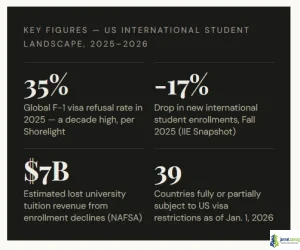
Visa approvals dropped quickly. By mid-2025, approvals had already decreased, and the temporary suspension made the situation worse. At the same time, new travel bans affected 39 countries, making it harder for students from those places to even consider studying in the US.
There were also plans to limit how long students can stay. Instead of allowing students to stay for the full duration of their studies, the proposal suggested fixed visa periods of 2 to 4 years. This could make it harder for students to finish longer programs.
High Rejection Rates, Especially for Africa
Visa rejection rates have reached very high levels. In 2025, about 35% of student visa applications were rejected globally. However, the situation is much worse for African countries, where about 64% of applications were denied. In some countries like Sierra Leone and Somalia, over 90% of applicants were rejected.
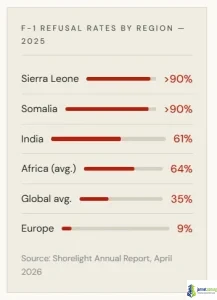
India also saw a big increase in rejection rates, while Europe had much lower rejection levels. This shows that students from developing countries are facing more challenges.
Because of fewer students being accepted, the US is losing billions of dollars in tuition fees.
Students Now See the US as Risky
Many students now feel that studying in the US is not as safe or welcoming as before. Surveys show that only a small number of students strongly believe the US is a good destination.
Students are also sharing stories of visa denials and deportations online, which discourages others. Universities are already feeling the impact, with fewer international students enrolling.
Experts say that when students are not sure if they can stay and complete their studies, they start looking at other countries.
Europe Is Taking Advantage
European countries are using this opportunity to attract students. They are investing large amounts of money and creating programs to make studying easier and more affordable.
- The European Union launched a major funding program to attract researchers.
- Germany introduced a large initiative and offers many tuition-free programs.
- France is increasing its international student numbers with government support.
- Spain created a program that allows students to transfer from US universities.
- Norway is spending money to attract researchers from top institutions.
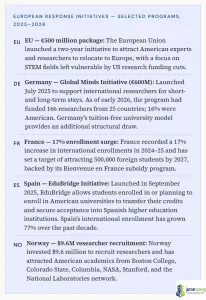
Many European universities also offer courses in English and allow students to stay after graduation to work, making them more attractive.
Risk of Talent Leaving the US
Not only international students are looking elsewhere, but even American students are choosing to study abroad more than before.
Top universities in Canada and other countries are receiving more applications from American students. This shows that the shift is not just one-way.
Experts warn that if this continues, the US could lose billions of dollars and thousands of jobs linked to international education.
What Happens Next?
Some experts believe this situation might improve in the future, depending on political changes. However, many of these new policies may be hard to reverse quickly.
If current trends continue, the US could lose even more international students in the coming years, while Europe and Canada continue to grow.
The United States still has some of the best universities in the world, and many students still dream of studying there. However, for the first time in many years, its position is being challenged—not just by other countries, but by its own policies.
The main question now is no longer whether students are choosing Europe over the US, but how many are making that choice—and how long this trend will continue.