
A recent LinkedIn poll asked an important question: “Which of the following scholarship problems is the most difficult for international graduate students and needs to be solved?” Four options were presented — Hidden Cost/Inflation Pressure, Low Quality Applications, Non-Academic Requirements, and Isolation & Lack of Mentorship.
The results were striking. Hidden Cost and Inflation Pressure captured 50% of all votes, more than the other three options combined. Isolation and Lack of Mentorship followed at 22%, Non-Academic Requirements at 16%, and Low Quality Applications at just 11%.
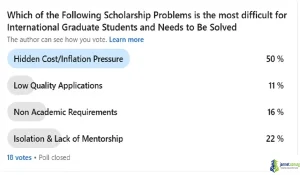
While the sample of 18 respondents is small, its composition matters. LinkedIn scholarship polls tend to attract graduate students, academic advisors, international education professionals, and financial aid practitioners, and people who live this problem every day. Their collective verdict is a data point worth taking seriously, because it validates what millions of international graduate students already know from painful personal experience: the money you are awarded and the money you actually need are two completely different numbers.
For international graduate students, this inconvenience can determine whether they:
- stay enrolled or drop out,
- complete their degree on time or extend it,
- remain mentally healthy or live under constant stress,
- build a productive academic life or spend their energy chasing survival.
This article takes a deep look at why hidden cost and inflation pressure is the most difficult scholarship problem, why it is more dangerous than it first appears, and what universities, scholarship providers, policymakers, and students can do about it.
Why Hidden Cost and Inflation Pressure Can be Critical to Graduate Students
At first glance, scholarship funding appears to be a straightforward equation: tuition is covered, a stipend is provided, and the student is set. In reality, international graduate education operates in a much more complicated environment.
A scholarship can look generous on paper and still fail in practice because the student’s actual spending power changes over time. This happens for several reasons:
- The official award does not reflect the true cost of attendance.
Universities and scholarship bodies often calculate costs based on outdated assumptions or average estimates that do not match real student behavior. - Inflation changes the value of money.
A stipend that felt adequate one year may become insufficient the next, especially when rent, groceries, and transport rise faster than funding. - International students face extra compliance costs.
Unlike domestic students, they must manage visas, permits, immigration documentation, health insurance requirements, and sometimes proof-of-funds obligations. - Currency weakness silently reduces purchasing power.
Students receiving money from home or from sponsors in a weaker currency often experience a real decline in value even when the nominal amount does not change. - The hardest costs are the ones students do not anticipate.
Surprise fees, deposit requirements, medical bills, travel costs, and academic expenses often appear only after arrival.
This is why hidden cost and inflation pressure is the issue that can undermine every other part of the scholarship journey. A student may have excellent grades, a strong application, and good mentorship, but if the finances collapse, the entire educational path becomes unstable.
Understanding the Hidden Cost Phenomenon
What We Mean by “Hidden Costs”
The term hidden costs in the context of graduate scholarships does not refer to fraud or deliberate deception, though the effect can feel similar. It refers to a systematic mismatch between the costs that scholarship budgets officially recognize and the full, real-world cost of being an international graduate student in a foreign country.
Most scholarship awards are calculated against a published Cost of Attendance (COA) figure provided by the host university. This figure typically includes tuition and fees, a standard housing allowance, a basic food stipend, and perhaps a modest personal expense budget. What it routinely underestimates or omits entirely includes:
Pre-arrival costs. International students must often pay visa application fees ($160–$500 depending on country), SEVIS fees ($350 for most U.S. programs), credential evaluation fees ($150–$400), and international courier costs for document submission — all before they set foot on campus and before the scholarship clock even starts.
Security deposits and upfront housing costs. University-published housing allowances reflect monthly rental estimates. They rarely account for the first-and-last-month deposit that most private landlords in expensive university cities demand, which can mean $3,000–$6,000 out-of-pocket before a student has even received their first stipend installment.
Health insurance gaps. Many scholarship awards either exclude health insurance entirely or include a basic plan that does not cover specialist visits, dental emergencies, mental health support, or prescription medications. For students from countries with universal healthcare, this can come as a devastating financial stress.
Technology and academic supply costs. Required software licenses, lab protective equipment, specialized research materials, conference registration fees, and academic journal access that falls outside library subscriptions all accumulate quickly. A STEM doctoral student can easily spend $800–$2,000 per year on items that no line in their scholarship budget accounts for.
Professional and immigration compliance costs. Maintaining valid immigration status carries ongoing financial obligations: biometric renewals, travel document fees, visa extension applications, and mandatory tax filing services for international students navigating complex dual-country tax obligations. In the United States alone, international students on F-1 visas are often required to file both federal and state taxes using non-standard forms (1040-NR), frequently requiring paid professional assistance.
Communication and family support costs. Unlike domestic students who may have nearby family networks for emergencies, international students bear the full cost of international phone plans, cross-border money transfers, and occasional emergency travel that domestic peers can resolve with a short drive home.
The Inflation Multiplier
Hidden costs alone would be manageable if scholarship awards kept pace with economic reality. The deeper crisis is that they do not and inflation has made the gap catastrophic.
Between 2020 and 2025 according to U.S. Bureau of Labor Statistics, the United States experienced cumulative inflation of approximately 23%, the highest sustained price growth in four decades. The United Kingdom saw similar pressures, with inflation peaking above 11% in late 2022. Canada, Australia, Germany, and the Netherlands, and all major destinations for international graduate students, experienced multi-year inflation cycles that compressed real purchasing power significantly.
Rental markets in university cities have been particularly brutal. Cities like Boston, Toronto, London, Sydney, and Amsterdam saw rental prices rise 30–50% between 2020 and 2024 in popular student neighbourhoods. Grocery costs rose 20–25%. Transportation costs increased sharply with fuel prices. Yet the Cost of Attendance figures that scholarship budgets are pegged to are updated infrequently — often annually or even less often — and frequently lag real market conditions by 12 to 24 months.
The practical effect is that a scholarship that was genuinely sufficient in 2020 may cover only 70–80 cents of every real dollar needed in 2025. For a stipend-based PhD fellowship of $25,000 per year, that represents a $5,000–$7,500 annual shortfall that the student must somehow bridge — through side employment (often restricted by visa terms), debt, or support from family in countries whose own currencies may be weakening against the dollar.
The Currency Fluctuation Trap
One of the most underappreciated face of the hidden cost crisis is exchange rate volatility, particularly for students who carry debt or family obligations in their home countries, or whose scholarships are disbursed in a currency different from their tuition currency.
Consider a student from Nigeria, India, or Brazil who receives a partial scholarship and must supplement it with savings or family transfers. Nigeria’s naira lost over 70% of its value against the US dollar between 2022 and 2024. India’s rupee has depreciated steadily. Brazil’s real has fluctuated dramatically. For a family in Lagos or Mumbai that committed to supporting a student’s gap costs based on 2024 exchange rates, the 2026 reality may mean those transfers now cover less than half of what was planned.
Students on government-sponsored scholarships from developing nations face a specific version of this trap: their stipend is often fixed in local currency and converted at disbursement. As the dollar or euro strengthens, their real purchasing power in the host country shrinks yet the scholarship amount remains unchanged on paper.
According to UNESCO’s Global Flow of Tertiary-Level Students data, the largest sending countries for international graduate students which are China, India, Nigeria, Pakistan, and Brazil, are precisely the countries whose currencies have faced the greatest depreciation pressure against major scholarship-issuing currencies.
Detailed Cost Pressure Analysis
Tuition and Fee Escalation
Even for fully-funded students, tuition escalation creates indirect pressure. When universities raise tuition faster than scholarship commitments grow, partially-funded students face an expanding gap each year. Many graduate students receive multi-year funding letters that specify a fixed annual tuition waiver amount — while tuition itself increases 3–6% annually. After four years of doctoral study, a student whose waiver was calculated for Year 1 tuition may find themselves personally responsible for thousands in cumulative tuition overages.
Graduate program fees — dissertation filing fees, examination fees, laboratory access fees, and department surcharges — are commonly excluded from scholarship coverage and are rarely disclosed prominently during the application process.
Housing: The Fastest-Growing Cost
Student housing markets near major research universities have become among the most severe affordability crises in urban real estate. Off-campus apartments near Boston University, UCL, the University of Toronto, and ETH Zurich now routinely cost 40–80% more than university-published housing allowances estimate, because those estimates are based on multi-year rolling averages that cannot capture rapid market moves.
University-owned graduate housing — where it exists — is chronically undersupplied. International students, who by definition cannot view apartments remotely before arrival, are disproportionately likely to end up in expensive short-term accommodation while they search for permanent housing, burning through their first month’s stipend on temporary costs that no scholarship budget anticipates.
Healthcare: The Silent Financial Emergency
The international student health insurance requirement, where it exists, provides a floor but rarely an adequate ceiling. Mental health services — critical for a population experiencing cross-cultural adjustment, academic pressure, and social isolation simultaneously — are frequently either uncovered or covered at rates that make sustained therapy prohibitively expensive. A single emergency room visit in the United States can generate out-of-pocket costs of $500–$3,000 even for insured students, depending on deductible structures.
Students from countries with universal public health systems (the UK, Canada, Germany, France, the Nordics) who move to the United States are often unprepared for the cost complexity of American healthcare. The reverse is also true for American students studying abroad who encounter healthcare systems requiring upfront payment and subsequent reimbursement.
Visa Compliance and Immigration Costs
This category may be the most invisible of all hidden costs, because it is both legally mandatory and emotionally stressful. In the United States, maintaining F-1 or J-1 status requires regular I-20 or DS-2019 renewals, annual SEVIS record maintenance, and — for any student who travels internationally — re-entry documentation. Students who marry, have children, or experience family emergencies face additional immigration filings that can cost $500–$3,000 per event.
Optional Practical Training (OPT) applications cost $410 in government filing fees alone. STEM OPT extensions add another $410. These are costs that scholarship award letters almost universally ignore.
Real-World Consequences for International Graduate Students
The impact of hidden cost and inflation pressure is often visible in the life decisions students make once they arrive.
1. Students take on extra work
When scholarships fall short, students often look for part-time work, freelance work, tutoring, delivery jobs, or remote gigs. While this can help financially, it can also reduce time for:
- research,
- reading,
- writing,
- networking,
- sleep,
- rest.
A student who is constantly working to cover bills may still be enrolled but academically overextended.
2. Students compromise on accommodation
Some students move into cheaper housing far from campus. That can increase transport time, reduce study time, and create isolation. Others accept overcrowded or low-quality housing because they have no better option.
This has a direct effect on productivity and wellbeing.
3. Students delay medical care
When money is tight, students may postpone doctor visits, ignore minor illnesses, or avoid counseling. This is one of the most damaging consequences of all, because untreated health problems can become emergencies.
4. Students feel isolated
Financial stress can push students away from social life. They may skip events, avoid trips, say no to meals with friends, and disengage from campus life. This creates emotional isolation on top of financial pressure.
5. Students lose momentum
Graduate school depends on momentum. Students need continuity in reading, research, and writing. Financial insecurity breaks that continuity. It can slow thesis progress, affect grades, and reduce confidence.
Detailed Breakdown of the Hidden Cost Areas Students Must Plan For
To understand the scholarship challenge properly, it helps to break expenses into categories.
Fixed costs
These are the expenses students know they must pay:
- tuition differences,
- accommodation,
- visa renewals,
- mandatory insurance,
- registration fees.
Variable costs
These fluctuate over time:
- food,
- transport,
- electricity,
- internet,
- books,
- printing,
- emergency spending.
Shock costs
These are unexpected but often large:
- medical bills,
- flight changes,
- legal or documentation issues,
- device replacement,
- family emergencies,
- delayed scholarship payments.
The hardest part of financial planning is not the fixed costs. It is the shock costs. Students often have no margin for surprises, and yet surprises are exactly what studying abroad tends to produce.
The Long-Term Impact on Academic Performance and Mental Health
The financial pressure created by hidden costs and inflation does not stay confined to the bank account. Research consistently demonstrates that financial stress impairs cognitive function, reduces academic output quality, and dramatically increases the risk of graduate student attrition.
A 2019 survey by Nature of over 6,000 graduate students found that 36% had sought help for anxiety or depression related to their academic experience — and financial insecurity ranked as a primary stressor. This figure is almost certainly higher today, after five years of elevated inflation and housing market pressure.
The hidden cost trap is particularly damaging for doctoral students in the humanities and social sciences, whose funding packages tend to be smaller and whose programs last longer. A student who entered a six-year PhD with a funding package that seemed adequate in Year 1 may find themselves in genuine financial crisis by Year 4, at the precise moment their dissertation requires the greatest focus and time investment. The result is often delayed degree completion — which extends the financial strain — or, worse, dropout.
International students face an additional layer of precarity: unlike domestic students who can typically take on-campus employment, side jobs, or home equity loans, international students on many visa categories face strict work authorization limits. The financial safety nets that domestic students have access to — credit history, family co-signers, state emergency aid funds — are frequently inaccessible to international students.
This is not merely a personal tragedy. When highly talented international graduate students leave programs early due to financial pressure, the universities lose research output, the scholarship providers lose their investment’s full return, and the global knowledge economy loses contributors who might have made meaningful scientific, artistic, or policy contributions.
Solutions That could Make a Difference
What Universities Can Do
Implement real-time Cost of Attendance audits. Universities should commit to updating their published COA figures semi-annually rather than annually, using actual market rent data from platforms like Zillow, Numbeo, or local housing databases rather than lagged survey data. These updated figures should form the basis for scholarship calculations.
Create emergency financial aid funds specifically for international students. Many institutions have emergency funds, but eligibility requirements — such as demonstrated state residency or FAFSA filing status — effectively exclude international students. Dedicated emergency pools of $2,000–$5,000, disbursable within 48–72 hours, could prevent financial crises from becoming academic crises.
Provide transparent pre-arrival financial planning tools. Universities should offer interactive cost calculators that include visa fees, security deposits, setup costs, and health insurance out-of-pocket estimates — not just the standard COA. This gives incoming students a realistic financial plan before they commit to attendance.
Expand graduate teaching and research assistantship opportunities. Rather than increasing stipend amounts (which requires budget reallocation), universities can increase the number of compensated hours available to international students within visa-compliant limits, providing inflation-responsive income growth.
Offer subsidized tax preparation services. The complexity and cost of international student tax filing is a hidden cost that universities could absorb at relatively low institutional expense, given the economies of scale of serving hundreds of international students simultaneously.
What Scholarship Providers Can Do
Build inflation escalation clauses into multi-year awards. Scholarship agreements that cover multiple years should include automatic Cost of Living Adjustment (COLA) provisions tied to CPI indices, similar to what many employment contracts offer. A 3–4% annual escalation provision dramatically reduces the real-value erosion problem.
Create supplementary “cost gap” grants. Rather than redesigning entire scholarship frameworks, providers can create smaller, targetted supplementary grants specifically for housing security deposits, healthcare gaps, and visa compliance costs — the highest-impact, most predictable hidden costs.
Disburse awards earlier in the academic cycle. Receiving a scholarship stipend in October when university housing deposits were due in July creates a structural liquidity gap. Earlier disbursement timelines, or bridge loan programs with zero interest, would prevent students from going into high-interest debt to cover timing gaps.
Expand eligibility for cost-of-living adjustments based on geographic location. A scholarship designed for a mid-size American city may be wholly inadequate for New York City or San Francisco. Location-sensitive stipend tiers — already used by some major fellowships like the NSF Graduate Research Fellowship — should become a standard feature of competitive scholarship programs.
Include currency risk provisions for internationally disbursed awards. For scholarships disbursed in local currency to students studying abroad, providers should consider periodic exchange-rate recalibration windows that allow stipend adjustments when home currency has depreciated significantly against the study country’s currency.
What Students Can Do
Build a comprehensive pre-arrival financial model. Before accepting any scholarship offer, students should construct a personal cost projection using the actual rental market prices in their destination city (not the university’s published estimate), including all one-time setup costs and visa fees. Tools like Numbeo, Expatistan, and city-specific subreddit communities can provide real ground-level data.
Research visa-compatible income sources proactively. Many international students are unaware of the full scope of income they can legally earn. In the United States, on-campus employment of up to 20 hours per week during academic terms, curriculum-related practical training, and certain fellowship income streams are all permissible on F-1 status. Understanding the exact parameters of what is allowed — before financial pressure strikes — is essential.
Join international student financial networks. Communities on LinkedIn, Reddit (r/gradadmissions, r/internationalstudents), and Discord provide peer-sourced intelligence on hidden costs, city-specific housing strategies, and financial hacks that no scholarship brochure will ever tell you.
Negotiate. Scholarship offers are not always final. Students with competing offers, particular financial circumstances (family dependency, unusual visa costs, medical needs), or documented evidence that the offered stipend is below market for their destination city should communicate directly and professionally with graduate program coordinators. Many programs have discretionary supplemental funds that are never publicly advertised.
Maintain a liquid emergency fund. Financial advisors typically recommend three to six months of expenses in liquid savings. For international students without access to home country credit or family emergency support, this is even more critical. Building this cushion before departure — even if it means delaying enrollment by one semester — can prevent a single unexpected cost from derailing an entire academic career.
Policy Recommendations
The hidden cost and inflation crisis in international graduate scholarships is not a problem that individual students or even individual universities can solve alone. It requires systemic policy responses at the national and international level.
National scholarship programs should benchmark stipends against independent cost indices. The Fulbright Program, Chevening, DAAD, MEXT, and their equivalents should all tie stipend levels to regularly updated, independent cost-of-living indices rather than applicant institution budgets. This removes the perverse incentive for universities to understate costs.
Bilateral scholarship agreements should include currency protection provisions. When governments negotiate scholarship exchange programs, the agreements should specify a mechanism for adjusting award values when exchange rate movements exceed a threshold (say, 10% in a rolling 12-month period). Several Scandinavian scholarship programs already do this for partner countries.
Immigration policy should expand work authorization for graduate researchers. Restrictions on the employment of graduate student researchers on visa categories create artificial financial precarity. Allowing graduate students on research-based programs to work up to 30 hours per week — rather than the current 20-hour cap in many countries — would provide meaningful inflation-responsive income flexibility without fundamentally altering the nature of the student visa category.
Universities should be required to report scholarship adequacy metrics. Just as universities report graduate student completion rates and employment outcomes, they should be required to report the gap between their published COA and median actual expenditure reported by current international graduate students. This transparency would create accountability and market pressure to close funding gaps.
Final Comment
The 50% Is Not a Surprise But a Signal
When half of all poll respondents identified hidden costs and inflation pressure as the most critical scholarship problem facing international graduate students, they were not expressing a niche grievance. They were describing a structural failure in how graduate education is funded globally.
The entire architecture of international scholarship design — from application to disbursement to multi-year award management — was largely built in an era of low inflation, stable exchange rates, and affordable housing near university campuses. That era is over. The infrastructure has not caught up.
The poll’s secondary findings are also instructive. The 22% who cited Isolation and Lack of Mentorship were likely describing problems that are themselves amplified by financial stress — students who are working extra hours to cover cost gaps have less time to build academic networks and mentor relationships. The 16% citing Non-Academic Requirements and the 11% citing Low Quality Applications reflect real problems, but they are somewhat amenable to individual effort and institutional support. Hidden costs and inflation are not. They are macroeconomic and structural.
The path forward requires honest, granular disclosure from universities about what graduate study actually costs. It requires scholarship providers to build inflation-responsive, geographically sensitive award structures. It requires governments to modernize the work authorization frameworks that constrain international students’ ability to respond to market conditions. And it requires the education finance community to measure, report, and act on the scholarship adequacy gap with the same rigor applied to tuition revenue and endowment returns.
International graduate students are among the most academically accomplished, resilient, and globally valuable contributors to university research ecosystems. They deserve scholarship frameworks equal to that value — frameworks that fund not just their enrollment, but their ability to actually succeed.