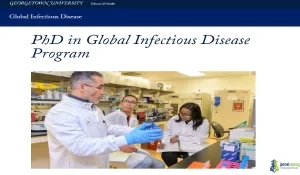
Applications are now open for the 2026 Georgetown University PhD in Global Infectious Disease Program. Launching an advanced research career in global health security is a major milestone that can position you at the forefront of international outbreak response and disease prevention. However, pursuing a doctoral degree in the United States often presents a massive financial hurdle, with rising tuition costs and living expenses in metropolitan cities. The Georgetown GLID fellowship perfectly solves this problem.

Join our Telegram Channel for Instant Scholarship Updates
Admitted doctoral candidates receive five years of complete financial support, covering their full tuition fees, a generous living stipend, and comprehensive health insurance. By securing this premier financial aid package, you can focus entirely on developing interdisciplinary solutions to combat infectious diseases and shape global health policies.
2026 Georgetown University Global Infectious Disease PhD Program Summary Table
| Detail Category | Value Information |
|---|---|
| Host Organisation | Georgetown University |
| Target Audience | Global Graduates in Science Policy and Governance |
| Primary Benefit | Full Tuition Coverage and Annual Stipend for Five Years |
| Academic Degree | Doctor of Philosophy PhD |
| Program Type | Fully Funded PhD Programs USA |
| Study Location | Washington DC United States |
| Application Deadline | December 1 2026 |
About the 2026 Georgetown University Global Infectious Disease PhD Program (Fully funded)
The Georgetown University PhD in Global Infectious Disease program is a premier academic training pathway designed to address the most critical public health threats of our time. Based in the diplomatic hub of Washington DC, this interdisciplinary program combines laboratory science, disease modeling, social sciences, economics, and international governance.
Unlike traditional microbiology programs that isolate researchers in a lab, this active initiative offers a systemic approach to infection prevention and control. Students study diverse aspects of health security, such as mathematical modeling of outbreaks, the economic impacts of pandemics, and the application of one health strategies. To ensure graduates are fully equipped for international leadership, students also have the option to complete the Graduate Certificate in Global Health Diplomacy, widely known as the HDIP certificate. This setup makes the program one of the most attractive options for students seeking premium Graduate School Preparation Fellowships.
Why This Program Boosts Your Future Career
Securing a spot in this world class doctoral program is a massive milestone for your scientific and professional journey. Studying inside a leading global health hub like Georgetown gives you direct access to distinguished academic advisors, state of the art research facilities, and prominent policy organizations. You will build deep analytical expertise and practical problem solving skills from your very first day on campus.
Furthermore, graduating from a top tier American university makes you exceptionally competitive in the international job market. Whether you aim to lead innovative laboratory investigations, join federal health departments, or secure prestigious academic roles, the credentials gained here will elevate your profile. This program stands out among the best Paid Science Research Fellowships Abroad, preparing you for rapid advancement pathways toward health security consultancy, national emergency management, and competitive international fellowships.
Core Program Curriculum
The Global Infectious Disease curriculum is designed for intellectually curious scholars dedicated to interdisciplinary approaches. The core courses provide foundational and advanced training during the first year of study:
- GLID 5000 Interdisciplinary Perspectives in Infectious Disease: 3 credits in the Fall semester of Year 1.
- GLID 5011 Research Methods and Ethics: 2 credits in the Fall semester of Year 1.
- Infection and Immunity Requirement: 3 credits in the Fall semester of Year 1, with multiple course options available.
- GLOH 5503 Epidemiology Models: 2 credits in the Fall semester of Year 1.
- GLID 5020 Evidence for Infectious Disease Policy: 3 credits, taken in the Fall of Year 1 or Year 2.
- Elective Requirements: Students select GLID 6020 Policy Analysis for GLID (1 credit) or GLID 5522 Modeling Populations and Diseases (1 credit) in their first year.
The remainder of the 30 credit requirement is determined in partnership with your Advisory Committee and Thesis Adviser, tailored to your unique background and research interests.
Benefits of the 2026 Georgetown University Global Infectious Disease PhD Program
- Complete Tuition Coverage: Enjoy absolute peace of mind with five years of full tuition funding to cover all your graduate coursework.
- Generous Annual Stipend: Receive a regular, competitive living allowance paid over five years to support your housing and daily costs.
- Comprehensive Health Insurance: Access complete medical insurance coverage for the entire duration of your doctoral enrollment.
- Global Health Diplomacy HDIP Certificate: Gain specialized training in multilateral and bilateral health diplomacy efforts under the guidance of the Institute for the Study of Diplomacy.
- Elite Internship Pathways: Connect with prominent agencies such as the Biomedical Advanced Research and Development Agency, the Biotechnology Innovation Organization, Talus Analytics, and the National Academies of Science.
- Flexible Research Rotations: Participate in optional research rotations during the first eight months to identify the perfect faculty mentor.
- Dedicated Career Support: Utilize the extensive resources of Georgetown University to find employment in federal, state, and local health departments.
Eligibility and Requirements of the 2026 Georgetown University Global Infectious Disease PhD Program
- Academic Background: Open to outstanding graduates holding a university degree in biology, public health, social sciences, economics, public policy, or related fields.
- Commitment to Teaching: Display a proactive willingness to fulfill the teaching requirement, which is a core skill in the field.
- Language Capability: Satisfy the English language proficiency requirements by submitting official TOEFL or IELTS scores, or qualify for an institutional waiver.
- Progressive Milestones: Be ready to sit for the Qualifying Exam at the end of Year 1 and defend your comprehensive dissertation proposal by December of Year 3.
- Full Availability: Be prepared to commence full time doctoral studies in Washington DC for the Fall semester.
Step by Step Application Guide for the 2026 Georgetown University Global Infectious Disease PhD Program
Phase 1: Portfolio and Document Setup
- Review your academic transcripts and identify the specific faculty mentors whose research aligns with your interests.
- Prepare your updated curriculum vitae and gather your professional statement of purpose.
- Request recommendation letters from academic professors who can verify your quantitative and research potential.
- Save all your supporting documents as clean PDF files on your device.
Phase 2: Online Registration and Portal Setup
- Go to the official online application portal managed by the Georgetown Graduate School of Arts and Sciences.
- Register your candidate profile using your primary personal or university email address.
- Verify your profile by clicking the automatic activation link sent to your email inbox.
- Log in to the application portal to start your digital application process.
Phase 3: Form Completion and Faculty Review
- Complete all personal information fields on the digital questionnaire with correct spelling.
- Enter your previous university scores, graduation dates, and degree classifications.
- Upload your certified academic transcripts, resume, and statement of purpose in the designated upload fields.
Phase 4: Research Rotations and Advising
- Access the specific program fields to select your chosen track within the Global Infectious Disease curriculum.
- Indicate whether you plan to participate in the optional research rotations during your first eight months.
- Submit the email addresses of your referees so the portal can send them automated prompts to upload their letters.
Phase 5: Submission and Qualifying Assessments
- Review your entire application draft to confirm all details are accurate and readable before clicking submit.
- Submit your completed application before the strict final deadline of December 1 2026.
- Monitor your inbox regularly for updates regarding virtual interviews and admissions decisions.
Common Mistakes to Avoid
- Applying with Generic Statements: Do not submit a generic essay. Personalize your statement of purpose to highlight your genuine interest in interdisciplinary infectious disease research and policy.
- Ignoring the Language Waiver Rules: Check if your previous university medium of instruction qualifies you for a TOEFL or IELTS waiver before paying for expensive tests.
- Waiting Until the Final Deadline: High web traffic near the December 1 deadline can cause portal slowdowns. Submit your profile early to ensure your entry is processed smoothly.
- Underestimating the Teaching Requirement: Do not treat teaching tasks as an afterthought. Highlight your public speaking and leadership experiences, as teaching is a core skill for all GLID candidates.
- Neglecting to Research Faculty Profiles: Avoid submitting your application without mentioning specific faculty members whose laboratory or policy work matches your academic goals.
Deadline: December 1 2026 (Fall Entry)
Frequently Asked Questions
Q1: What is the primary focus of the Georgetown GLID PhD program?
The program aims to provide outstanding graduate students with fully funded pathways to pursue interdisciplinary research that combines science, policy, and modeling to combat global infectious diseases.
Q2: How many years of financial support are provided to selected students?
Successful candidates receive five years of comprehensive financial support covering tuition, a living stipend, and health insurance.
Q3: What is the application deadline for the PhD program?
The final application deadline for PhD applications seeking Summer or Fall entry is December 1 2026.
Q4: Is a background in computer science or modeling required to apply?
No, the program actively seeks a broad range of graduates from arts, humanities, business, computer science, engineering, health sciences, mathematics, and social sciences.
Q5: What is the Graduate Certificate in Global Health Diplomacy HDIP?
This specialized certificate is offered in conjunction with the School of Foreign Service to prepare students to advance health and foreign policy in multilateral environments.
Q6: Are research rotations mandatory during the first year?
No, research rotations during the first eight months are optional. Students not electing to rotate can begin their dissertation research immediately in Year 1.
Q7: What are the main teaching requirements for GLID PhD candidates?
Students must complete a teaching requirement, which can be fulfilled by serving as a teaching assistant, teaching an undergraduate class, or designing a short course.
Q8: What internship opportunities are available to students?
Georgetown faculty help connect students with organizations such as the Department of Health and Human Services, Talus Analytics, NYC Health, and the National Academies of Science.
Q9: When must candidates complete their comprehensive exams?
Candidates must sit for a Qualifying Exam at the end of Year 1 and take their Comprehensive Exam (dissertation proposal defense) by December of Year 3.
Q10: How long does it take to complete the PhD program?
The program is designed to be completed in five years of full time study and research.