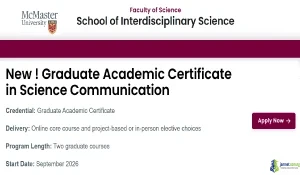
Applications are now open for the 2026 McMaster University Graduate Academic Certificate in Science Communication. Developed by the School of Interdisciplinary Science (SIS), this competitive and highly specialized credential is designed to transform ambitious graduate scholars, STEM specialists, and active industry professionals into elite scientific communicators.
Join our Telegram Channel for Instant Scholarship Updates
By offering a flexible delivery model that balances virtual synchronous learning with remote, hands-on portfolio creation, McMaster University ensures that students can master the art of conveying complex scientific information to media, public policy, education, and industry channels without disrupting their existing graduate studies or professional commitments.
2026 McMaster University Graduate Academic Certificate in Science Communication Summary Table
| Detail | Value |
|---|---|
| Host Organization | School of Interdisciplinary Science, McMaster University |
| Location | Hamilton, Ontario, Canada |
| Target Audience | STEM Graduates, Active Masters/PhD Candidates, and Industry Professionals |
| Primary Benefit | Two-Course Professional Portfolio and Collaborative Partner Placements |
| Program Type | Standalone or Concurrent Graduate Academic Certificate |
| Delivery Format | Hybrid (Online Course + Remote Project or In-Person Elective) |
| Total Tuition Fee | $5,848.68 (Plus Supplementary Fees of Approximately $280/Year) |
| Application Deadline | August 15, 2026 (September Start Only) |
About the 2026 McMaster University Graduate Academic Certificate in Science Communication
The Graduate Academic Certificate in Science Communication equips students with the advanced skills required to translate scientific theories, research discoveries, and clinical advancements into engaging, ethical, and accessible public knowledge. Unlike generalized communication degrees, this specialized credential combines rigorous interdisciplinary theory with practical, work-integrated learning experiences. By partnering directly with active academic researchers, non-profit institutions, and corporate media networks, McMaster places you at the heart of public scientific engagement.
As a student in this program, you will explore how science is represented in media, public policy debates, and modern digital ecosystems. Rather than relying on static examinations, the program emphasizes hands-on, project-based learning. You will collaborate with peers and faculty advisors to create original communication materials—ranging from media releases and science podcasts to educational modules and research strategy papers. This dynamic framework bridges the gap between complex research and global understanding, preparing you to lead dialogues that champion evidence-based decision-making.
Why this Program Boosts Your Future Career
Completing your professional communication credentials under McMaster’s esteemed academic brand is a powerful way to accelerate your standing as a public science champion, research strategist, or science policy advisor. Unlike standard undergraduate certifications, this graduate-level program prioritizes critical thinking, work-integrated learning, and strategic portfolio design. You will build a comprehensive, employer-ready portfolio of original work and gain direct exposure to a collaborative network of potential employer organizations. These credentials are in high demand across government environmental agencies, corporate biotech firms, pharmaceutical industries, museum curation circles, and science journalism outlets.
Benefits of the Graduate Science Communication Certificate
- • Fast-Track Delivery: Complete the full two-course graduate academic certificate in as little as one academic term.
- • Flexible Hybrid Learning: Balance your studies with online core courses designed specifically for active graduate students and full-time working professionals.
- • Professional Portfolio Development: Generate high-value, partner-collaborative creative and research projects that you can showcase directly to prospective employers.
- • Diverse Cohort Environment: Network and collaborate alongside a talent-dense cohort of recent graduates, active industry specialists, and advanced PhD holders.
- • Direct Industry Placement Opportunities: Gain exclusive access to a robust network of partner organizations for collaborative placements and real-world project execution.
- • Standalone or Concurrent Framework: Easily integrate the certificate into your active McMaster master’s or doctoral degree program.
Program Courses & Structure
To earn the Graduate Academic Certificate in Science Communication, students must successfully complete two graduate courses: one required core foundations course and one elective course.
| Course Code | Course Name | Delivery Format | Term | Description |
|---|---|---|---|---|
| SCICOMM 701 (Required) | Foundations in Science Communication | Online (Virtual, Synchronous) | Fall 2026 | Introduction to core concepts, theories, and practices in science communication. |
| SCICOMM 702 (Elective) | Creative Project in Science Communication | Remote (Faculty Supervised) | Winter 2027 | Develop an original science communication product for a specific target audience. |
| SCICOMM 703 (Elective) | Science Communication Research Project | Remote (Faculty Supervised) | Winter 2027 | Conduct a research project examining science communication strategies or challenges. |
| SCICOMM 704 / GEOG 721 (Elective) | Narratives of Science | In-person | Fall 2026 | Explore storytelling as a tool for communicating scientific and geographical knowledge. |
Eligibility and Requirements
- Academic Background: An undergraduate degree in a Science, Technology, Engineering, or Mathematics (STEM) discipline is generally required.
- Grade Minimums: A minimum academic average of $B^+$ (or its international academic equivalent) is typically required.
- Alternative Admissions: Candidates holding undergraduate degrees in other non-STEM fields, or those with a lower undergraduate grade average, will be considered on an individual basis if they possess equivalent professional experience.
- Language Capabilities: Foreign applicants whose native language is not English must provide official evidence of English proficiency, adhering to the minimum requirements outlined in the General Regulations of the Graduate School.
- Required Documents: All prospective applicants must compile and submit a tailored statement of interest, an updated curriculum vitae, and official academic transcripts.
Five Phases of the Application Process
Phase 1: Academic Track Verification and Supervisor Alignment
- • Review your academic history to confirm you meet the preferred STEM undergraduate degree background with a $B^+$ average.
- • If you hold a non-STEM degree or have a lower academic average, compile clear proof of your relevant professional communication experience.
- • Evaluate your schedule to ensure you can attend the virtual, synchronous SCICOMM 701 core sessions starting in Fall 2026.
- • Identify if you plan to pursue the certificate concurrently with an active McMaster graduate degree or as a standalone credential.
- • Align your career goals with the target sectors of science journalism, outreach, policy advocacy, or educational design.
Phase 2: Document Compilation and CV Tailoring
- • Update your curriculum vitae to highlight academic projects, public engagement work, and your technical toolkit.
- • Request digital copies of your official undergraduate and graduate transcripts from your university’s registrar.
- • Write a compelling Statement of Interest highlighting your passion for science communication and your career goals.
- • If your native language is not English, secure your official Test of English language score sheets.
- • Scan all physical documents and transcripts clearly and save them as separate, high-resolution PDF files.
Phase 3: Navigating the Online Admission Platform
- • Visit the official McMaster University graduate application portal before the closing deadline.
- • Create a secure applicant profile using your primary professional personal email address.
- • Navigate the selection filters: Select September -> Apply the Science filter -> Set the term as September.
- • Click on Science and select Graduate Academic Certificate in Science Communication.
- • Input your personal data, residential address, academic history, and language proficiency scores accurately.
Phase 4: Document Upload and Quality Verification
- • Upload your tailored curriculum vitae, statement of interest, and transcripts to the designated fields in the portal.
- • Attach your English language proficiency scores and relevant portfolio samples if applicable.
- • Review all uploaded files from your user dashboard to ensure they open smoothly and are highly readable.
- • Verify that no mandatory application questions regarding residency or academic history are left blank.
- • Double-check that your registered name matches your academic certificates exactly to prevent administrative delays.
Phase 5: Submission and Rolling Review Monitoring
- • Click the submit button to finalize your digital application package before the strict deadline of August 15, 2026.
- • Monitor your registered email address daily for automated confirmations of receipt and evaluation updates from the SIS admission team.
- • Prepare for your course fee payments, keeping in mind the rate of $2,924.34 per course for the 2026–2027 academic year.
- • Upon receiving your official offer letter, complete your digital acceptance through the university’s central portal.
- • Coordinate with the School of Interdisciplinary Science to finalize your SCICOMM course selections for the upcoming term.
Common Mistakes to Avoid
Many competitive candidates miss out on postgraduate admissions due to simple, easily avoided errors during the application phase. Keep these tips in mind to protect your application:
- • Applying for the Wrong Term: McMaster is currently only accepting a September start for this academic certificate. Do not select alternate terms or intakes.
- • Failing to Explain a Lower GPA: If your undergraduate average is below a $B^+$, write a compelling paragraph in your statement of interest detailing your professional experience to justify your admission.
- • Uploading Blurry Scans of Transcripts: If the registrar or admissions panel cannot read your academic grades, your profile will be immediately set aside.
- • Submitting a Generic Statement of Interest: Avoid using generic templates. Your statement must show an authentic, tailored interest in science storytelling, policy, or public outreach.
Deadline: August 15, 2026 (Rolling Review)
Frequently Asked Questions (FAQ)
Q1: What is the primary host institution for this science communication program? A1: The program is organized and hosted by the School of Interdisciplinary Science (SIS) at McMaster University, located in Hamilton, Ontario, Canada.
Q2: What is the official deadline to submit my online application? A2: The application portal officially closes on August 15, 2026. However, applications are reviewed on a rolling basis, so early submission is highly recommended.
Q3: How many courses are required to successfully earn the graduate certificate? A3: Students must complete a total of two graduate-level courses: one required core course (SCICOMM 701) and one elective course (SCICOMM 702, 703, or 704).
Q4: How is this program different from the undergraduate science communication certificate? A4: The graduate certificate emphasizes advanced theoretical learning, professional practice, portfolio building, work-integrated learning, and collaborative projects with industry partners.
Q5: Who is the target audience for the McMaster Graduate Sci-Comm Certificate? A5: It is designed for recent STEM graduates, active master’s and doctoral candidates, PhD holders, and working professionals looking to transition into communications.
Q6: What is the total tuition cost for the two-course program? A6: As of Fall 2026, tuition is $2,924.34 per course, making the total tuition cost $5,848.68. Supplementary university fees of approximately $280 per year also apply.
Q7: Can I complete the entire certificate program online? A7: Yes. If you select SCICOMM 701 (online core) and either SCICOMM 702 or 703 (remote electives with faculty supervision), you can complete the entire program remotely.
Q8: What is the minimum grade requirement to be considered for admission? A8: Applicants generally require an undergraduate degree in a STEM discipline with a minimum academic average of $B^+$ or equivalent professional experience.
Q9: What career paths does this science communication credential prepare students for? A9: Graduates are prepared for professional roles in public engagement, science journalism, public relations, museum curation, governmental science policy, and industry consulting.
Q10: Where can I contact the university for specific program inquiries? A10: For direct admissions and program questions, you can email the School of Interdisciplinary Science at sis@mcmaster.ca.