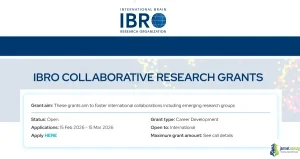
Building a global research network is a major goal for many scientists. The 2026 IBRO Collaborative Research Grants, powered by the International Brain Research Organization, is a dedicated financial support program designed to spark teamwork between different labs.

Join our Telegram Channel for Instant Scholarship Updates
By providing research funds and travel support, IBRO ensures that talented neuroscientists can work together across borders rather than working alone.
IBRO Collaborative Research Grants Summary Table
| Detail | Value |
|---|---|
| Host Organization | International Brain Research Organization (IBRO) |
| Target Audience | Early Career Principal Investigators |
| Primary Benefit | Up to $6,000 USD Financial Grant |
| Program Type | Research Collaboration and Travel |
| Gender Focus | Open to All Genders |
| Application Deadline | March 15, 2026 |
About the Initiative 2026
The IBRO Collaborative Research Grants is more than just a grant; it is a bridge between different scientific worlds. This program helps two new research groups or one new group and one established group to join forces. The main goal is to share knowledge and resources to solve complex brain research puzzles. It focuses on paying for the actual costs of working together, such as moving between labs and buying necessary research materials.
Why This Collaboration Matters
This grant provides a unique chance for researchers to step outside their local environment. It helps build a strong network of neuroscientists who can support each other over many years. By focusing on emerging laboratories, IBRO helps young leaders establish their presence in the global scientific community.
Eligibility Criteria for Applicants
- Career Stage: The lead researcher must be a principal investigator for no more than 7 years.
- Laboratory Status: The lead lab must be an “emerging laboratory” (started within the last 7 years).
- Collaborator Status: The partner must be a principal investigator from either a new or an established lab.
- Location Rules:
- Africa, Asia, and Europe: Must partner with a lab from a different region.
- Latin America: Can partner with a lab in their own region or a different one.
- US and Canada: Can partner within the two countries or go international.
- Research Breaks: Time away for family or health reasons is allowed if explained in the application.
Step by Step Application Guide for the IBRO Research Grants
Phase 1: Eligibility and Partner Selection
- Review the official regional rules to ensure you qualify as an emerging laboratory leader.
- Identify a research partner who is a principal investigator in a qualifying region.
- Confirm that both groups are ready to participate in two way travel between laboratories.
Phase 2: Project Planning and Design
- Define the specific scientific goals your collaboration aims to achieve.
- Draft a clear plan for how the two labs will share tasks and expertise.
- Outline a timeline for the project that fits within the two year limit.
Phase 3: Budget Preparation
- List all direct costs for travel, including flights and local transport.
- Calculate costs for housing and daily living during the exchange period.
- Itemize research materials or services needed specifically for this joint project.
- Ensure no indirect or overhead institutional fees are included in the request.
Phase 4: Document Collection and Portal Entry
- Gather your curriculum vitae and proof of your role as a principal investigator.
- Write a detailed description of the project and its expected impact on your research.
- Access the IBRO Grants Portal to create your applicant account.
Phase 5: Final Review and Submission
- Double check all entered data for accuracy and clarity.
- Verify that the budget totals align with the maximum amount for your region.
- Submit the completed application through the portal before the March 15 deadline.
Jamnet.com.ng Expert Advice
- Use the SMART Method: Be specific about your research targets, ensure progress is measurable through shared data, and keep goals relevant to the field of neuroscience.
- Apply the STAR Technique: When describing past successes, explain the specific situation, the task you faced, the action you took, and the positive result you achieved.
- Emphasis: Focus on how this partnership will specifically grow your emerging lab.
- Proactive Tip: Start your conversations with potential partners early to ensure your scientific goals are perfectly aligned.
Application Deadline: March 15, 2026
CLICK HERE TO APPLY
Learn More Here
Frequently Asked Questions (FAQ)
Does this grant cover my university overhead fees? No, the funds are strictly for direct research and travel costs.
Can I apply if I have been a PI for 10 years? No, the lead applicant must have been a PI for 7 years or less.
How is the money paid out? The grant follows an 80/20 rule where 80 percent is paid before the start and 20 percent after the final report.
Must the travel be for the PI only? No, the travel can include students and postdocs working on the project.
Is it okay to collaborate with a lab in my own country? This depends on your region; check the specific regional eligibility section for details.
How long can the project last? The collaboration must be finished within a maximum of two years.
What is the maximum grant for Europe? Research groups in the Pan-Europe region can receive up to $5,000 USD.