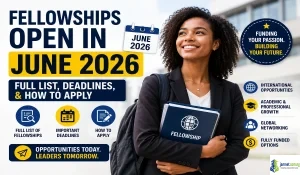
June 2026 is one of the most active months of fellowship opportunities and are closing this month and every single one of them is open for applications right now.
Join our Telegram Channel for Instant Scholarship Updates
This guide gives you the full list, complete with deadlines and application links, followed by a practical step-by-step guide to applying for any fellowship so you can move from reading to applying without losing a single day.
The opportunities listed in this guide span four continents, multiple disciplines, and a wide range of academic and professional levels. Before you scroll to the full list, commit to one decision: use Jamnet.com.ng as your central tracking platform. It is the most reliable and up-to-date source of fellowship and scholarship opportunities for African applicants, and every link in this guide routes through it for exactly that reason.
Fellowships Open in June 2026 (Full List, Deadlines, & How to Apply)
The following programmes are listed in order of their application deadline, from the earliest closing date to the latest.
2026 Marjorie Boulton Fellowships in Linguistic Grants
Deadline: June 1, 2026
The Marjorie Boulton Fellowships are among the most urgent opportunities on this month’s list, with a deadline of June 1st. These fellowships are designed for scholars and researchers working in the field of linguistics, language preservation, language policy, and related areas of humanistic inquiry. If your academic or professional background intersects with language studies, sociolinguistics, or indigenous language documentation and revitalization, this fellowship offers grant funding specifically to support that research. Act immediately.
2026 Democracy Hackathon — Strasbourg Tech Advocacy
Deadline: June 5, 2026
The 2026 Democracy Hackathon is one of the most distinctive opportunities on this list — a technology and civic advocacy programme hosted in Strasbourg, one of the symbolic centers of European democracy and home to the Council of Europe and the European Parliament. This programme is aimed at young technologists, civic innovators, developers, and advocates who are working at the intersection of digital tools and democratic participation. If your background includes tech, political science, civic technology, or human rights advocacy, and you are drawn to the challenge of using technology to strengthen democratic institutions, this is a rare and competitive opportunity. The June 5th deadline gives very little time — apply immediately.
2026 BRAC SELP Legal Fellowship
Deadline: June 8, 2026
The BRAC SELP Legal Fellowship is offered through BRAC, one of the world’s largest and most impactful non-governmental development organizations. This legal fellowship targets early-career lawyers, law graduates, and legal advocates with a demonstrated commitment to social justice, public interest law, and the legal empowerment of underserved and marginalized communities. BRAC’s work spans poverty alleviation, gender justice, education access, and community legal services — and the SELP Legal Fellowship positions its recipients at the intersection of law and development in a way that few other early-career fellowships can match. If you are a law graduate with a passion for using legal tools in service of social change, the June 8th deadline makes this an urgent priority.
2026 Canada Flight PS752 Commemorative Scholarship for Students
Deadline: June 9, 2026
The Canada Flight PS752 Commemorative Scholarship was established to honour the memory of those who perished in the tragedy of Flight PS752 and to invest in the educational futures of students who embody the values of excellence, community, and international connection that those individuals represented. This scholarship is available to students pursuing higher education and carries with it the weight and dignity of a commemorative award — applications should be approached with the seriousness and respect that the programme’s origins deserve. The June 9th deadline applies, and full details are available through the jamnet.com.ng link above.
2026 ACU Expert Group Grants
Deadline: June 9, 2026
The Association of Commonwealth Universities (ACU) Expert Group Grants are designed to support collaborative academic and research networks across Commonwealth member countries. These grants fund small expert groups of researchers, academics, and practitioners who are working on shared questions of significance to Commonwealth societies — spanning areas including education, health systems, climate resilience, and governance. For Nigerian academics and researchers who are part of or building professional networks across Commonwealth nations, the ACU Expert Group Grants represent a highly credible funding mechanism with a June 9th closing date.
2026 Ardova Plc Graduate Trainee Programme
Deadline: June 10, 2026
The Ardova Plc Graduate Trainee Programme is one of Nigeria’s most structured entry-level career opportunities in the downstream oil and gas sector. Ardova Plc — formerly known as Forte Oil — is one of Nigeria’s leading indigenous and integrated energy companies, operating over 450 retail petroleum outlets nationwide and serving as the sole authorized distributor of Shell branded Helix Engine Oils in Nigeria.
The Graduate Trainee Programme is designed to identify high-potential recent graduates, provide them with intensive professional training, and convert top performers into confirmed full-time employees across commercial, operational, technical, and strategy functions. The programme is open to graduates with a minimum of a Second-Class Lower degree who have completed NYSC. The June 10th deadline is fast approaching — visit the jamnet.com.ng link for full requirements and the direct application portal.
2026 Scib Graduate Trainee Program for Nigerians
Deadline: June 12, 2026
The 2026 Scib Graduate Trainee Program gives you a real head start in your corporate financial career. When you join, you are not just getting an ordinary job, but a full learning experience where top risk management experts and corporate brokers teach you real operational skills. The directors of the organization believe that professional talent development works best when paired with expert coaching.
The initiative challenges you to operate across multiple business portfolios and think dynamically about local business protection. Your performance is judged on your unique ability to analyze complex commercial risks, communicate strategic solutions clearly, and collaborate effectively with diverse stakeholders. By bringing these difficult business cases to life, you demonstrate how modern risk management and customer focused operations can serve as powerful tools for national economic stability.
2026 Atlantic Dialogues Emerging Leaders Program in Morocco
Deadline: June 14, 2026
The Atlantic Dialogues Emerging Leaders Program is a prestigious international leadership development initiative hosted in Morocco, one of Africa’s most strategically positioned nations in terms of its connections to both the African continent and the Euro-Atlantic world. This programme brings together a highly curated group of young leaders from across the Atlantic basin — Africa, Europe, Latin America, and North America — for an immersive multi-day conference and dialogue experience that explores the most pressing geopolitical, economic, and social challenges of our era.
For young African professionals, policymakers, civil society leaders, and researchers who want to enter high-level international policy dialogue, the Atlantic Dialogues is among the most impactful leadership grants and emerging leader programmes in existence. The June 14th deadline applies.
2026 Africa Health Tech Accelerator
Deadline: June 14, 2026
The 2026 Africa Health Tech Accelerator gives you a real head start in your healthcare technology career. When you join, you are a full learning experience where top healthcare professionals and venture capital investors teach you real business scaling skills. The program aims to bridge the gap between financial limitations and major healthcare breakthroughs, giving ambitious founders direct access to active research portfolios, international procurement partners, and elite corporate hospital networks across Africa.
The initiative represents a landmark partnership led by Africa Health ExCon under the endorsement of the Egyptian Authority for Unified Procurement. The strategic layout involves selecting up to 15 promising startups in its first phase to undergo a rigorous six month incubation journey. By combining technical training, product validation support, and business development strategies, the program addresses the structural challenges facing Africa healthcare systems, including weak connectivity, fragmented regulatory frameworks, and capital shortages.
2027 AIA NRW Fellowship — Research Grant in Germany
Deadline: June 15, 2026
The AIA NRW Fellowship is a research grant programme based in Germany, one of the world’s leading destinations for international academic fellowship and postdoctoral research funding. This fellowship supports researchers in gaining access to academic institutions in the North Rhine-Westphalia region of Germany, one of the country’s most vibrant intellectual and economic centers. For researchers seeking international academic mobility, a research grant in Germany through a programme like the AIA NRW Fellowship represents an opportunity to advance a research agenda within one of Europe’s most rigorous academic environments, while also building professional networks that span the European research community. The application deadline for the 2027 fellowship is June 15, 2026.
2026 CDPR Young Policy Scholar Programme for Pre-University Students
Deadline: June 15, 2026
The CDPR Young Policy Scholar Programme is one of the most distinctive entries on this list because it is specifically designed for pre-university students — meaning secondary school students who have not yet begun a university degree. This programme is a rare and genuinely exciting opportunity for highly motivated and intellectually curious young people to engage with the world of public policy, research, and evidence-based governance well before their formal higher education begins. If you know a bright, ambitious secondary school student who reads widely, thinks critically about social and political issues, and wants to be challenged beyond their school curriculum, the CDPR Young Policy Scholar Programme is tailor-made for them. The June 15th deadline applies.
2026–2027 Sisters in Public Health (SiPH) Scholarship for Women
Deadline: June 21, 2026
The Sisters in Public Health Scholarship is a women-focused academic funding programme designed to support female scholars pursuing education and research in public health, global health, epidemiology, health policy, community medicine, and related disciplines. At a time when women’s leadership in public health is more urgently needed than ever — from pandemic preparedness to maternal and child health to universal health coverage — the SiPH Scholarship invests directly in the next generation of female public health leaders. This is an especially important opportunity for Nigerian and African women in health-related academic programmes who are seeking international scholarship funding to advance their education and research. The June 21st deadline makes this a mid-month priority.
2027/2028 France FIAS Fellowship Programme
Deadline: June 25, 2026
The France FIAS Fellowship Programme is a prestigious international fellowship opportunity hosted in France, offering researchers, academics, and advanced scholars access to France’s world-class research institutions and intellectual communities. As one of the leading destinations for international academic mobility globally, France offers an incomparable environment for cross-disciplinary research, cultural exchange, and professional networking within Europe’s academic ecosystem. The FIAS Fellowship supports participants with structured institutional access, professional mentorship, and the financial backing necessary to pursue high-quality research or advanced study in France. The application window for the 2027/2028 fellowship closes on June 25, 2026 — allowing applicants sufficient time to prepare a strong submission.
2026 Chicago Blend Venture Fellowship
Deadline: June 28, 2026
The 2026 Chicago Blend Venture Fellowship gives you a real head start in your investment career. When you join, you are not just getting an ordinary internship, but a full learning experience where top venture capitalists and tech leaders teach you real financial evaluation skills. The program aims to bridge the gap between financial theories and practical investing, giving ambitious fellows direct access to active portfolios, international underwriting partners, and elite corporate networks across the United States.
The fellowship program is a structured four month cohort journey designed to expand access to high paying finance roles. Over the course of the cohort experience, fellows work directly with a partner venture capital firm, carrying out authentic operational tasks such as sourcing promising startups and performing investment due diligence. The entire journey culminates in Blend Demos, a live in person presentation day on December 9 2026. During this capstone event, graduating fellows pitch their final strategic projects focusing on the intersection of artificial intelligence and investment strategies to an audience of over one hundred active investors, founders, and industry leaders.
2026 Curtis Artist Fellowship
Deadline: June 30, 2026
The Curtis Artist Fellowship is one of the most compelling creative funding opportunities closing at the end of June. This fellowship is designed for practicing artists — across visual arts, music, performance, and interdisciplinary creative practices — who are at a formative stage of their professional development and seeking the time, space, and financial support necessary to advance a significant body of work. Artist fellowship programmes like the Curtis Award recognize that creative work requires sustained attention and professional environment, and they provide both. If you are a working artist with a portfolio and a clear creative project or body of work you want to develop, the June 30th deadline gives you time to prepare a strong application.
2026 Virginia Spate Research Fellowships
Deadline: June 30, 2026
The Virginia Spate Research Fellowships support academic research in art history, visual culture, and related disciplines, with a particular focus on scholars whose work engages seriously and rigorously with the history of modern and contemporary art. For researchers in the humanities whose work sits at the intersection of visual culture, historical method, and critical theory, this fellowship provides both the institutional affiliation and the financial support necessary to pursue sustained archival and scholarly research. The June 30th deadline applies.
2026 Barr Fellowship Program — Leadership Grants
Deadline: June 30, 2026
The Barr Fellowship Program is a leadership grant and development initiative designed to support experienced non-profit leaders and social change practitioners who need time for renewal, reflection, and strategic growth. Unlike many fellowships that target early-career professionals or recent graduates, the Barr Fellowship explicitly recognizes that sustained leadership in the social sector is demanding work — and that investing in the wellbeing, vision, and continued learning of experienced leaders produces outsized impact for the communities and organizations they serve. If you are a mid-career non-profit leader, social entrepreneur, or community development practitioner with a significant track record of impact, the Barr Fellowship’s June 30th deadline is worth your serious attention.
2026 Sir Ratan Tata Visiting Fellowships
Deadline: June 30, 2026
The Sir Ratan Tata Visiting Fellowships are prestigious academic awards that carry the name of one of the most significant philanthropic legacies in South Asian and global history. These fellowships support visiting scholars — particularly those working in the fields of social sciences, development studies, poverty and inequality research, and related areas — who are seeking institutional affiliation and financial support to pursue advanced research. The Sir Ratan Tata name carries substantial prestige within the international academic community, and holding this fellowship is a credential that speaks powerfully to the quality and social relevance of your research agenda. The June 30th deadline gives applicants the maximum available time to prepare materials.
2026 TWAS CAS Young Scientists Award
Deadline: June 30, 2026
The TWAS CAS Young Scientists Award is a highly prestigious international science award jointly administered by The World Academy of Sciences (TWAS) and the Chinese Academy of Sciences (CAS) — two of the world’s most respected scientific institutions. This award recognizes outstanding young scientists from developing countries who have made exceptional contributions to their fields of research. For Nigerian and African scientists working in natural sciences, life sciences, mathematics, engineering, or technology — particularly those who have produced peer-reviewed research with measurable impact — the TWAS CAS Young Scientists Award is one of the most credible and internationally recognized science career boosters available. The June 30th deadline makes this an end-of-month priority for scientists who qualify.
2026 Access Bank Entry Level Training Program (ELTP)
Deadline: June 30, 2026
The Access Bank Entry Level Training Program (ELTP) is one of Nigeria’s most competitive and prestigious graduate banking career programmes. Access Bank Plc is one of Africa’s largest commercial banks — with over 600 branches across Nigeria, Sub-Saharan Africa, and the United Kingdom — and the ELTP is its flagship graduate recruitment initiative for the Nigerian market.
The programme is structured around three distinct career tracks: ELTP Grad for high-academic graduates with a 2:1 degree interested in corporate banking and leadership, ELTP Retail for 2:2 graduates drawn to customer experience and branch banking, and ELTP Tech for 2:2 graduates with STEM backgrounds interested in digital banking and technology innovation. Training takes place at Access Bank’s School of Banking Excellence, and graduates who complete the programme are absorbed into full-time banking careers with a competitive salary and a structured path toward senior roles. The June 30th deadline is firm. Visit the jamnet.com.ng link for the full requirements and direct application portal.
Step-by-Step Guide: How to Apply for Any Fellowship on This List
The following guide is designed to walk you through the entire fellowship application process from beginning to successful submission. While each programme on this list has its own specific application portal and unique requirements, the underlying process is the same across all of them. Master this process once, and every fellowship application you submit for the rest of your life will be faster, stronger, and more competitive.
Step 1: Match Each Fellowship to Your Profile Before Anything Else
The biggest mistake most fellowship applicants make is applying for every available opportunity without considering fit. Committees receive thousands of applications and are specifically looking for the candidate who was born to receive their award. Before opening a single application portal, read each listing carefully and evaluate it against your profile.
Ask yourself these three questions for every fellowship: Am I eligible based on nationality, educational level, field of study, and career stage? Does this fellowship’s mission and purpose align genuinely with what I am actually working on or genuinely care about? Can I write a personal statement that connects my background and goals to this specific fellowship’s purpose in a way that is honest and compelling?
If the answer to all three is yes, that fellowship goes on your priority shortlist. If any answer is no, move on to the next one. Investing a week in three genuinely well-matched applications will always outperform spending a month on fifteen mismatched ones.
Step 2: Visit the jamnet.com.ng Listing for Full Details on Each Programme
Every link in this article routes to jamnet.com.ng, which is the most reliable and consistently updated platform for fellowship and scholarship opportunities open to African applicants. Each jamnet.com.ng listing for the programmes above contains the full eligibility criteria, the complete list of required documents, the official application portal link, and additional context about the programme that will help you write a stronger application.
Make it a habit to visit jamnet.com.ng whenever you are searching for fellowship and scholarship opportunities — not just in June, but throughout the year. The platform aggregates opportunities from around the world specifically with African applicants in mind, which means you are not wading through thousands of geographically ineligible listings. You are seeing a curated, relevant, and current selection every time.
Step 3: Build Your Fellowship Application Folder
Before you begin any application, create a dedicated folder — on your computer or in cloud storage — for your fellowship applications. Inside it, create a subfolder for each programme you are applying to, named clearly with the programme name and deadline date.
In your central folder, keep master copies of the following documents that virtually every fellowship will require: your current curriculum vitae (CV) or resume, your academic transcripts, copies of your degree certificate and any postgraduate qualifications, your NYSC discharge certificate if applicable, your passport data page and any other government-issued identification, a recent passport photograph in the correct digital format, two to three reference letters from professors, supervisors, or professional mentors, and a master draft of your personal statement or motivation letter.
Having these materials organized and ready before you begin any individual application dramatically reduces the time and friction of the application process — and eliminates the risk of missing a deadline because you were chasing down a document at the last minute.
Step 4: Write Your Personal Statement or Motivation Letter
The personal statement is the most important and most consistently underestimated component of any fellowship application. It is the one document that gives the selection committee direct access to your voice, your thinking, and your purpose — and in a highly competitive pool of technically qualified applicants, it is almost always what determines whether you advance.
A strong fellowship personal statement does four things clearly and specifically. It explains who you are in a way that is relevant to this fellowship’s mission — not a CV summary, but a narrative. It describes what you are working on or what you want to do, with enough specificity that the committee can envision your work. It explains why this particular fellowship, at this particular institution or organization, is the right support for your work at this moment — referencing specific aspects of the programme, not generic praise for the opportunity. And it articulates what you will contribute to the fellowship community and what you intend to do with the support you receive.
Write a core personal statement first, then customize it for each fellowship you apply to. The customization is not optional — selection committees can tell immediately when a personal statement was written generically and lightly edited. The most competitive applications contain statements that could only have been written for that specific award.
Step 5: Request Your Reference Letters Early
Most fellowship programmes require two to three reference or recommendation letters from academics, employers, supervisors, or professional mentors who can speak to the quality and relevance of your work. These letters are weaker than they should be far more often than most applicants realize — not because the referees are unwilling, but because they were asked too late, given too little context, or provided no guidance on what the letter should address.
Request your reference letters at least three to four weeks before the application deadline. When you make the request, give each referee the following: a clear statement of which fellowship you are applying for and why, a brief summary of your own background and what makes you a competitive candidate, the specific deadline by which the letter must be submitted, and any specific themes or experiences you would like the letter to address if they are comfortable doing so.
A referee who has full context can write a genuinely strong, specific, and tailored letter. A referee who is asked at the last minute with no context writes a generic one — and generic letters do not win fellowships.
Step 6: Navigate to the Official Application Portal
For each programme on this list, visit the jamnet.com.ng listing first to access the official programme link. From there, navigate to the official application portal — which may be hosted on the fellowship programme’s own website, an institutional scholarships management system, or a third-party application platform like Submittable, Fluxx, or similar.
Apply only through the official portal or the verified link provided on jamnet.com.ng. Do not apply through informal channels, forwarded email links from unknown sources, or third-party sites claiming to process applications on behalf of these programmes. If you are ever uncertain whether an application link is legitimate, cross-reference it against the fellowship’s official organizational website before submitting any personal information.
Step 7: Create Your Applicant Account and Complete Your Profile
On the application portal, create your account using a professional email address — one that you actively monitor and that will remain accessible throughout the selection period, which can span several months. Use a clear, professional email format. All communications from the fellowship — including shortlisting notifications, interview invitations, and award decisions — will arrive at this address.
Complete your applicant profile fully and accurately, ensuring that every detail matches your official documents exactly. Inconsistencies between your application profile and your supporting documents — different name spellings, mismatched dates, incorrect degree information — raise immediate red flags at the review stage and can eliminate an otherwise strong application.
Step 8: Complete the Application Form With Care and Precision
Take your time filling in the application form. Read every question carefully before answering, and answer what is actually asked — not what you assumed was being asked. Fellowship application forms are carefully designed to elicit specific information, and answers that drift off-question signal a lack of attention to detail that no personal statement can fully recover from.
For text-based questions with character or word limits, write your answer in a separate document first, check it for word count, read it aloud to check for clarity, and then copy it into the form. Never compose long text directly in a web browser form field — if the page refreshes or your session times out, your work can be lost.
Step 9: Upload Every Required Document in the Correct Format
Upload each required document in the format specified by the portal — PDF, JPEG, Word document, or otherwise. Name each file clearly and professionally before uploading, for example: “Firstname_Lastname_CV_2026.pdf” or “Firstname_Lastname_PersonalStatement.pdf”. This small detail communicates professionalism and makes life easier for the committee members who will be reviewing your materials.
After uploading each document, verify that it has been received correctly using the preview or confirmation indicator on the platform. A document that failed to upload without your noticing is a gap in your application that can eliminate you before a human reviewer ever sees your materials.
Step 10: Review Your Entire Application Before Submitting
Before clicking the submit button on any application, spend fifteen to twenty minutes reading through the entire submission from beginning to end. Check that your name is correctly and consistently spelled across all sections. Confirm that your dates — graduation year, NYSC completion, current enrolment status — are accurate. Read your personal statement one final time with fresh eyes. Verify that every required document has been successfully uploaded. Confirm that your contact email address and phone number are correct.
This review step takes a fraction of the time that the application took to build, but it catches the small errors that can cause even excellent applications to fail on technical grounds.
Step 11: Submit and Save Your Confirmation
Click Submit. Once your application is successfully received, save the confirmation — screenshot it, copy the reference number if one is provided, and save the confirmation email in a dedicated folder. This documentation is your proof of submission and may be needed if you ever need to follow up on the status of your application.
Step 12: Track Your Deadlines and Apply for Multiple Programmes
If you have identified more than one fellowship on this list as a strong match for your profile, pursue all of them — not one at a time, but simultaneously using a parallel tracking system. Create a simple spreadsheet or tracking document with one row per programme, listing the fellowship name, the deadline, the required materials, the status of your reference letter requests, the submission status, and any follow-up actions outstanding.
Review this tracker every two to three days and update it as you progress. This system converts what can feel like an overwhelming multi-front process into a manageable, organized workflow — and it ensures that no deadline slips past you simply because another application was taking your attention.
Step 13: Monitor Your Email Diligently After Submission
After submitting your applications, check your registered email inbox and your spam or junk folder at least twice daily. Fellowship selection processes are communicated exclusively via email, and a missed shortlisting notification or interview invitation — even missed by just a few days — typically results in the opportunity being reallocated to the next candidate. Responsiveness after submission is its own form of professionalism, and it begins the moment your application is sent.
The window is open. Walk through it.
Frequently Asked Questions (FAQs)
Q1. Can I apply for more than one fellowship at the same time?
Yes — and you should. Applying for multiple fellowships simultaneously is not only allowed, it is the strategy that most successful fellowship recipients use. The key is to ensure that each application is genuinely tailored to its specific programme rather than submitted as a copy-paste across platforms. Use the tracking spreadsheet method described in Step 12 of this guide to manage simultaneous applications without missing a deadline or mixing up materials.
Q2. Do I need to be from Nigeria or Africa to apply for the fellowships on this list?
Not all of them. Some programmes on this list — such as the Access Bank ELTP and the Ardova Plc Graduate Trainee Programme — are specifically designed for Nigerian residents. Others, such as the TWAS CAS Young Scientists Award, the Barr Fellowship Program, the Curtis Artist Fellowship, and the France FIAS Fellowship, are international in scope and accept applicants from many countries around the world. Always check the full eligibility criteria on each programme’s jamnet.com.ng listing and official page to confirm your geographic eligibility before applying.
Q3. Are any of the fellowships on this list fully funded?
Several of the programmes on this list carry full or substantial funding. Fully funded and highly supported fellowship programmes typically cover a combination of stipends, research expenses, travel, accommodation, institutional affiliation fees, and professional development costs. The exact funding structure for each programme is detailed in the individual jamnet.com.ng listings linked throughout this article. Always verify the funding package directly on the official programme page before making application decisions based on financial need.
Q4. What is the difference between a fellowship and a scholarship?
A scholarship typically refers to financial support awarded to a student to fund their formal academic degree — covering tuition, living expenses, or both. A fellowship, on the other hand, typically refers to a programme that combines financial support with structured professional development, research access, mentorship, institutional affiliation, or a specific deliverable such as a project or publication. Fellowships are often awarded to graduates, early-career professionals, and mid-career practitioners rather than to current students. Some of the opportunities on this list — such as the Canada PS752 Commemorative Scholarship and the SiPH Scholarship for Women — are formally scholarships, while others are fellowships in the fuller sense.
Q5. What happens if I miss a deadline?
Fellowship and grant deadlines are almost universally firm. Unlike some informal hiring processes where late applications might occasionally be reviewed, funded fellowship programmes operate within institutional and legal funding cycles that make exceptions extremely rare. If you miss a deadline, the most productive response is to mark the programme in your tracking system for the next available cycle and use the intervening time to strengthen your application materials. Many of the programmes on this list run annually or biannually — missing this year’s cycle is disappointing but not permanent.
Q6. How competitive are the fellowships on this list?
Competitiveness varies significantly across the programmes listed here. Large international fellowships like the TWAS CAS Young Scientists Award and the Atlantic Dialogues Emerging Leaders Program attract thousands of applicants globally and are highly competitive. More specialized programmes — such as the Marjorie Boulton Fellowships in linguistics or the Virginia Spate Research Fellowships in art history — attract smaller, more focused applicant pools in which genuine subject expertise and a clearly articulated research agenda can make an application highly competitive even without an elite institutional affiliation. The general principle is: the more precisely your profile matches the programme’s mission, the more competitive your application becomes, regardless of the programme’s overall volume.
Q7. Do I need a postgraduate degree to apply for any of these fellowships?
Not for all of them. The requirements vary widely. The CDPR Young Policy Scholar Programme is specifically designed for pre-university students — no university degree is required at all. Graduate trainee programmes like Access Bank ELTP and Ardova Plc Graduate Trainee accept applicants with a first degree and completed NYSC. Research fellowships like the Sir Ratan Tata Visiting Fellowships and the Virginia Spate Research Fellowships are typically designed for postgraduate researchers and academics. The SiPH Scholarship for Women and the Canada PS752 Commemorative Scholarship are for students at various levels of higher education. Check each programme’s eligibility section via its jamnet.com.ng link for the precise academic requirements.
Q8. Can I apply for a fellowship while still completing my NYSC?
This depends on the specific programme. For Nigerian corporate graduate trainee programmes — Access Bank ELTP and Ardova Plc Graduate Trainee — you must have completed your NYSC service before applying, as both programmes require a valid NYSC discharge or exemption certificate. For international fellowships on this list that do not require NYSC, your current service status is typically irrelevant to eligibility. Always confirm whether NYSC completion is listed as a requirement for any specific programme before applying.
Q9. Is jamnet.com.ng free to use for fellowship searches?
Yes. Jamnet.com.ng is a free platform for searching and accessing fellowship, scholarship, and career opportunities. There is no registration fee, subscription charge, or payment required to browse listings or access the application links provided on the site. If any source ever asks you to pay a fee in order to access a jamnet.com.ng listing or to apply for any fellowship through the platform, treat it as a fraud attempt. Legitimate fellowships and scholarship programmes never charge applicants to apply.
Q10. How do I stay updated on new fellowship opportunities after June 2026?
The most reliable way to stay consistently informed about fellowship and scholarship opportunities is to make jamnet.com.ng a regular part of your weekly routine — visit the site at least twice a week and check for new listings across categories relevant to your profile. Beyond that, follow jamnet.com.ng on its official social media channels for real-time updates. You can also set up Google Alerts for search terms like “fellowship open 2026,” “graduate trainee programme Nigeria,” “international scholarship deadline,” and “funded research fellowship” to receive automatic notifications whenever new matching content appears online.