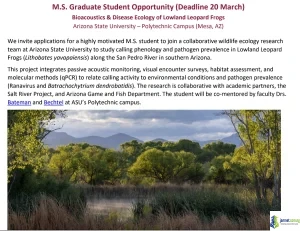
Advancing the field of environmental conservation requires a blend of rigorous academic study and intensive field research. The 2026 Arizona State University Masters Scholarship, powered by the Wildlife Ecology Research team at ASU, is a dedicated professional support program designed to train the next generation of wildlife biologists.

Join our Telegram Channel for Instant Scholarship Updates
By offering a substantial annual stipend and hands on research opportunities along the San Pedro River, ASU ensures that brilliant students can contribute to critical ecological studies on the Lowland Leopard Frog while building a robust career in natural resource management.
Arizona State University Scholarship Summary Table
| Detail | Value |
|---|---|
| Host Institution | Arizona State University (ASU) |
| Target Audience | Prospective Masters (M.S.) Students |
| Primary Benefit | $35,000 Annual Stipend |
| Research Focus | Lowland Leopard Frog Phenology and Pathogens |
| Location | Mesa, Arizona, USA |
| Application Deadline | March 20, 2026 |
About the Arizona State University Masters Scholarship Initiative 2026
The Arizona State University Masters Scholarship is more than just a grant; it is an immersive Graduate Services Assistant (GSA) appointment. Selected candidates will join a high level research project investigating calling phenology and pathogen prevalence in aquatic systems. This initiative allows students to work directly under the guidance of expert faculty while pursuing an M.S. in Applied Biological Sciences. The role requires a commitment of 20 hours per week during the academic semester and full time engagement during the summer months to ensure comprehensive data collection and analysis.
Why the Arizona State University Masters Scholarship Matters
Ecological research in desert environments presents unique challenges that require specialized training and equipment. This scholarship provides the financial security needed for students to focus entirely on their research and coursework without external employment. By participating in this program, students gain invaluable experience in bioacoustic analysis and molecular techniques, making them highly competitive for future roles in state or federal wildlife agencies and non profit conservation organizations.
Benefits of the Arizona State University Masters Scholarship
- Significant Annual Stipend: Recipients receive a total annual funding package of $35,000 to support living and study expenses.
- Guaranteed Research Hours: The appointment provides 20 paid hours per week during the academic year and up to 40 hours per week during the summer.
- Advanced Research Training: Gain specialized skills in identifying herpetofauna and conducting pathogen prevalence studies.
- Fieldwork Experience: Direct exposure to conducting aquatic and desert field research in southern Arizona.
- Professional Mentorship: Work closely with Dr. Heather Bateman and Dr. Molly Bechtel within a collaborative laboratory environment.
- Academic Enrollment: Successful candidates join the prestigious M.S. program in Applied Biological Sciences at the ASU College of Integrative Sciences and Arts.
Eligibility Criteria for the Arizona State University Masters Scholarship
- Academic Foundation: Applicants must hold a Bachelor’s degree in wildlife biology, ecology, environmental science, or a related conservation field.
- Technical Skills: Demonstration of solid quantitative reasoning and effective data management capabilities is required.
- Communication Ability: Strong written and verbal communication skills are essential for both independent and collaborative work.
- Physical Requirements: A willingness and ability to conduct rigorous fieldwork in desert environments and aquatic systems is mandatory.
- Logistical Readiness: Candidates must have the ability to drive a personal high clearance vehicle to field sites for which mileage will be reimbursed.
- Timeline Commitment: The selected student must be able to begin the program in person in Mesa, Arizona, by May 18, 2026.
- Preferred Qualifications: Prior experience with bioacoustic analysis, molecular techniques, or handling aquatic vertebrates will be viewed favorably.
Step by Step Application Guide for the Arizona State University Masters Scholarship
Phase 1: Academic Portfolio Compilation
- Review your undergraduate transcripts to ensure your coursework aligns with wildlife biology or ecology standards.
- Update your Curriculum Vitae to highlight any previous research experience or laboratory skills.
- Identify three professional or academic references who can speak to your research potential and work ethic.
Phase 2: Narrative and Cover Letter Drafting
- Write a professional cover letter that details your interest in the Lowland Leopard Frog project and your relevant technical skills.
- Explicitly mention your experience with fieldwork or your interest in learning molecular techniques.
- Ensure the letter reflects your ability to work independently in challenging desert environments.
Phase 3: Digital Document Consolidation
- Organize your cover letter, CV, reference contact information, and unofficial transcripts into one single PDF file.
- Name the file strictly using the format Lastname_Firstname to ensure it is correctly processed by the admissions team.
- Verify that the scan quality of your unofficial transcripts is clear and legible.
Phase 4: Preliminary GSA Application Submission
- Address your email application to both Dr. Heather Bateman and Dr. Molly Bechtel using the official ASU contact addresses provided.
- Attach your consolidated PDF and clearly state your intent to apply for the GSA position in the email subject line.
- Submit this application package before the primary deadline of March 20, 2026.
Phase 5: Graduate Program Formal Enrollment
- After receiving a favorable response regarding the GSA position, proceed to the official ASU Graduate Admissions portal.
- Complete the formal application for the M.S. in Applied Biological Sciences with a concentration in Natural Resource and Wildlife Ecology.
- Finalize all university level requirements and prepare for your in person start date in Mesa by mid May.
Jamnet.com.ng Expert Advice for the Arizona State University Masters Scholarship
- Use the SMART Method: Be specific about the research techniques you want to master, ensure your field data collection is measurable through project milestones, and keep your career goals relevant to Arizona’s ecological conservation.
- Apply the STAR Technique: When describing your research history, explain a specific ecological situation you encountered, the task you performed, the action you took in the field or lab, and the result of your study.
- Emphasis: Focus on Quantitative Reasoning and Desert Fieldwork Readiness.
- Proactive Tip: If you have experience driving in off road conditions or using high clearance vehicles, highlight this clearly as it is a critical logistical requirement for the San Pedro River field sites.
Application Deadline: March 20, 2026
CLICK HERE TO APPLY
Frequently Asked Questions About the Arizona State University Masters Scholarship
Does the $35,000 stipend cover my tuition fees? No, this specific appointment provides a living stipend but does not include tuition remission or health insurance benefits.
Do I need an IELTS score to apply for this scholarship? The scholarship itself does not list IELTS as a requirement, though international students must meet general ASU graduate admission language standards.
What kind of vehicle is required for the fieldwork? A personal high clearance vehicle is necessary to reach the remote field sites, and the university provides reimbursement for the mileage used.
Can I start the program remotely? No, the research requires an in person presence in Mesa and southern Arizona starting no later than May 18, 2026.
Is this scholarship available for PhD students? The current opening is specifically for an M.S. student, though PhD students are often part of the broader research lab ecosystem at ASU.
How many hours a week will I be working during the summer? The Summer appointment allows for up to 40 hours per week to accommodate the intensive fieldwork schedule.
Who should I contact if I have technical questions about the research? You should direct your inquiries to Dr. Heather Bateman or Dr. Molly Bechtel, who are leading the Wildlife Ecology Research team.