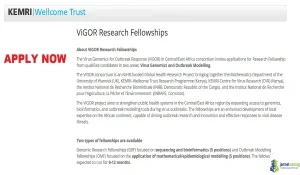
Strengthening the frontline of viral defense requires more than just lab equipment; it requires specialized human expertise in Pathogen Genomics Sequencing and data-driven response strategies. For early-career researchers in Central and East Africa, bridging the gap between local viral threats and Computational Epidemiology Modeling is a career-defining opportunity.

Join our Telegram Channel for Instant Scholarship Updates
The 2026 ViGOR Research Fellowships, funded by the NIHR, is a dedicated academic support program designed to solve this. By providing grants of up to £15,000 and access to an international research consortium, ViGOR ensures that brilliant scientists can focus on Viral Outbreak Surveillance rather than project funding constraints.
SECURE YOUR VIGOR RESEARCH FUNDING FOR 2026
Africa 2026 ViGOR Research Fellowship Summary Table
| Detail | Value |
|---|---|
| Host Organization | ViGOR Consortium (Warwick, KEMRI, INRB, INRAPE) |
| Target Audience | Early-Career Researchers (Master’s or PhD) |
| Primary Benefit | Grant Support (Up to £15,000) |
| Program Type | 9-12 Month Research Fellowship |
| Geographic Focus | Central and East Africa |
| Application Deadline | April 30, 2026 |
About the Africa 2026 ViGOR Research Fellowship Initiative
The ViGOR project is more than just a financial award. It is a complete regional development platform. The organizers believe that public health systems are most effective when local expertise drives Metagenomic Data Analysis and Infectious Disease Forecasting. Because of this, the consortium—which includes the University of Warwick and KEMRI—has created two specialized tracks. The goal is to close the gap between raw outbreak data and actionable Public Health Genomic Policy, creating a sustainable network of African scientists capable of leading the response to future viral threats.
Why You Should Apply (Benefits) for the Africa 2026 ViGOR Research Fellowships (Funding for Virus Genomics)
- Targeted Funding: Receive up to £15,000 for Genomics projects or £10,000 for Modelling projects.
- 9-12 Month Duration: Sufficient time to complete a project with significant public health impact.
- Consortium Access: Collaborate with experts from the UK (University of Warwick), Kenya, DRC, and Comoros.
- Skills Development: Advance your expertise in sequencing, bioinformatics, or mathematical modeling.
- Institutional Strengthening: Use the fellowship to build local capacity within your home research or government lab.
- Research Prestige: Gain recognition as a ViGOR Fellow within the NIHR Global Health Research network.
Career and Academic Impact
This fellowship offers a rare opportunity to pivot your research toward high-impact Viral Outbreak Surveillance. Participants move beyond standard laboratory work to engage with Computational Epidemiology Modeling at a regional scale. Whether you are aiming for a senior role in a national public health institute or looking to lead an international research group, the ViGOR pedigree ensures your technical skills in Pathogen Genomics Sequencing meet global standards for outbreak response.
Africa 2026 ViGOR Research Fellowship Eligibility and Requirements
To be considered for this opportunity, you must meet the following criteria:
- Educational Status: Hold a Master’s degree or a PhD (up to 6 years post-PhD).
- Affiliation: Must have full-time employment or affiliation with a recognized academic or research institution in Eastern or Central Africa.
- Professional Background: Work in a public health lab, government department, or research center.
- Relevant Skills: Already possess the foundational skills required to execute the proposed research project.
- Commitment: Ability to undertake a 9-12 month fellowship while maintaining institutional support.
- Geographic Scope: Open to researchers currently resident and working in Central or East African nations.
DOWNLOAD THE OFFICIAL PROPOSAL & BUDGET TEMPLATE HERE
Documentation Required
To ensure a smooth application, you should prepare the following documents:
- Research Proposal: A 2–3 page document including a clear budget and justifications.
- Curriculum Vitae: An up-to-date CV (maximum 3 pages).
- Motivation Statement: A brief explanation of why you should benefit from this scheme.
- Institutional Support Letter: Confirmation that your salary/stipend will be supported by your home institution during the fellowship.
- Letters of Support: From your immediate institutional supervisor and project supervisor.
- Academic Certificates: Copies of relevant Master’s and/or PhD qualifications.
Step by Step Africa 2026 ViGOR Research Fellowship Application Guide
This application process is divided into five easy phases to ensure you do not miss any important steps.
Phase 1: Track Selection and Proposal Drafting
- Choose between the Genomic Research Fellowship (GRF) or the Outbreak Modelling Fellowship (OMF).
- Draft a 2-3 page proposal focusing on a virus with clear public health significance in your region.
- Align your methodology with advanced Metagenomic Data Analysis or forecasting tools.
Phase 2: Budgeting and Justification
- Use the ViGOR template to justify your costs (up to £10k/£15k).
- Ensure your budget clearly explains how the funds will directly support the research outcomes.
- Check for any institutional overheads that need to be accounted for.
Phase 3: Securing Institutional Support
- Meet with your home supervisor to secure a support letter confirming your availability for 9-12 months.
- Ensure the institution confirms they will continue your salary support during the period.
- Identify a specific project supervisor if they are different from your home institute head.
Phase 4: Compiling the Application Package
- Combine your 3-page CV, motivation statement, and academic certificates.
- Ensure all documents are in PDF format and clearly labeled with your name and the fellowship track.
- Review your motivation statement to highlight your potential as a future leader in African health research.
Phase 5: Online Submission
- Follow the submission instructions provided by the ViGOR consortium (typically via an online portal or dedicated email).
- Submit before the midnight deadline on April 30, 2026.
- Keep a copy of your submission confirmation for your records.
Jamnet.com.ng Expert Advice for Success
- Use the SMART Method: Be Specific about the viral outbreak you are targeting, make sure your data collection milestones are Measurable, and keep your project Relevant to regional health security.
- Apply the STAR Technique: In your motivation statement, describe a Situation where you identified a public health gap, the Task you needed to perform, the Action you took (e.g., using Pathogen Genomics Sequencing), and the Resulting impact.
- Stay Proactive: Focus your proposal on “outbreak response.” The ViGOR committee prioritizes projects that have immediate utility for public health departments during a crisis.
Important Dates to Remember
- Application Deadline: April 30, 2026
- Selection Period: May – June 2026
- Fellowship Duration: 9 – 12 Months
- Expected Start: Late 2026
Deadline: April 30, 2026
CLICK HERE TO APPLY
Frequently Asked Questions (FAQ) About the 2026 ViGOR Fellowships
- Is this a full-time salary? No, the grant is for research support (up to £15k). Your home institution must confirm they will continue your stipend/salary support.
- What is the difference between GRF and OMF? GRF is for lab-based sequencing and bioinformatics; OMF is for mathematical and epidemiological modeling.
- Can I apply if I finished my PhD 7 years ago? The eligibility is up to 6 years post-PhD, so you may not be eligible unless there are documented career breaks.
- Which countries are included in Central/East Africa? Generally includes Kenya, DRC, Comoros, Uganda, Rwanda, Tanzania, Ethiopia, etc.
- Does it cover travel? Travel costs directly related to the research project can be included in your justified budget.
- What is a “recognized institution”? Any government lab, public health department, or university recognized by the national education/health ministry.
- Can I apply for both tracks? It is recommended to choose the one that best fits your current skills and career goals.
- Who funds this? The NIHR (National Institute for Health and Care Research) Global Health Research Project.
- Is there a template for the proposal? Yes, you must use the official proposal and budget template provided by ViGOR.
- What viruses are prioritized? Any virus with outbreak potential and public health significance (e.g., Ebola, Marburg, Yellow Fever, Rift Valley Fever).