Amplifying African voices in the global arena is a critical milestone for the continent’s future. For researchers specializing in International Arbitration Law or Microfinance Regulatory Frameworks, finding a platform that bridges local insights with global policy is essential.

Join our Telegram Channel for Instant Scholarship Updates
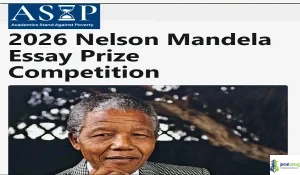
The 2026 Nelson Mandela Essay Prize, powered by Academics Stand Against Poverty (ASAP) in collaboration with the University of Zambia and UNILUS, is a dedicated academic support program designed to empower the next generation of African thinkers. By providing $5,000 in cash and a prestigious fellowship, this initiative ensures that brilliant young scholars can focus entirely on proposing innovative solutions for global governance rather than their research costs.
SUBMIT YOUR ESSAY FOR THE $5,000 MANDELA PRIZE NOW
Africa 2026 Nelson Mandela Essay Prize Summary Table
| Detail | Value |
|---|---|
| Host Organization | ASAP, UNZA, and UNILUS |
| Target Audience | Young African Scholars (Citizens) |
| Primary Benefit | $5,000 Cash + 1-Year Fellowship |
| Program Type | Essay Competition & Mentorship |
| Gender Focus | Open to All Candidates |
| Application Deadline | June 14, 2026 |
About the Africa 2026 Nelson Mandela Essay Prize Initiative
The Nelson Mandela Essay Prize is more than just a competition. It is a complete development platform aimed at placing African perspectives at the center of the G20 and African Union discussions. The organizers believe that intellectual contributions are most effective when they address Sustainable Infrastructure Investment and Intellectual Property Rights Litigation. Because of this, winners are invited to present their work at the Yale Global Justice Program conference. The goal is to close the gap between African academic potential and global policy-making, providing a timely platform as South Africa prepares to chair the G20.
Why You Should Apply (Benefits) for the Africa 2026 Nelson Mandela Essay Competition
- Grand Prize: $5,000 USD cash award for the winning essay(s).
- ASAP Fellowship: An optional one-year fellowship featuring elite mentoring and internships.
- Global Exposure: Opportunity to present your research at a Yale University conference in the USA.
- Networking: Connect with a global network of academics fighting poverty and inequality.
- Publication: Winning entries gain visibility among international policy-makers and scholars.
- Collaboration: Option for joint submissions, allowing two authors to combine their expertise.
Career and Academic Impact
This competition offers a rare opportunity to pivot your academic work toward real-world policy influence. Participants move beyond theoretical study to engage with pressing themes like Digital Inclusion Policy and healthcare reform. Whether you are aiming for a career in Global Governance Consulting or international human rights, winning the Nelson Mandela Essay Prize ensures your voice is recognized by the world’s most influential justice programs and academic institutions.
Africa 2026 Nelson Mandela Essay Prize Eligibility and Requirements
To be considered for this opportunity, you must meet the following criteria:
- Citizenship: Must be a citizen of an African country.
- Academic Year: Entry for the 2026 inaugural competition cycle.
- Submission Type: Individual or joint submissions (max two authors) are accepted.
- Thematic Alignment: Essays must address one of the priority themes (Climate, Health, Education, etc.).
- Originality: Proposals must be specific, actionable, and innovative.
- Affiliation: Applicants should have an affiliation with a university or recognized organization.
Documentation Required
To ensure a smooth application, you should prepare the following:
- Your completed essay (focusing on actionable policy proposals).
- A clear title for your essay.
- Proof of university or organizational affiliation.
- Contact details for both authors (if submitting a joint entry).
- A brief bio or C.V. highlighting your research background.
Step by Step Africa 2026 Nelson Mandela Essay Prize Application Guide
This application process is divided into five easy phases to ensure you do not miss any important steps.
Phase 1: Theme Selection and Research
- Choose from the seven core themes, such as Digital Transformation or Peace and Security.
- Research current global governance gaps where African voices are underrepresented.
- Ensure your proposal includes a “specific, actionable” solution rather than just theory.
Phase 2: Drafting the Proposal
- Structure your essay to be clear, persuasive, and academically rigorous.
- Connect your arguments to the role of the African Union or the G20.
- Edit your work for clarity, focusing on how your solution impacts vulnerable communities.
Phase 3: Peer Review (Optional but Recommended)
- If submitting a joint entry, collaborate closely with your co-author for a balanced view.
- Use the SMART method to ensure your proposed policy framework is realistic.
- Check for compliance with the inaugural 2026 guidelines.
Phase 4: Email Submission
- Format your submission email to: mandelaprize@academicsstand.org.
- Use the subject line: “Mandela Prize Submission 2026 – [Your Essay Title]”.
- Include your university affiliation and the names of all authors in the body of the email.
Phase 5: Deadline and Notification
- Ensure your email is sent before 11:59 PM on June 14, 2026.
- Monitor your inbox for a confirmation of receipt from the ASAP-ESA team.
- Shortlisted candidates will be notified regarding the Yale presentation schedule.
Jamnet.com.ng Expert Advice for Success
- Use the SMART Method: Ensure your policy proposal is Specific, Measurable, Achievable, Relevant, and Time-bound.
- Apply the STAR Technique: When describing the problem your essay solves, outline the Situation (global gap), the Task (needed reform), the Action (your proposal), and the Result (expected impact).
- Proactive Tip: Focus on the “Actionable” part of the prompt. Judges are looking for solutions that a body like the G20 could actually implement.
Important Dates to Remember
- Application Deadline: June 14, 2026 (Some sources cite June 16, but aim for the 14th to be safe).
- Evaluation Period: July – August 2026.
- Winner Announcement: September 2026.
- Yale Conference Presentation: TBD (Late 2026/Early 2027).
Deadline: June 14, 2026
CLICK HERE TO SUBMIT YOUR ESSAY VIA EMAIL
Frequently Asked Questions (FAQ) About the Africa 2026 Nelson Mandela Essay Prize
- Is there a word count limit? While not strictly specified in the summary, most high-level prizes prefer 2,500 to 5,000 words. Check the official site for exact limits.
- Can I submit more than one essay? Typically, only one submission per lead author is accepted.
- Do I have to take the fellowship? No, the one-year ASAP fellowship is optional for winners.
- Is the prize only for PhD students? No, it is open to “young African scholars,” which generally includes Masters and early-career researchers.
- What does “joint submission” mean? Two authors can write one essay together and share the prize.
- Will travel to Yale be paid for? Winning includes the presentation at the Yale Global Justice conference; travel support is usually part of the prize package.
- Can I write about any topic? You must focus on one of the seven themes provided (Climate, Health, etc.).
- Is there an application fee? No, entering the Nelson Mandela Essay Prize is free.
- Who are the organizers? ASAP-ESA, UNZA Graduate School of Business, and UNILUS.
- Can non-Africans apply? No, the competition is strictly for citizens of African countries.