The OPay Innovation Challenge 2026 is a national startup contest for Nigerian undergraduates, awarding a total of ₦19.2 million in grants and scholarships to teams building impactful fintech, agritech, healthtech, and other tech solutions.

Join our Telegram Channel for Instant Scholarship Updates
This guide provides a step-by-step guide of how to apply, from researching eligibility and assembling your team to drafting your proposal and preparing your pitch deck with tips on avoiding common mistakes.
About the Opay Innovation Challenge 2026
The OPay Innovation Challenge 2026 is part of Opay’s 10-year, ₦1.2 billion education and innovation initiative. It empowers Nigeria’s brightest undergraduates to develop tech solutions especially in fintech/digital payments, healthtech, agritech, AI, etc. with real social impact. Applicants work in teams of five undergraduates to compete for project grants (₦10M, ₦5M, ₦3M for 1st-3rd place, plus ₦300k scholarship each). Winners also get media exposure, mentorship, and even job placement or internships. In partnership with Google, OPay combines this competition with skill-building webinars and a bootcamp, much like a startup accelerator, to prepare teams for venture capital and industry engagement.
Challenge timeline
Applications open in May 25th, 2026 and close June 14, 2026. After shortlisting 48 teams in June, a 6-week virtual training and exam (June–August) narrows contestants to the top 10. Those finalists enter a 6-week Bootcamp (Aug–Sept) led by OPay experts. The program concludes with a Grand Finale on Nov 6, 2026, where the top 4 teams pitch refined solutions at the Empowering Futures Conference.
How to Apply for 2026 Opay Innovation Challenge (Step-by-Step Guide)
Phase 1: Eligibility Requirements
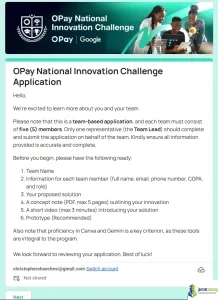
Before applying for the Opay Innovation Challenge 2026, confirm that all your team members meet the basic eligibility criteria below. To qualify, each team member must be:
- A Nigerian national undergraduate student at a recognized tertiary institution.
- Studying any field of study (STEM or non-STEM).
- Maintaining at least a 2.8/4 CGPA for colleges/polytechnics or 3.5/5 (second-class upper) for universities.
- Proficient with AI-assisted design tools (e.g. Canva with Google’s Gemini).
- Strong preference is given to those demonstrating financial need.
- Available for the program timeline (June–December 2026) if shortlisted.
- Make sure none of your team members are recent graduates (the challenge specifies current students). Also, check any IP or project restrictions from your institution; keep original IP ideas, but be ready to sign agreements if required (many such contests require shared usage rights). Consult your school’s innovation or legal office if uncertain.
Step 1 Checklist:
- Verify all members are eligible undergraduate students (Nigerian institutions).
- Confirm CGPA meets the minimum.
- Each team member practices Canva/Gemini.
- Assign one member as Team Lead to submit on behalf of the team.
Phase 2: Build Your Team and Concept
- Once eligibility is confirmed, form your team of 5. Seek members with complementary strengths: at least one coder/technical lead, one designer/presentor, one business/finance mind, etc. Diversity in skills and backgrounds is valued. Make sure your team includes someone fluent in English for written proposals and video, since all submissions are in English.
- Now define your innovation concept. The challenge encourages solutions in areas like fintech (mobile wallet, digital payments), healthtech, agritech, edtech, AI for social good, sustainability, and SME digital tools. Pick a problem that resonates with local challenges but also has broader impact. Use the problem-solution approach.
Team & Concept Checklist:
- Team roles assigned (e.g. Project Manager, Developer, Designer, Marketer, Researcher).
- Brainstormed and agreed on the core problem to solve.
- Identified sector/theme of focus (e.g. Fintech, Agritech).
- Conducted quick product-market fit research: potential users, competitors, and needs.
- Developed an initial concept note draft outlining the solution idea.
NOTE: Working on your concept early lets you refine it before writing the formal proposal. Consider building a basic prototype or wireframe (e.g. a mockup mobile wallet UI) even at this stage; it can improve your pitch and show feasibility. Leverage resources like government startup incubators, campus entrepreneurship centers, or mentors (OPay and Google may offer guidance sessions) to sharpen your idea. Remember, having a clear business model (how your solution makes money or sustains itself) can impress judges looking for serious startups.
Phase 3: Craft Your Proposal & Pitch Deck
With your idea defined, it is time to write your proposal (concept note) and prepare a pitch deck. The concept note is a PDF (max 5 pages) where you explain your innovation in detail. It should cover the key elements:
- Problem Statement: Describe the challenge or need your solution addresses.
- Solution Overview: Explain your product/service and how it works.
- Technical Stack: Outline the technologies used (e.g. mobile wallet, AI model, cloud services).
- Market Analysis: Define your target market and competition; highlight product-market fit by showing user demand.
- Business Model: Explain how the project will be sustainable or generate revenue (if applicable) – consider seed funding and venture capital interest.
- Impact and Metrics: Discuss potential social/economic benefits (e.g., jobs created, people served) and how you will measure success.
- Budget Estimate: Provide a high-level budget for the project grant (e.g., equipment, development costs).
- Team Profiles: Brief bios of each member with relevant skills and roles.
- Timeline: Outline key milestones (e.g., prototype launch, pilot testing).
Structure your document with clear headings and bullet points for readability. Use visuals where helpful (diagrams, charts). The goal is to convince judges that your solution is innovative, feasible, and addresses a real need.
Simultaneously, prepare a 1-page pitch deck to summarize your proposal. A typical structure (6–8 slides) might be:
- Title/Cover: Team name, project name, catchy tagline.
- Problem: Explain the issue in 1–2 slides with data.
- Solution: Show your product/service (screenshots or diagrams).
- Market & Business Model: Size of market, customer segments, and revenue model.
- Technology: Key tech components (e.g. mobile wallet API, AI features).
- Impact/USP: Why your solution is unique and the impact on users.
- Team: Photos/names and short intro of each member’s expertise.
- Ask: What you’ll do with the grant (project plan) and contact info.
A well-designed pitch deck (using Canva/Gemini as required) demonstrates clarity and professionalism. Practice explaining slides concisely – judges will likely review slides alongside your concept note and video.
Proposal & Pitch Checklist:
- Drafted concept note (PDF, up to 5 pages) with sections above.
- Created pitch deck (6–8 slides, PDF or image) covering problem, solution, model, impact, team.
- Highlighted keywords like fintech startup funding, seed funding, digital payments, mobile wallet in context (where relevant) to catch attention.
- Reviewed for grammar, clarity, and format (PDF/JPEG/MP4, ≤10MB each).
Phase 4: Submit
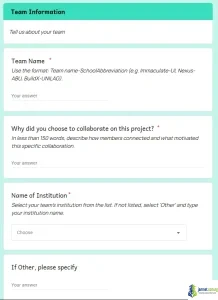
When everything is ready, submit your application through the official portal. OPay uses an online Google Form to collect entries. Only the Team Lead should submit on behalf of the team and can only respond to the form once.. The form requires:
- Team name and all five members’ details (full name, email, phone, CGPA, role).
- Upload of the concept note PDF (max 5 pages), your pitch/video (MP4, max 3 minutes), and optionally a prototype/demo (image or video).
- Proficiency in Canva/Gemini is verified via your application materials.
Check these carefully:
- Format & Size: Ensure each file is in an accepted format (PDF, JPEG, or MP4) and under 10MB. Large images or videos must be compressed.
- Completeness: Incomplete applications are automatically disqualified. Double-check that all form fields are filled and documents attached.
- Deadlines: Submit by June 14, 2026 (no extensions). Applications are only accepted online via the portal – no emails or mail-in entries.
After submission, you should receive a confirmation (email or on-screen). If you have questions or encounter issues, contact the organizers. Keep records of your submission (take screenshots, save confirmation messages). Make sure your team is subscribed to OPay’s official channels (WhatsApp/Telegram/newsletter) for any updates.
Phase 5:Interview and Pitch Preparation
If your team is shortlisted, the real work begins. Shortlisted teams (48 teams of 240 students) are announced in June. Those teams enter a 6-week Virtual Training & Assessment (July–August). This includes webinars and a timed exam, after which the top 10 teams advance to the Bootcamp. Use this period to refine your concept:
- Study the Themes: Attend all OPay webinars (likely on fintech, startup funding, digital payments, etc.) to absorb insights. This is like a startup accelerator class.
- Practice Your Pitch: Sharpen your 3-minute video pitch. Focus on clear storytelling: articulate problem, solution, and impact in compelling terms. Rehearse common interview questions (e.g., “Why your team? Why now?”).
- Build or Prototype: If possible, develop a minimum viable product (MVP) or prototype demo. Judges may want to see code snippets or clickable prototypes.
- Refine Business Model: Polish how your solution could scale – consider seed funding angles, partnership opportunities, and how you’d use the grant effectively.
- Gather Feedback: Seek mentors or industry experts (even outside OPay) for advice on your startup idea and presentation.
Finally, prepare for the Grand Finale pitch (Nov 6). The top 4 teams will refine their final solutions and present to investors and tech leaders. Your pitch deck will be critical here – make sure it’s polished, visually appealing, and rehearsed. Highlight any progress since the proposal (new metrics, pilot results, partnerships).
.
Required Documents Checklist
| Document | Description | Format/Notes |
|---|---|---|
| Team Registration Form | Online form on OPay portal with team members’ info | Google Form (Team Lead submits) |
| Concept Note | Detailed proposal of your innovation (max 5 pages) | PDF, ≤5 pages, 10MB max |
| Pitch Video | Short introduction to your solution (≤3 minutes) | MP4, ≤3 min, 10MB max |
| Prototype/Demo | (Optional) Product demo screenshots or prototype video | JPEG/MP4, shows functionality |
| (Suggested) Slides | Pitch deck summarizing problem, solution, etc. | PDF/JPEG (for rehearsal only) |
| Academic Documents | (If requested) CGPA proof or transcript | PDF or JPEG (ensure up-to-date) |
Proposal Outline (Template)
Below is a suggested structure for your written proposal (concept note). Tailor it to your project, but ensure you cover all critical points:
- Title & Overview: Project name, team name, one-line description.
- Problem Statement: What is the real-world problem? Who is affected? Why current solutions fall short.
- Proposed Solution: Your innovation – explain how it works (with diagrams if helpful). Specify the tech stack (e.g. mobile wallet app, AI model, blockchain) and how it solves the problem.
- Market Analysis: Describe your target users/customers and market size. Include key stats. How do you achieve product-market fit?
- Business Model: How will the project be sustainable? Explain funding sources (grants, subscriptions, partnerships) or how it could attract seed funding and venture capital.
- Innovation & Impact: What is unique or disruptive about your solution? Outline social and economic impact (jobs created, efficiency gains, lives improved).
- Project Plan & Budget: High-level milestones (e.g. “Prototype by Month 3, Pilot by Month 6”). Provide a budget breakdown for using the grant (e.g. equipment, development, marketing).
- Team: Introduce each member with credentials (e.g. “Jane – CTO, 2nd-year Comp. Sci, built XYZ app”). Emphasize relevant experience.
- Supporting Data: Any pilot tests, surveys, or letters of support you have.
- Conclusion: Summarize why your project deserves to win (tie back to Challenge objectives: youth innovation, fintech, etc.).
Pitch Deck Outline (Template)
Create a clear, visually engaging 1-page pitch deck (6–8 slides). Each slide should convey one core idea. For example:
- Slide 1: Title/Cover – Project name, tagline, team names, logos.
- Slide 2: The Problem – One-sentence statement of the problem; include a striking stat or story.
- Slide 3: Our Solution – Show your product/service and key features. Use visuals or mockups.
- Slide 4: Market & Customers – Who needs this? Market size or target user profile.
- Slide 5: Business Model – How you make money or sustain operations (e.g. transaction fees, ads, subscriptions).
- Slide 6: Technology – Quick overview of tech stack (programming languages, tools, platform).
- Slide 7: Traction / Roadmap – Any progress to date (users, prototype), and next milestones.
- Slide 8: Team – Photos and quick bios of each member (highlight skills).
- Slide 9: Financial Ask/Use of Funds – How grant money will be used (bulleted budget items).
- Slide 10: Contact – Team lead contact info, thank you message.
Judges Scoring Board Guidelines
Competition judges evaluate entries on innovation, feasibility, impact, and presentation. Below is a sample rubric with weightings. Note that Judges will look for evidence of market research, clear financial planning, and alignment with OPay’s fintech/digital payments focus. Address all criteria in your materials.
| Criterion | Description | Weight |
|---|---|---|
| Innovation & Creativity | Novelty of idea and creativity in solving the problem. | 20% |
| Technical Feasibility | Soundness of the tech solution and prototype viability. | 20% |
| Business Model/Market | Clarity of revenue model, market analysis, product-market fit. | 20% |
| Impact & Scale | Potential social/economic benefit and scalability. | 15% |
| Team & Execution | Team’s skills, roles, and plan to execute the project. | 15% |
| Presentation Quality | Clarity, polish, and professionalism of proposal/pitch. | 10% |
| Total | 100% |
Common Application Mistakes to Avoid
- Missing the Deadline: Last year’s finalists emphasize early submission. Late or partial applications are not accepted.
- Ignoring Guidelines: Follow file formats and page limits exactly. Don’t upload unrequested documents.
- Weak Problem Statement: Some applicants describe solutions without clearly defining the problem. Start with a compelling need.
- Overloading Slides/Text: Keep slides concise. Crowded pitch decks lose points on presentation quality.
- Technical Gaps: Ensure at least one team member can implement the tech. Judges penalize unrealistic tech plans.
- Poor Team Roles: Unclear team roles or solo-led teams are red flags. Demonstrate collaboration and complementary skills.
- Not Showcasing Impact: The challenge values social impact. Quantify expected benefits wherever possible.
- No Prototype: A working prototype or demo (even simple) can greatly boost credibility. If possible, attach one in JPEG/MP4 form.
Learn from past participants: engage mentors early, rehearse your pitch like a startup pitch deck. Treat this like a seed funding opportunity.
Good Luck!