The old promise of get a degree, get a job, stay safe is weakening fast. Across industries, companies are restructuring around artificial intelligence, cutting roles they once considered stable, and expecting fewer people to do more work. At the same time, economic officials in major regions are still warning about slow growth and persistent inflation pressures, which keeps household budgets tight and job security uncertain.

Join our Telegram Channel for Instant Scholarship Updates
That is why becoming a successful founder is no longer a dream for ambitious people. It is becoming a practical answer to a changing economy. A founder can build income instead of waiting for it. A founder can create opportunity instead of begging for a seat at an increasingly crowded table. And in a world where entry-level roles are being reshaped by AI, the ability to build, sell, and solve problems may be more valuable than ever. Recent research and labor-market analysis suggest AI is already changing the structure of jobs, including junior roles and AI-exposed postings.
The Real Reason Founder Life Matters Now
Being a founder is not only about wealth. It is strongly about control.
When you work a job, your income depends on a manager, a budget cycle, and a company’s strategy. When you build a business, your income depends on whether you can create value people actually want. That is a different kind of risk, but it is also a different kind of power.
In unstable times as this age, power matters. A founder has the chance to shape pricing, customers, product direction, brand, and timing. That does not mean founding is easy. It means the upside is much larger than the typical salary ceiling, and the downside can be managed with a small, smart start. That is the decision many people are now making for entrepreneurship, side businesses, digital products, service firms, and AI-assisted ventures.
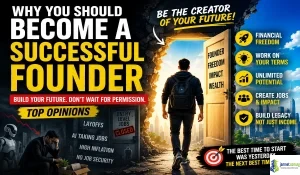
8 Key Reasons Why You Should Become a Successful Founder (Top Opinions)
Job Security Is Not What It Used to Be
One of the strongest reasons to become a founder is that traditional job security is eroding. Companies are trimming roles, flattening management layers, and using AI to automate tasks that were once handled by large teams. A recent example is Intuit, which announced a sizeable workforce reduction while explaining that the company was simplifying operations and expanding its AI strategy.
That trend is bigger than one company. Research on AI-exposed jobs shows that many roles are changing in task composition, and some postings in high-exposure areas have already declined after the rise of Artificial Intelligence.
The message is simple: if the labor market is becoming more selective, you need a second engine. Founding gives you that engine.
AI Rewards Builders More Than Followers
One of the things AI is changing what counts as valuable work. Many employers now want people who can work alongside AI, not people who only perform routine functions. The AI Workforce Consortium’s 2025 findings showed that 78% of the job roles they analyzed across G7 countries now reference AI-related skills, and 92.6% of entry-level ICT roles showed high or moderate transformation potential due to AI.
That matters because founders are builders by nature. They are forced to understand customer pain, automate repetitive tasks, test ideas quickly, and use technology to move faster. AI is not a threat to founders but a force multiplier for founders who learn how to use it well.
This age where the best jobs increasingly demand AI fluency, becoming a founder lets you become the person who benefits from that shift instead of being trapped by it.
Inflation Makes Side Income and Ownership More Important
Inflation changes how people think about money. When prices keep rising, one salary feels smaller, savings feel less powerful, and emergency spending becomes more painful. Recent reporting from major outlets continues to show inflation pressure and downgraded growth forecasts in parts of the global economy, with governments and central banks still trying to manage the squeeze.
That is exactly why ownership matters. A salary may keep up for a while, but a business can increase its prices, expand into new markets, and add new revenue streams over time. A founder is not completely protected from inflation, but a founder has more tools to respond to it.
That includes:
- raising prices strategically
- selling digital products
- using low-cost online channels
- building recurring revenue
- serving international customers
- automating operations with AI
Inflation punishes people who only consume. It rewards people who create.
Entry-Level Jobs Are Getting Harder, So Skill Creation Matters
A lot of people still believe the path is: get an entry-level job, learn on the job, then grow. That path is not gone, but it is harder. AI is increasing expectations even for junior workers, and some employers are redesigning entry-level roles to require more analytical judgment and less routine work. Recent reporting on entry-level hiring found employers are asking for more skill from day one, while academic work on job postings shows increasing demand for AI-related competencies and rising transformation pressure in junior roles.
That makes founding appealing for another reason: it forces skill creation.
A founder has to learn:
- sales
- marketing
- product thinking
- operations
- branding
- customer research
- cash management
- negotiation
These are not just business skills. They are life skills. Even if your first venture does not become a giant company, the process turns you into someone more employable, more resilient, and more valuable in any market.
Founding Gives You Income Independence
A successful founder is not necessarily the person with the biggest company. It is the person who builds something that pays them consistently and grows over time.
That could be:
- a consulting business
- a digital agency
- a content brand
- an AI-assisted service business
- an online course
- a software product
- a subscription model
- an e-commerce brand
- a B2B lead generation service
The real advantage is independence.
When you own your income, you are less exposed to layoffs, hiring freezes, budget cuts, and promotion delays. You also gain bargaining power. Even if you still work a job, side business ownership changes your financial psychology. You become less desperate, less dependent, and more strategic.
A Founder Thinks in Assets, Not Earnings
Most workers focus on monthly pay. Founders focus on assets.
An asset can be:
- a brand
- a domain
- a newsletter
- an audience
- a software tool
- a repeat customer base
- a referral network
- a process that saves time
- a trusted reputation
Assets create leverage. Leverage creates wealth.
That is why successful founders often seem to move differently. They are not just looking for money this month. They are building something that can still pay them next year, and maybe for the next decade. That is especially important in a world where inflation erodes cash and AI reduces the value of repetitive work.
Building a Business Can Be the Fastest Way to Reposition Yourself
For many people, founding is not a career detour. It is a fast-track reset.
If you are:
- underpaid
- laid off
- stuck in a shrinking industry
- worried about automation
- tired of instability
- ready for more control
then building a business can be a way to reposition your life. It can turn your experience into a service, your expertise into a product, and your network into a customer base.
That is especially powerful now, because AI tools lower the cost of starting. You can draft marketing copy, create landing pages, automate customer follow-up, build prototypes, and test ideas much faster than before. That lowers the barrier to entry for new founders.
Founder Status Builds Confidence and Identity
There is also a psychological reason to pursue this path. Founders do not just earn differently. They think differently.
They become:
- more decisive
- more resourceful
- more comfortable with uncertainty
- more comfortable selling
- more confident under pressure
That matters in a world where insecurity is becoming normal. When the economy feels unstable, many people become passive and fearful. Founders train themselves to become active and adaptive. That does not remove fear, but it prevents fear from controlling the outcome
What Kind of Founder Should You Become?
Not everyone should try to build a venture-backed startup. In fact, many people are better suited to simpler, faster, more profitable founder models.
The best place to start is with what you already know.
You can become:
- a service founder if you have a marketable skill
- a digital founder if you can build online products
- a content founder if you can attract attention
- a tech founder if you can solve software problems
- a local business founder if you understand a community need
A good founder model should match your strengths, available capital, and tolerance for risk.
How to Start Without Waiting for the Perfect Moment
The biggest mistake is waiting until you feel fully ready. Most successful founders start before they feel ready.
A practical path looks like this:
- Identify a painful problem people already pay to solve.
- Choose a small market you can understand quickly.
- Build a simple offer or product.
- Get your first customer before overbuilding.
- Use AI tools to reduce cost and speed up execution.
- Improve based on real feedback, not assumptions.
- Reinvest early profit into growth.
- Build systems, not just hustle.
That is how a small idea becomes a real business.
What Successful Founders Do Differently
Successful founders usually do three things well.
First, they notice change early. They see layoffs, inflation pressure, and AI disruption as signals, not just bad news. They understand that market shifts create openings.
Second, they stay close to customers. They do not build in isolation. They ask what people need, what they fear, what they pay for, and what they complain about.
Third, they move fast. They test, adjust, and keep going. They do not wait for certainty because certainty usually arrives after the opportunity has passed.
The Risk Is Real, But So Is the Reward
Founding is not a guarantee of success. There will be failure, rejection, cash-flow stress, and self-doubt. But compared with simply waiting to be protected by a job market that is changing under your feet, it can be a far better long-term bet.
The risk of not building anything is often invisible at first. It looks safe until the layoffs come, inflation eats savings, or AI shifts demand away from your role. Then the cost of inaction becomes obvious.
A founder takes a different risk: visible, intentional, and potentially transformative.
Final Thoughts
You should consider becoming a successful founder because the world is changing in a way that favors ownership, adaptability, and skill creation. Companies are laying off workers while reshaping around AI. Entry-level jobs are becoming more demanding. Inflation is still pressuring households and businesses. In that environment, building something of your own is not only ambitious — it is practical.
A successful founder does not just chase money. A successful founder builds leverage, stability, dignity, and long-term freedom. That is why this path matters now more than ever.
Frequently Asked Questions (FAQs)
Why should I become a founder in today’s economy?
Because job security is weaker, AI is changing work, and inflation makes dependence on one paycheck riskier. Founding gives you more control over income and opportunity.
Is entrepreneurship still worth it during layoffs and inflation?
Yes. In uncertain markets, businesses that solve real problems can grow faster than wages, especially when they use low-cost digital tools and AI to operate efficiently.
What kind of founder is best for beginners?
A service founder or digital founder is usually the easiest to start, because it requires less capital and can validate demand quickly.
Do I need a lot of money to start?
No. Many founders begin with a skill, a simple offer, a laptop, and a clear problem to solve.
How does AI help founders?
AI can speed up research, content creation, customer support, prototyping, and automation, which lowers startup costs and improves speed.
What is the biggest benefit of becoming a founder?
Ownership. You build assets, control pricing, and create income that is not fully tied to an employer’s decisions.
What is the biggest mistake new founders make?
Waiting too long to start, overbuilding before selling, and trying to impress people instead of solving a real problem.
Can I be a founder while still employed?
Yes. Many successful founders start as side hustlers, validate the idea, and grow it before going full-time.