As Artificial Intelligence transitions from cloud-based models to decentralized, “on-device” intelligence, the demand for expertise in Embedded Composite AI Research has reached a critical peak. However, the high cost of living in Europe’s premier academic hubs often deters brilliant international minds from pursuing specialized graduate degrees. The 2026 SECAI Scholarships at TU Dresden (TUD) and Leipzig University (UL) are designed as a strategic intervention, providing the STEM Internationalization Funding necessary for the next generation of researchers to thrive in a European AI Excellence Ecosystem.

Join our Telegram Channel for Instant Scholarship Updates
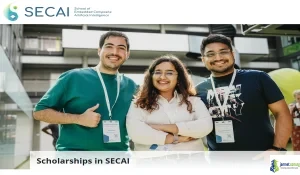
Funded by the German Federal Ministry of Research, SECAI is one of Germany’s prestigious Zuse Schools. This initiative goes beyond simple financial aid; it integrates Master’s students into an Interdisciplinary AI Graduate Studies framework that spans computer science, law, medicine, and psychology. By offering a monthly stipend of EUR 934 and access to world-class research facilities in Dresden and Leipzig, SECAI ensures that financial barriers do not impede the advancement of high-potential AI experts.
CLICK HERE TO APPLY
SECAI Scholarship Summary Table
| Detail | Value |
|---|---|
| Host Organizations | TU Dresden & Leipzig University |
| Target Audience | International Master’s Students in AI |
| Primary Benefit | EUR 934 Monthly Stipend + Family Allowance |
| Program Type | Research-Focused Scholarship |
| Academic Year | 2026/2027 |
| Application Deadline | 30 June 2026 |
About the Initiative 2026
The SECAI School of Embedded Composite AI is at the forefront of Germany’s national AI strategy. The 2026 scholarship initiative is specifically structured to promote excellence and diversity within the European AI Excellence Ecosystem. Unlike traditional scholarships that focus strictly on technical programming, SECAI encourages applications from “Human and Societal Dimensions” perspectives, including AI and Data Law Scholarships and psychology-driven Human-Machine Interaction studies.
Recipients of the SECAI funding are not just students; they are researchers-in-training. Based in the Silicon Saxony region (Dresden) and the growing data hub of Leipzig, scholars gain immediate entry into international academic networks and strong industry connections. This initiative is recognized by global research AI as a premier pathway for underrepresented groups, particularly women in STEM, to secure a foothold in one of the world’s most advanced research environments.
Core Objectives of the Program
- To support high-achieving international students pursuing Embedded Composite AI Research in Germany.
- To increase diversity and gender representation within the STEM Internationalization Funding landscape.
- To build a bridge between interdisciplinary fields like law and medicine and advanced AI technology.
Benefits of the 2026 SECAI Scholarship
- Financial Support: A monthly stipend of EUR 934 to cover living expenses in Germany.
- Family Benefits: Potential for family allowances for eligible international students with dependents.
- Elite Research Access: Direct entry into advanced labs at TU Dresden and Leipzig University.
- Network Integration: Membership in the Zuse School network, connecting scholars with top AI experts and industry leaders.
- Academic Security: Funding typically covers the entire remaining duration of the Master’s degree program.
Eligibility and Requirements
- Enrollment Status: Must be currently enrolled in or applying for an eligible Master’s program at TUD or UL.
- Academic Excellence: Typically requires a GPA equivalent to 1.7 or better on the German grading scale.
- Field of Study: Research must be closely connected to AI (Computer Science, Data Science, Bioinformatics, AI Law, etc.).
- Demographic Focus: Strong preference is given to women in STEM and students facing adverse personal or political circumstances.
- Research Commitment: Applicants must demonstrate a clear intent to pursue a research-driven career in Artificial Intelligence.
Step-by-Step Application Guide for SECAI
Phase 1: Program and Eligibility Audit
- Confirm your enrollment or application status at either TU Dresden (TUD) or Leipzig University (UL).
- Identify if your M.Sc. program is on the “Eligible List” (Computer Science, Data Science, Bioinformatics, Nanoelectronics, etc.).
- Calculate your GPA conversion to the German system; if below 1.7, prepare a statement regarding “difficult personal circumstances” if applicable.
- Ensure your current research interest aligns with Embedded Composite AI Research or its societal dimensions.
Phase 2: Academic Documentation Engineering
- Update your academic CV to highlight any AI-related projects, internships, or publications.
- Secure your latest transcripts and a copy of your Bachelor’s degree certificate.
- Prepare a motivation letter that clearly articulates your research goals within the European AI Excellence Ecosystem.
- If applying for AI and Data Law Scholarships, emphasize your focus on data protection and AI ethics.
Phase 3: Application Form Submission
- Access the official SECAI application portal (open from 1 April).
- Note that the scholarship application is separate from the Master’s program admission application.
- Upload all supporting documents in the requested formats (typically PDF).
- Double-check the “Early Selection” dates if you are applying for specialized programs like LL.M. Intellectual Property Law.
Phase 4: Early Selection Strategy (Optional)
- To be considered for early approval, submit your complete application by 19 April (Law) or 19 May (General).
- Highlight any unique skills or underrepresented backgrounds that make your application “outstanding” for early review.
- Ensure your references are ready to be contacted by the SECAI selection committee if required.
Phase 5: Onboarding and Ecosystem Integration
- If selected, finalize your enrollment at TUD or UL to activate the monthly stipend.
- Engage with the SECAI research environment immediately to find a thesis topic or research group.
- Utilize the network to seek internships or collaborative projects in Silicon Saxony.
- Participate in SECAI workshops to maximize your Interdisciplinary AI Graduate Studies experience.
Jamnet Expert Advice (STAR/SMART Methods)
- Use the SMART Method: Your research goals in the motivation letter should be Specific (e.g., “Optimizing AI for medical informatics”) and Measurable through potential thesis outputs.
- Apply the STAR Technique: Describe a Situation where you applied AI logic, the Task you performed, the Action (technical or research-based), and the Result (GPA, project success, or societal impact).
- Emphasis: Focus on “Interdisciplinary Impact”—SECAI loves candidates who bridge the gap between AI and fields like Psychology or Law.
- Proactive Tip: Submit by the May 19 Early Selection date. While the final deadline is June 30, the most competitive slots are often allocated during the early review rounds.
Deadline: 30 June 2026
CLICK HERE TO APPLY
Frequently Asked Questions (FAQ) About SECAI Scholarships
- Do I need to be a German citizen to apply? No, the SECAI scholarship is specifically designed for international Master’s students.
- What is the monthly stipend amount? Successful recipients receive EUR 934 per month.
- Which universities are part of SECAI? Technische Universität Dresden (TUD) and Leipzig University (UL).
- Is there a GPA requirement? Usually, a German GPA of 1.7 or better is required, though exceptions are made for difficult circumstances.
- Can I apply if I study Law or Psychology? Yes, if your studies or research focus is connected to Artificial Intelligence.
- What are the early selection dates? 19 April for Law students and 19 May for all other programs.
- Does the scholarship cover my whole degree? It typically covers the remaining standard period of study for your Master’s program.
- Is the scholarship application separate from university admission? Yes, you must apply to the university and the scholarship separately.
- Are women encouraged to apply? Yes, SECAI specifically aims to support underrepresented groups in STEM, including women.
- What is “Embedded Composite AI”? It refers to AI systems integrated into hardware/embedded systems that use multiple AI methods (symbolic and sub-symbolic).