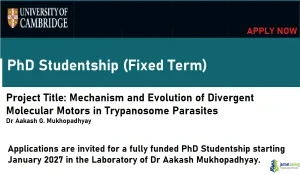
Applications are now open for the 2027 University of Cambridge Pathology PhD Studentship. This highly prestigious academic initiative is specifically designed to transform ambitious undergraduate and postgraduate students into elite molecular biology and pathology specialists through a structured and comprehensive development program.

Join our Telegram Channel for Instant Scholarship Updates
By mastering advanced cellular biology, parasite genetics, and structural biochemistry, this elite professional pathway helps candidates secure lucrative cell biology careers and attain high paying research analyst roles. Through this structured global framework, the hosting university ensures that selected scholars can focus entirely on gaining fully funded biology doctorates and building powerful international networks.
2027 University of Cambridge Pathology PhD Studentship Summary Table
| Detail Category | Value Information |
|---|---|
| Host Organization | University of Cambridge Department of Pathology |
| Project Supervisor | Dr Aakash G. Mukhopadhyay |
| Target Audience | UK Home Fee Candidates with a strong biology background |
| Primary Benefit | Fully funded four year PhD studentship covering tuition fees and living costs |
| Program Type | Doctoral Research Studentship in Pathology |
| Study Location | Cambridge United Kingdom |
| Application Deadline | Friday 31 July 2026 |
2027 University of Cambridge Pathology PhD Studentship Initiative Details
The 2027 University of Cambridge Pathology PhD Studentship scheme is much more than a standard postgraduate study grant. It is a premier global scientific research and technological innovation platform designed to support global sustainable development and next generation medical discoveries. Eukaryotic flagella or cilia are remarkable cellular organelles that enable cells to move, sense their environment, and communicate with surrounding tissues. In humans, defects in these structures cause a wide range of diseases, including retinal degeneration, developmental disorders, and obesity. Many microbial pathogens also rely on flagella for survival, transmission, and host adaptation.
Among the most fascinating examples are the trypanosomatid parasites, a group that includes the causative agents of leishmaniasis and sleeping sickness. These parasites possess a specialised flagellum that is essential for motility, environmental sensing, and successful progression through multiple hosts including humans. This project will investigate the mechanism of the trypanosome intraflagellar transport (IFT) motors and determine how their architecture supports flagellum assembly and function. You will apply multidisciplinary approaches from cell biology, parasite genetics, biochemistry, and structural biology to uncover fundamental principles governing the function and evolution of these molecular motors.
2027 University of Cambridge Pathology PhD Studentship Career Boost
Securing a place in this cohort serves as an exceptional catalyst for your professional trajectory. By securing these prestigious research grants, selected scholars gain the valuable opportunity to pioneer research solutions within world class laboratories. This immersive experience allows early career candidates to collaborate directly with leading international scientists, master advanced computational protocols, and solve complex quantitative challenges to build a stellar reputation in the academic sector.
Gaining this hands on exposure prepares you to lead massive technological projects, secure senior research director roles, and drive scientific efficiency on a large scale. Furthermore, participating in these structured academic programs integrates early career analysts into active university teams where they work on vital industry applications. Building these strong professional networks allows you to win academic recognition, design strategic proposals, and lead major science development initiatives worldwide.
2027 University of Cambridge Pathology PhD Studentship Benefits
- Complete coverage of university tuition fees and research expenses throughout the entire program duration.
- Generous tax free living stipend to support your general expenses in Cambridge.
- Access to the newly established Mukhopadhyay Laboratory to work on active scientific projects.
- Continuous professional development training including structured leadership courses and cohort activities.
- Direct collaboration opportunities with staff scientists and engineers to design and fabricate new experimental setups.
- Elite membership in a prestigious research community with access to outstanding university libraries and research facilities.
- Clear professional pathways designed to facilitate a permanent research career within the global scientific sector.
2027 University of Cambridge Pathology PhD Studentship Eligibility Criteria
- Academic Record: Achieved or on track to receive the equivalent of a UK upper second class honours degree or higher (UK upper $2.1$ or higher) in an undergraduate honours or Masters degree in a relevant subject.
- Fee Status: Meet the requirements to qualify for UK Home Fee status only.
- Personal Attributes: High self motivation, excellent analytical thinking, strong ethical standards, and a passion for pathogen biology.
- Program Start: Fully eligible to begin a full time PhD course at the university starting in January 2027.
- Reference Matching: Ability to secure two outstanding references from senior academic mentors.
2027 University of Cambridge Pathology PhD Studentship Step by Step Guide
Phase 1: Portfolio and Document Organization
- Gather your university transcripts, certificates, and research papers to verify your academic performance.
- Draft your statement of motivation explaining why you wish to pursue a PhD in this area and outlining your research interests and background.
- Consult the structural layout inside the Template for Blogging Assistance.pdf to ensure all your files are formatted correctly.
- Save all your academic files and national identity documents as clear PDF documents on your computer.
Phase 2: Applicant Portal Access and Registration
- Visit the official online postgraduate admissions portal of the university and read through the guidelines.
- Create your unique candidate profile using your primary email address and complete the online form.
- Select the PhD in Pathology under course code BLPA22 as your chosen program.
- Verify your email registration by clicking the secure confirmation link sent to your inbox.
Phase 3: Reference Verification and Referees Coordination
- Identify two academic referees who can verify your research potential and write strong letters of recommendation.
- Alert your referees via email that an automated letter request will be sent to them upon your submission.
- Confirm that your referees understand they will have exactly two weeks to upload their recommendation letters.
- Input the contact details and email addresses of your referees into the designated applicant fields.
Phase 4: Document Upload and Submission
- Upload your CV, university transcripts, and motivation statement directly into the designated document spaces.
- Ensure that you quote reference PK49372 on your application form to link your profile to this specific vacancy.
- Pay the required university application fee of $\pounds 20$ through the secure postgraduate application portal.
- Submit your finalized application profile before the strict local cutoff on Friday 31 July 2026.
Phase 5: Admissions Review and Onboarding
- Monitor your candidate portal to ensure your referees upload their letters of recommendation before the deadline.
- Wait for the departmental admissions committee to review all submitted forms and shortlist candidates.
- Participate in structured academic interviews with Dr Aakash Mukhopadhyay to discuss your scientific interests.
- Learn your qualification status and prepare to begin your fully funded PhD program in January 2027.
2027 University of Cambridge Pathology PhD Studentship Required Documents
To make sure your application goes smoothly, please prepare the following documents in advance:
- Official university academic transcripts detailing your degree grades and courses.
- Detailed curriculum vitae summarizing your academic and research achievements.
- Statement of motivation outlining your research interests, background, and the qualities you bring to the role.
- Valid passport or national identity documents confirming your eligibility for UK Home Fee status.
- Contact details and email addresses for two academic references.
2027 University of Cambridge Pathology PhD Studentship Common Mistakes to Avoid
- Missing the reference code: Submitting your application without quoting reference PK49372, which prevents the team from matching your profile to the project.
- Delaying referee alerts: Submitting your form without notifying your referees, leaving them with less than two weeks to upload their letters.
- Applying with international fee status: Registering for the program when you do not qualify for domestic UK Home Fee status.
- Presenting uncertified records: Uploading blurry transcripts or documents that lack official institutional stamps or signatures.
- Missing the initial deadline: Delaying your application past Friday 31 July 2026, as late submissions are not evaluated under any circumstances.
2027 University of Cambridge Pathology PhD Studentship Selection Process
The selection process is highly structured and follows these standards:
- Profile evaluation: The departmental admissions committee reviews all submitted forms to verify qualifications, UK Home Fee eligibility, and references.
- Departmental interviews: Shortlisted candidates participate in academic interviews with Dr Aakash Mukhopadhyay and departmental representatives.
- Candidate qualification: Successful individuals are designated as Qualified Candidates and receive direct support.
- Formal offers: The university announces the final selection decisions and contacts successful scholars to issue admission notices.
- Starting arrangements: Successful candidates coordinate their starting arrangements to begin their doctoral studies in January 2027.
Application Deadline: Friday 31 July 2026
2027 University of Cambridge Pathology PhD Studentship Frequently Asked Questions
Question 1: What is the primary purpose of this PhD studentship?
Answer 1: The program aims to study the mechanism and evolution of divergent molecular motors in trypanosome parasites within the newly established Mukhopadhyay Laboratory.
Question 2: Who is eligible to apply for this studentship?
Answer 2: The studentship is open exclusively to candidates who qualify for UK Home Fee status and hold or expect to obtain a UK upper $2.1$ or higher honours degree.
Question 3: What is the application deadline for this program?
Answer 3: The postgraduate application portal and reference system close strictly on Friday 31 July 2026.
Question 4: Do I need to pay an application fee?
Answer 4: Yes, there is a university application fee of $\pounds 20$ required to submit your profile through the postgraduate portal.
Question 5: What is the exact vacancy reference that I must quote?
Answer 5: Applicants must quote reference PK49372 on their application form and in all related correspondence.
Question 6: When does this PhD program start?
Answer 6: The successful candidate is scheduled to commence their doctoral studies in January 2027.
Question 7: How many academic references are required?
Answer 7: You must provide the contact details for two academic references, and they must submit their letters before the deadline.
Question 8: Does this studentship cover international travel fees?
Answer 8: No, the funding covers university tuition fees and a living stipend for candidates with UK Home Fee status, but it does not cover international flights.
Question 9: What course code should I select on the applicant portal?
Answer 9: You should apply for a PhD in Pathology with course designation code BLPA22.
Question 10: Where is this research project based?
Answer 10: The project is based on site at the Department of Pathology at the University of Cambridge, United Kingdom.