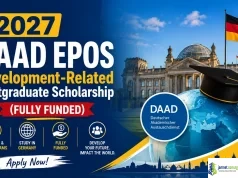

Applications are now open for the 2027 DAAD EPOS Scholarships for Young Professionals. Pursuing a post graduate degree at an elite European institution is a major milestone that can transform your career and position you as a global leader in sustainability. However, navigating the high costs of international travel, tuition fees, and monthly living expenses in Germany can often feel like a massive financial hurdle. The German Academic Exchange Service, widely known as DAAD, perfectly solves this problem through the EPOS scheme.

Join our Telegram Channel for Instant Scholarship Updates
By securing this outstanding financial aid package, you can enroll in the prestigious Master of Science in Environmental Governance program at the University of Freiburg. This fully funded opportunity covers all your academic costs and provides a generous monthly living allowance, letting you focus entirely on creating real world solutions for environmental protection.
2027 DAAD EPOS Scholarships for Young Professionals in Germany Summary Table
| Detail Category | Value Information |
|---|---|
| Host Organisation | Deutscher Akademischer Austauschdienst and University of Freiburg |
| Target Audience | Young Professionals from Developing Countries |
| Primary Benefit | Fully Funded Tuition Monthly Stipend and Travel Support |
| Academic Level | Master of Science MSc Environmental Governance MEG |
| Program Type | International Student Financial Assistance Europe |
| Study Location | Freiburg Germany |
| Application Deadline | October 15 2026 |
About the 2027 DAAD EPOS Scholarships for Young Professionals in Germany
The DAAD EPOS environmental governance program is a premier academic training pathway designed to train the next generation of sustainability managers. Based in the beautiful and green city of Freiburg, this multidisciplinary course combines natural sciences, social sciences, economics, and international policy.
Unlike traditional science programs that focus only on theory, this active scheme offers a systemic approach to resource management. Students study diverse aspects of sustainability, such as environmental policy analysis, public administration, international conventions, and conflict resolution strategies. To ensure graduates are fully equipped for international leadership, the program runs as a cohort based training pathway. This setup makes the program one of the most attractive options for students seeking premium Graduate School Preparation Fellowships.
Why This Program Boosts Your Future Career
Securing a spot in this world class master program is a massive milestone for your scientific and professional journey. Studying inside a leading European research hub like the University of Freiburg gives you direct access to distinguished academic advisors, modern computational resources, and prominent environmental policy networks. You will build deep analytical expertise and practical problem solving skills from your very first day in Germany.
Furthermore, graduating from a top tier German university makes you exceptionally competitive in the international job market. Whether you aim to lead innovative conservation projects, join federal environmental departments, or secure prestigious research roles, the credentials gained here will elevate your profile. This program stands out among the best European university fellowships for STEM and policy, preparing you for rapid advancement pathways toward environmental consultancy, resource management, and competitive international fellowships.
Benefits of the 2027 DAAD EPOS Scholarships for Young Professionals in Germany
- Complete Tuition Coverage: Enjoy absolute peace of mind with full tuition funding to cover all your graduate coursework and laboratory fees.
- Generous Monthly Stipend: Receive a regular, competitive living allowance paid throughout the program duration to support your housing and daily costs.
- Health Insurance Coverage: Access complete medical insurance coverage for the entire duration of your postgraduate enrollment in Germany.
- Travel Relocation Allowance: Claim travel grants to cover your international flight tickets from your home country to Germany and back.
- Specialized Leadership Training: Participate in exclusive cohort based workshops, group seminars, and professional skills training sessions.
- Excellent Networking Circles: Build lifelong connections with international peers and professional mentors working across Europe.
- Post Graduation Pathways: Leverage your German degree to secure high paying jobs or research positions across European Union countries.
Eligibility and Requirements of the 2027 DAAD EPOS Scholarships for Young Professionals in Germany
- National Residency: Open to outstanding young professionals from developing countries who meet the official DAC list criteria.
- Academic Background: Hold a recognized bachelor degree in environmental science, social sciences, public policy, economics, biology, or related fields.
- Academic Performance: Possess a strong academic record with final bachelor grades placing you within the upper third of your graduating class.
- Professional Work Experience: Demonstrate at least two years of relevant professional work experience after completing your bachelor degree. Voluntary work and internships are not accepted.
- Graduation Timeline: Your academic degree must not be older than six years at the time of your application in October 2026.
- Residency Restriction: Applicants must not have resided in Germany for more than 15 months before the application deadline.
- Language Capability: Satisfy the English language proficiency requirements by submitting official TOEFL, IELTS, Cambridge, or PTE scores, or qualify for an exemption.
Required Documents Checklist
Before starting your application process, ensure you have these files compiled and ready on your device:
- Official MEG Application Form: The completed program questionnaire filled out with correct spelling and signed.
- Signed DAAD Application Form: The official scholarship application form, ensuring the date of issue is clearly indicated.
- Personal Motivation Letter: A well written statement of purpose, up to two pages long, following the official program guidelines.
- Europass Curriculum Vitae: An updated professional resume in the mandatory Europass format with no unexplained gaps longer than three months.
- Official Academic Transcripts: Clean copies of your university transcripts of record showing your final numerical grades and grading scale.
- Certified Degree Certificate: Certified copies of your bachelor graduation certificate.
- Proof of Professional Experience: Signed work certificates on headed paper from your employers, showing at least two years of relevant post bachelor work.
- Two Recommendation Letters: One letter from your current employer and one from an academic professor, sent directly to the program office by the referees.
- Language Proficiency Proof: Certified copy of your English language test certificate, such as IELTS band 7 or TOEFL.
- Signed DAAD Checklist: The official checklist printed, signed with a pen, and scanned back into PDF format.
- APS Certificate: Compulsory only for applicants graduating from universities in China, India, and Vietnam.
Step by Step Application Guide
Phase 1: Eligibility and Documents Assembly
- Review the entry requirements and verify that your bachelor graduation year is not older than six years.
- Gather your official academic transcripts and ensure your grading scale contains numeric classifications.
- Request formal work certificates from your employers to verify your two years of professional post bachelor experience.
- Save all your supporting documents as clean PDF files on your computer.
Phase 2: Form Completion and Europass Resume Setup
- Download both the official MEG application form and the DAAD scholarship form from the university portal.
- Complete all personal information fields on both digital questionnaires with correct spelling and matching dates.
- Access the Europass online platform to create your professional resume in the mandatory reverse chronological layout.
- Review your CV to ensure all career gaps longer than three months are clearly explained.
Phase 3: Language Verification and Referee Coordination
- Sit for your English language test and secure a score of at least IELTS band 7 or TOEFL 95 to meet the language requirements.
- If you are a native English speaker or followed your entire university studies in English in an approved country, prepare your passport copy for the exemption.
- Share the official referee guidelines with your current employer and academic professor.
- Instruct both referees to email their signed recommendation letters directly to the university admissions inbox before October 15 2026.
Phase 4: Compiling your Single PDF Portfolio
- Print out the official DAAD checklist, read each item carefully, and sign the document physically with a pen.
- Scan the signed checklist and save it as a PDF file on your computer.
- Use a secure PDF tool to merge all your compiled files into one single PDF document.
- Arrange the documents strictly in the following order: MEG form, DAAD form, Motivation letter, CV, Transcript, Degree certificate, Work proof, English certificate, APS certificate, and DAAD checklist.
Phase 5: Email Submission and Interview Preparation
- Log in to the primary email account and address your message to the official admissions email listed on the university platform.
- Attach your single compiled PDF file, ensuring the file size is manageable and does not exceed portal limits.
- Submit your complete application package before the strict scholarship deadline of October 15 2026.
- Monitor your inbox regularly in February for updates regarding short list nominations and virtual selection interviews.
Common Mistakes to Avoid During Your Application
- Submitting Multiple PDF Attachments: Do not send several separate files. The admissions committee strictly requires all documents to be merged into one single PDF file in the exact specified order.
- Using a Digital Signature on the Checklist: Avoid using electronic or typed signatures on the DAAD checklist. You must print the checklist, sign it physically with a pen, and scan it back.
- Sending Reference Letters Yourself: Never upload or email the recommendation letters yourself. The system strictly requires your referees to send the letters directly to the admissions inbox.
- Using Non Numeric Transcripts: Do not submit transcripts showing only letter grades or descriptive terms. Ensure your university provides a numeric grading scale, or attach an official explanatory annex.
- Including Internships as Work Experience: Do not rely on internships or voluntary work to meet the work requirement. You must prove at least two years of full time, paid professional employment.
Deadline: October 15 2026
Frequently Asked Questions
Q1: What is the main goal of the DAAD EPOS MEG program?
The program aims to provide outstanding young professionals from developing countries with fully funded pathways to pursue interdisciplinary research and policy design in environmental governance.
Q2: Which countries are eligible to apply for this scholarship?
The scholarship is open to qualified applicants who are citizens of developing countries listed on the official DAC list.
Q3: Is a master degree holder eligible to apply for this funding?
Yes, candidates who already hold a master degree can apply, but they must provide a well argued statement explaining why they need to pursue another postgraduate degree.
Q4: What are the language requirements for this postgraduate course?
Applicants must prove their English language proficiency through certificates like IELTS band 7, TOEFL 95, Cambridge C1, or PTE 76. Native English speakers are exempt.
Q5: Can I submit my recommendation letters myself?
No, the recommendation letters must be sent directly from your referees to the official program admissions email address before the deadline.
Q6: What is the required length and content of the motivation letter?
The motivation letter must be a maximum of two pages long, refer to your current occupation, explain your motivation for further study, and follow the official MEG guidelines.
Q7: Are internships counted as part of the two years work experience?
No, internships, university assistant roles, and voluntary activities are not accepted. The program requires full time paid professional employment.
Q8: How should I format my academic transcripts for submission?
Your transcripts must be certified, written in English or German, and contain a final weighted average GPA and a numeric grading scale.
Q9: What is the APS certificate and who needs to submit it?
The APS certificate is a mandatory document verifying academic credentials, compulsory only for applicants from China, India, and Vietnam.
Q10: When will the selection committee announce the final results?
The initial selection results are shared in February. Shortlisted candidates will then participate in selection interviews before final scholarship decisions are made.