Advancing a career in high-level research often requires the ability to move across borders, bridge the gap between academic and non-academic sectors, and master new scientific disciplines. For many PhD holders, the biggest hurdle is not the research itself, but finding the Global Mobility funding necessary to carry out activities abroad while maintaining financial stability. Finding a program that covers living, mobility, and family allowances is a career-defining milestone for any aspiring scientist.

Join our Telegram Channel for Instant Scholarship Updates
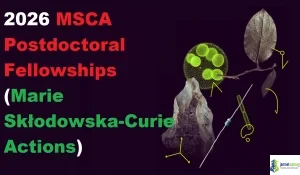
The 2026 Marie Skłodowska-Curie Actions (MSCA) Postdoctoral Fellowships, powered by Horizon Europe, is the gold standard for Research Innovation and career development. By providing comprehensive financial support and fostering excellence across all disciplines, MSCA ensures that brilliant minds can focus on solving global challenges. This is a premier choice for researchers who wish to acquire new skills, build international networks, and earn the prestigious “Seal of Excellence” in their field.
CLICK HERE TO APPLY
2026 MSCA Postdoctoral Fellowships Summary Table
| Detail | Value |
|---|---|
| Host Organization | European Commission (MSCA) |
| Target Audience | PhD Holders with <8 Years Research Experience |
| Primary Benefit | Living, Mobility, & Family Allowances + Research Costs |
| Program Type | Postdoctoral Research & Mobility Fellowship |
| Academic Record | PhD Degree & High-Impact Research Proposal |
| Application Deadline | September 2026 (Annual Call) |
About the MSCA Postdoctoral Fellowships 2026
The MSCA Postdoctoral Fellowships are more than just a salary; they are a strategic investment in the future of European and global science. The program offers two distinct pathways: the European Postdoctoral Fellowships, which facilitate movement within or into Europe, and the Global Postdoctoral Fellowships, which fund European researchers to spend time in non-associated third countries before returning to Europe.
These fellowships are open to all research areas, including those covered by the Euratom Research and Training Programme. A unique feature of the 2026 cycle is the continued emphasis on “building bridges” through non-academic placements of up to six months at the end of the fellowship. This allows researchers to gain experience in businesses, SMEs, or government agencies, significantly boosting their employability and contribution to Social Innovation.
Core Objectives of the Program
- To support the careers of researchers through international and interdisciplinary mobility
- To foster excellence in research by funding high-potential PhD holders
- To bridge the gap between the academic and non-academic sectors via specialized placements
- To provide comprehensive financial security through a dedicated allowance system
Career Impact and Professional Excellence
Receiving an MSCA Fellowship is a transformative career event. Fellows gain access to world-class Research Training, management experience, and international networking opportunities. Even those who are not funded due to budget constraints but score above 85% receive the “Seal of Excellence,” a powerful certificate that helps secure alternative national or regional funding. Within 2-3 years, MSCA fellows often transition into permanent faculty positions or senior leadership roles in the private sector.
Why Apply for MSCA in 2026?
The MSCA program is unique in its “Bottom-Up” approach—you choose the research topic, the host organization, and the supervisor. Unlike many grants that are restricted to specific fields, MSCA welcomes All Disciplines. Choosing this fellowship means you are supported by the European Research Executive Agency, ensuring your project is evaluated by top-tier international experts. It is the perfect environment for researchers looking to maximize their Scientific Impact while exploring new cultures and disciplines.
Benefits of the 2026 MSCA Postdoctoral Fellowships
- Monthly Living Allowance to cover personal expenses
- Mobility Allowance to assist with the costs of moving and settling abroad
- Family, Long-term Leave, and Special Needs Allowances (where applicable)
- Dedicated funding for research, training, and networking activities
- Additional support for a 6-month non-academic placement at the end of the term
Eligibility and Requirements
- Academic Degree: You must hold a PhD degree at the time of the call deadline
- Experience: Maximum of 8 years full-time research experience from the date of PhD award
- Mobility Rule: You must not have resided in the host country for >12 months in the last 3 years
- Nationality: Open to any nationality (European track); limited to EU/Associated residents (Global track)
- Resubmission: Restrictions apply for applications scoring below 80% the previous year
- Host: Must apply jointly with a host organization based in an EU Member State or Associated Country
Comprehensive List of Eligible Countries
A. EU Member States
Any of the 27 European Union countries can host both European Fellowships and the return phase of Global Fellowships:
- Austria,
- Belgium,
- Bulgaria,
- Croatia,
- Cyprus,
- Czech
- Republic,
- Denmark,
- Estonia,
- Finland,
- France,
- Germany,
- Greece,
- Hungary
- Ireland,
- Italy,
- Latvia,
- Lithuania,
- Luxembourg,
- Malta,
- Netherlands,
- Poland,
- Portugal,
- Romania,
- Slovakia,
- Slovenia,
- Spain,
- Sweden.
B. Horizon Europe Associated Countries
In addition to EU nations, countries formally associated with Horizon Europe can also act as hosts for European Fellowships and the return phase of Global Fellowships. Commonly associated countries include:
- Armenia,
- Georgia,
- Iceland,
- Israel,
- Kosovo,
- Moldova,
- Montenegro,
- North Macedonia,
- Norway,
- Serbia,
- Turkey,
- Ukraine,
- United Kingdom, among others.
(Note: Associated countries may vary; applicants should consult the official Horizon Europe Associated Countries list for the exact year’s updates).
C. Third Countries
For the outgoing phase of Global Fellowships, the host can be any other country in the world (e.g., the United States, Australia, Canada, Japan, Brazil, South Africa, etc.), provided it is not already an EU Member State or Associated Country.
Step by Step Application Guide for the 2026 MSCA Postdoctoral Fellowships
Phase 1: Self-Assessment and Host Identification
- Use the official self-assessment tool to verify you have less than 8 years of research experience
- Identify a host organization (university, SME, or research institute) via your network or Euraxess
- Ensure your host is based in an EU Member State or a Horizon Europe Associated Country
- Secure a supervisor at the host institution who will help you develop the joint proposal
Phase 2: Track Selection and Mobility Verification
- Choose between the European track (1-2 years) or the Global track (2-3 years with a return phase)
- Verify the “Mobility Rule” for your chosen country to ensure you are legally eligible
- If your research involves nuclear energy, ensure you meet the specific Euratom eligibility criteria
- Decide if you want to include a 6-month non-academic placement at the end of your fellowship
Phase 3: Proposal Development and Joint Drafting
- Draft your research proposal focusing on Excellence, Impact, and Implementation
- Work closely with your host’s administrative office to handle the “Management and Indirect Costs” section
- Ensure your proposal highlights how you will acquire new skills and develop your career
- If applying for the Global track, clearly outline the mandatory one-year return phase to Europe
Phase 4: Official Portal Submission
- Access the Funding and Tender Opportunities Portal to find the open 2026 call
- Complete the online application forms (Part A and Part B) with your supervisor
- Upload all required annexes, including your PhD evidence and mobility history
- Submit the application on behalf of the researcher before the September 2026 deadline
Phase 5: Evaluation and Result Monitoring
- Track your application via the European Research Executive Agency website
- If you receive a score of 85% or higher but no funding, download your Seal of Excellence
- Successful applicants will begin the recruitment and onboarding process with their host organization
- Prepare for your move and finalize your training and networking plan with your new supervisor
JamnetExpert Advice
- Use the SMART Method: Ensure your research goals are Specific, and your progress is Measurable through clear milestones in the Implementation section.
- Apply the STAR Technique: When describing your past achievements in the CV section, describe a Situation, the Task, the Action you took, and the successful Result.
- Main Focus: Emphasize the “Two-Way Knowledge Transfer”—how the host benefits from you and how you benefit from the host.
- Proactive Tip: Start your search for a host organization at least 6 months before the deadline; strong supervisor-fellow relationships lead to higher scores.
Deadline: September 2026 (Check Portal for Exact Date)
CLICK HERE TO APPLY
Frequently Asked Questions (FAQ) About the 2026 MSCA Postdoctoral Fellowships
1. Can I apply if I haven’t received my PhD diploma yet? Yes, as long as you have successfully defended your doctoral thesis by the application deadline.
2. What is the maximum research experience allowed? You must have a maximum of eight years of research experience from the date of your PhD award (breaks and non-research work are excluded).
3. What is the difference between European and Global Fellowships? European Fellowships are for moving into or within Europe (1-2 years), while Global Fellowships involve a phase outside Europe (1-2 years) plus a mandatory 1-year return to Europe.
4. What does the “Mobility Rule” mean? You cannot have lived or worked in the host country for more than 12 months in the 3 years before the deadline.
5. Does MSCA fund all research disciplines? Yes, MSCA uses a bottom-up approach and covers all disciplines, including social sciences and nuclear research (Euratom).
6. Is the “Seal of Excellence” useful if I don’t get the grant? Yes! It is a prestigious label that can help you secure funding from national or regional sources that recognize MSCA’s high standards.
7. Can I include a placement in a business? Absolutely. You can receive support for an additional placement of up to 6 months in a non-academic organization at the end of your fellowship.
8. Are resubmissions allowed? Starting in 2026, resubmission restrictions apply to applications that received a score below 80% in the previous year.
9. What kind of financial support is provided? The grant covers a living allowance, mobility allowance, and, if applicable, family, long-term leave, and special needs allowances.
10. Who actually submits the application? The application is submitted jointly by the researcher and the host organization, but the host organization is technically the applicant on the portal.