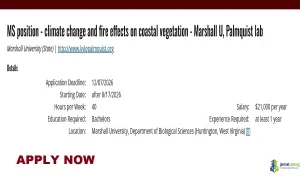
Applications are now open for the 2026 Marshall University MS Plant Ecology and Coastal Conservation Fellowship. This highly prestigious industry initiative is specifically designed to transform ambitious biology and environmental science graduates into elite plant ecology and conservation specialists through a structured and comprehensive development program.

Join our Telegram Channel for Instant Scholarship Updates
By joining this active academic community, successful candidates will learn how to turn complex biological observations into groundbreaking spatial models. This pathway provides the competitive stipend, full tuition coverage, and expert laboratory resources needed to excel in the competitive global higher education and ecological research sectors.
Marshall University MS Plant Ecology Position Summary Table
| Detail Category | Value Information |
|---|---|
| Host Organisation | Marshall University Department of Biological Sciences |
| Research Laboratory | Palmquist Lab |
| Primary Benefit | Twenty One Thousand Dollars Stipend and Full Tuition Waiver |
| Program Type | Funded Master of Science and Teaching Assistantship |
| Support Duration | Two Years of Guaranteed Funding |
| Application Deadline | December 7 2026 |
About 2026 Marshall University Masters Scholarship (Full Funding for Plant Ecology)
The Palmquist Lab at Marshall University represents a premier portal into world class ecological research and conservation science. Administered by the Department of Biological Sciences in Huntington, West Virginia, this competitive research group coordinates advanced investigations into how plant communities change across space and time. The lab is particularly interested in understanding how pattern and process in plant communities will be altered in the face of global environmental change, addressing critical ecological questions at large spatial scales to inform landscape conservation.
Prospective scholars joining this cohort become members of an elite intellectual community that values cross disciplinary innovation. Supported by funding from the Department of Biological Sciences, selected master of science candidatesconduct field data collection, analyze large observational datasets, and implement simulation modeling. For investigators looking to transition their academic insights into practical ecological restoration policies, this comprehensive framework offers an unparalleled launchpad.
Why This Program Boosts Your Future Career
Advancing your academic path with prestigious Graduate Climate Science Fellowships like the position hosted at Marshall University provides an exceptional foundation for your research aspirations. By participating in this funded Master of Science program, selected students transition from general biology graduates into highly skilled ecological scientists. Through hands on field data collection and the utilization of extensive spatial databases, you will master advanced methods in plant ecology, establishing yourself as a prime candidate for premium Coastal Conservation Academic Placements in the public and private sectors.
Additionally, this structured research track allows you to collaborate directly with federal and military stakeholders to design sustainable management solutions. By securing these competitive Forest Ecology Research Grants, you will investigate the long term effects of prescribed fire and storm events on sensitive coastal ecosystems. Gaining complete mastery of remote sensing applications and geographic information systems provides robust Quantitative Environmental Modeling Support to help you map complex plant community responses. This comprehensive training prepares you to secure senior conservation director roles, lead ecological consulting initiatives, and manage high impact environmental preservation projects globally.
Benefits of the 2026 Marshall University Masters Scholarship (Full Funding for Plant Ecology)
- Competitive Annual Stipend: Receive a secure payment of twenty one thousand dollars per year distributed across twelve months.
- Full Tuition Fee Waiver: Experience absolute peace of mind with your university tuition fees fully covered by the department.
- Guaranteed Multi Year Funding: Access two full years of financial support through a combination of research and teaching assistantships.
- Valuable Teaching Practice: Develop professional communication and instructional skills by serving as a teaching assistant within the department.
- World Class Field Sites: Gain hands on research experience at unique coastal locations such as Parris Island in South Carolina.
- Balanced Collaborative Culture: Join a supportive academic team that highly values work life balance and diverse personal backgrounds.
Eligibility for the 2026 Marshall University Masters Scholarship (Full Funding for Plant Ecology)
- Academic Qualifications: Candidates must hold a Bachelor of Science or equivalent degree in biology, ecology, environmental science, or a related quantitative discipline.
- Experience Requirements: Possess at least one year of relevant research, field work, or professional laboratory experience.
- Technical Competencies: Show a solid background in plant ecology or fire ecology, alongside strong quantitative and communication skills.
- Desirable Technical Exposure: Familiarity with remote sensing software, geographic information systems, or the flora of the southeastern United States is highly advantageous.
- Schedule and Commitment: Ability to dedicate forty hours per week to research tasks and teaching responsibilities starting after August 17 2026.
Required Documents for the 2026 Marshall University Masters Scholarship (Full Funding for Plant Ecology)
- Short Statement of Research Interests: A concise written essay describing your scientific interests and career goals, limited to a maximum of one page.
- Updated Professional Curriculum Vitae: A comprehensive academic resume highlighting your publications, coursework, and field experiences.
- Unofficial Grade Transcripts: Scanned copies of your university academic records to expedite the initial screening.
- Professional References Contact: Names, phone numbers, and active email details of three professional references who can verify your capabilities.
Five Phase Application Guide for the 2026 Marshall University Masters Scholarship (Full Funding for Plant Ecology)
Phase 1: Project Exploration and Portfolio Prep
- Research the publications of the Palmquist Lab to understand their work on temperate shrublands, wetlands, and forests.
- Gather your bachelor transcripts, draft a detailed resume, and identify three mentors who can provide strong recommendations.
- Draft a tailored statement of research interests that explains your passion for fire ecology and coastal plant communities.
- Save all your application materials as clear, high resolution PDF files on your primary device.
Phase 2: Email Submission to Dr Palmquist
- Draft a professional email addressed to the lead advisor, Dr Kyle Palmquist, at palmquist@marshall.edu.
- Use the exact subject line “MS position: coastal vegetation” followed by your full name.
- Attach your statement of research interests, curriculum vitae, and unofficial transcripts as clear PDF files.
- Submit your materials to begin the initial screening phase before the closing date.
Phase 3: Lab Fit Consultation
- Monitor your registered inbox closely for an invitation to discuss your graduate school goals.
- Participate in virtual discussions with Dr Kyle Palmquist to explore how your technical background aligns with the lab objectives.
- Revisit your previous geographic information systems or spatial mapping projects to explain your quantitative capabilities clearly.
Phase 4: Formal University Admission Submission
- If selected by the lab, access the official Marshall University graduate application portal.
- Create your applicant profile, upload your verified transcripts, and pay the required university fee.
- Submit your complete application to the Department of Biological Sciences before the deadline on December 7 2026.
Phase 5: Onboarding and Relocation
- Await your official admission and assistantship offer letter generated by the university board.
- Coordinate with the department to finalize your teaching assistant duties and class schedule.
- Prepare your relocation logistics to move to Huntington, West Virginia, before the program starts.
Success Strategies
- Highlight Spatial Analysis Skills: Clearly detail any academic or personal projects where you utilized remote sensing or geographic information systems, as these are highly valued by the recruitment team.
- Demonstrate Physical Stamina: Explicitly mention any prior experience conducting field work in challenging environments like wetlands, shrublands, or coastal dunes to prove your readiness for site sampling.
- Apply Well Ahead of December: Since applications are reviewed immediately on a rolling basis, submitting your files early maximizes your chances before the position is filled.
Common Mistakes To Avoid
- Exceeding the Statement Page Limit: Uploading a research statement longer than one page, which indicates poor editing skills and poor compliance with application guidelines.
- Omitting the Specific Subject Line: Sending your email application without the exact required subject phrasing, causing your portfolio to be missed by the hiring advisor.
- Failing to Verify References: Submitting contact details of recommenders without securing their permission, which leads to significant communication delays.
- Neglecting the Quantitative Focus: Focusing purely on descriptive plant observations while failing to highlight your mathematical, statistical, or database skills.
- Ignoring University Fee Obligations: Planning your budget without accounting for university fees, as the tuition waiver covers tuition costs but excludes student fee payments.
Deadline: December 7 2026
HOW TO APPLY
Interested students should apply by submitting the above mentioned documents to Dr. Kyle Palmquist (palmquist@marshall.edu)
Frequently Asked Questions About the 2026 Marshall University Masters Scholarship (Full Funding for Plant Ecology)
- What is the main objective of this MS research project? The successful candidate will explore the interacting effects of sea level rise, storm surge, and prescribed fire on coastal vegetation on Parris Island, South Carolina.
- Where is the position based? The academic and teaching assistant duties are based at Marshall University in Huntington, West Virginia, with field work conducted in South Carolina.
- What is the value of the annual stipend? Selected students receive a competitive stipend of twenty one thousand dollars per year.
- Does the fellowship cover university fees? No, the program offers a full tuition waiver, but the student is responsible for covering university fees.
- What is the deadline to apply for this MS position? The application system closes on December 7 2026.
- Is prior professional experience required? Candidates should possess a bachelor degree and at least one year of relevant experience in biology or ecological research.
- What are the expectations regarding teaching? The selected fellow will serve as a teaching assistant within the Department of Biological Sciences.
- Who should I contact regarding my application? Interested candidates should submit their materials directly to Dr Kyle Palmquist by emailing palmquist@marshall.edu.
- When does the research program officially commence? The position is available starting after August 17 2026.
- Is work life balance supported in the lab? Yes, the Palmquist Lab highly values and encourages work life balance, and strongly supports students from diverse backgrounds.