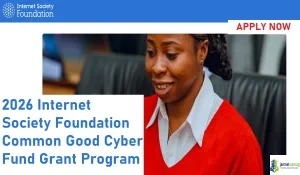
Applications are now open for the 2026 Common Good Cyber Fund Grant Program. Growing a secure digital infrastructure while protecting vulnerable communities from online threats is a major milestone that requires immense dedication.

Join our Telegram Channel for Instant Scholarship Updates
However, many creative nonprofit organizations and community builders face a massive financial hurdle when attempting to scale their operations, secure modern technical training, or maintain shared internet security systems. The Common Good Cyber Fund perfectly solves this problem. Designed to celebrate and empower organizations that champion equity and digital safety, this elite global initiative provides successful candidates with substantial multi year operating grants worth up to 300000 USD, letting you focus entirely on building a safer internet and defending civic space.
2026 Internet Society Foundation Common Good Cyber Fund Grant Program Summary Table
| Detail Category | Value Information |
|---|---|
| Host Organisations | Internet Society Foundation and Global Cyber Alliance |
| Target Audience | Nonprofit Cybersecurity Organizations across the Globe |
| Primary Benefit | Operating Grants up to 300,000 USD over Two Years |
| Program Type | Multi Year Operating Grants |
| Application Window | June 23 to August 4 2026 |
| Main Event Launch | Open Call Portal Access Launching June 2026 |
| Study Location | Global with Remote and Office Options |
| Application Deadline | August 4 2026 at 21:00 UTC |
About the 2026 Internet Society Foundation Common Good Cyber Fund Grant Program
The Common Good Cyber Fund grant is a premier professional development and funding pathway designed to support outstanding nonprofit organizations who drive positive change. Operating under a collaborative framework established in 2025, this joint scheme highlights the vital role that local practitioners play in protecting the shared security plumbing of the internet.
Unlike standard corporate grants that only focus on short term projects, this active program prioritizes organizations with a proven commitment to public interest cybersecurity, social equity, and community development. Implemented with the generous support of global partners, including Craig Newmark Philanthropies and the foreign ministries of the United Kingdom, Germany, Canada, and the Netherlands, the initiative ensures that these community builders can expand their outreach, optimize their technical tools, and build sustainable practices for a better world. By providing critical capital and resources, the program enables young leaders to formulate practical, financially viable, and implementation oriented projects that can engage public institutions, financial actors, and responsible private sector stakeholders.
Why This Program Boosts Your Organization
Winning a spot in this prestigious funding initiative is a massive milestone for any ambitious nonprofit, technical team, or advocacy network. Getting connected to advanced threat intelligence, cyber defense tools, and technical training makes your operations exceptionally competitive in the global digital economy. You will build deep operational resilience and refine your project plans from your very first day of funding.
Furthermore, being connected to an elite network of global experts gives you invaluable exposure to international funding structures and policy frameworks. This specialized training makes you exceptionally competitive for senior leadership roles. Completing this program establishes your brand reputation, elevates your community profile, and opens up rapid advancement pathways toward major international partnerships, global venture capital funding, and long term organizational success. It serves as an exceptional path for those interested in premium Graduate School Preparation Fellowships or searching for Paid Science Research Fellowships Abroad to advance their analytical skills.
Core Program Objectives of the 2026 Internet Society Foundation Common Good Cyber Fund Grant Program
The funding and support structure is designed as a multi phase development pathway to support deep project development and strategic international partnerships across three main objectives:
Objective 1: Maintenance of Critical Cybersecurity Infrastructure
This program objective supports the shared security plumbing of the internet. These are the technical services and operational capabilities that many organizations rely on, but few can fund on their own.
- Internet Infrastructure Protection: Support activities such as DNS security, routing security, secure defaults, and other widely deployed controls.
- Large Scale Threat Detection: Deliver threat analysis, including noncommercial threat intelligence that can be shared responsibly across networks.
- Response Enabling Services: Develop tools, coordination mechanisms, automation, and operational support to help others act faster.
- Open Systems Upkeep: Maintain and improve security relevant open systems where long term upkeep is the primary constraint.
Objective 2: Delivery of Scalable Support to Secure Internet Users from Digital Harm
This program objective funds capabilities that protect people and organizations facing persistent digital threats, including state directed cyber activity and digital transnational repression.
- Rapid Response and Incident Assistance: Provide account takeover recovery, device triage, and secure restoration workflows for civil society and independent media.
- Threat Informed Hardening: Design secure onboarding practices, including multi factor authentication, account recovery, backups, and secure communications tailored to real attacker tradecraft.
- Protective Service Delivery at Scale: Support managed help models, remote assistance clinics, and regional responder networks that handle volume without lowering quality.
- Privacy Preserving Coordination: Surface threat patterns and actionable indicators without exposing beneficiaries or partners, with special focus on addressing technology facilitated gender based violence.
Objective 3: Advancement of a Safer Internet for Vulnerable Groups and High Risk Communities
This program objective supports work that translates operational insight into safer outcomes for vulnerable groups and high risk communities, including civil society and journalists.
- Evidence Based Policy Work: Develop standards grounded in operational threat realities, aimed at concrete improvements in platform safeguards or security defaults.
- Vulnerability and Abuse Reporting: Create responsible coordination pathways to improve how threats are surfaced and mitigated without increasing exposure for targets.
- Norms and Coordination Mechanisms: Improve ecosystem response through incident coordination protocols, trusted escalation channels, and shared approaches to protecting at-risk groups.
Benefits of the 2026 Internet Society Foundation Common Good Cyber Fund Grant Program
- Substantial Financial Grants: Access multi year operating grants ranging from 100,000 to 300,000 USD to fund your organizational scaling and core project costs.
- Advanced Technical Training: Access specialized training programs covering digital security, threat modeling, and operational scaling.
- Valuable Data and Insights: Leverage expert data analytics and threat intelligence to understand security trends and optimize your defense strategies.
- Global Visibility and Promotion: Boost your public profile through custom features, spotlights, and brand promotion across major Internet Society Foundation platforms.
- No IELTS Exam Required: Organizations and staff members from any background can apply without paying for expensive English language tests.
- Prestigious Network Access: Connect with senior executives from the Global Cyber Alliance, global nonprofit directors, and a supportive community of peer digital defenders.
- Inclusive Goal Alignment: Align your work with the United Nations Sustainable Development Goals, boosting your corporate social responsibility credentials.
Eligibility and Requirements
- Nonprofit Status: Open to registered nonprofit organizations holding official US 501 c 3 status or its equivalent in their home country.
- Financial Compliance: The applicant organization must have an active, official bank account in their name capable of receiving funds from a foundation based in the United States.
- Ecosystem Capacity: Priority is given to organizations capable of ecosystem building, especially those based in the global majority, or those with the capacity to regrant to smaller local organizations.
- Gender Equity Track: Additional prioritization is offered to organizations demonstrating a clear history of addressing gender equity, including technology facilitated gender based violence.
- Language Capability: Demonstrate strong written and verbal English communication skills to participate in the grants management system and submit reporting documents.
- Time Commitment: Be fully prepared to dedicate several hours every week to manage grant requirements, coordinate implementation, and participate in progress reviews.
Required Documents Checklist
Before starting your application process on the grants management platform, ensure you have these files compiled and ready on your device:
- Current Operational Budget: A detailed breakdown of your organization current financial year spending and income.
- Tax Identification Document: Official proof of your tax registration or nonprofit exemption status.
- Governing Document: Scanned copies of your articles of incorporation, organization charter, or approved bylaws.
- Institutional Funders List: A comprehensive list of current institutional funders along with the specific funding amounts they provide.
- National Tax Returns: Certified copies of your national tax returns from the two most recent available fiscal years.
- Audited Financials: Certified audited financial statements from the two most recent available fiscal years.
- Equivalency Determination (Optional): Official US 501 c 3 equivalency determination document, if available.
Step by Step Application Guide
Phase 1: Portal Registration and Account Setup
- Navigate to the secure online grants management system known as Fluxx.
- Register a new candidate profile for your organization at least 24 hours before the application window deadline.
- Verify your profile by clicking the automatic activation link sent directly to your institutional email inbox.
- Log in to the Fluxx portal to access the active digital application form.
Phase 2: Budgeting and Financial Consolidation
- Gather your operational budgets, Tax ID documents, and list of institutional funders.
- Ensure your tax returns and audited financial statements from the two most recent fiscal years are saved as clean PDF files on your device.
- Review your financial documents to confirm they are readable, complete, and do not contain password locks.
Phase 3: Selection of Primary Objectives
- Review the three main program objectives of the Common Good Cyber Fund to identify your primary alignment area.
- Formulate a clear narrative explaining how your daily operations support the maintenance of critical infrastructure or secure vulnerable groups.
- Ensure you provide specific details, dates, and measurable impact metrics from your past projects.
Phase 4: Completing the Solution Narrative
- Log in to Fluxx and fill out all organizational and contact fields on the digital questionnaire with correct spelling.
- Enter your solution narrative, specifying your chosen objectives, and explaining how you plan to spend the grant funding to scale your impact.
- Double check your spelling and grammar to showcase your excellent communication and report writing skills.
Phase 5: Submission and Review Panel Evaluation
- Upload your certified budget documents, tax returns, governing charters, and funding lists in the designated upload fields.
- Review your entire application draft to confirm all details are accurate before clicking submit.
- Submit your complete application package before the strict deadline of August 4 2026 at 21:00 UTC, as no email submissions will be accepted.
- Monitor your registered email address regularly for updates regarding selection outcomes and external review nominations.
Why You Should Apply for This Opportunity
Taking part in this global grant program is a brilliant way to supercharge your organization profile and scale your social impact. Winning a joint award from respected brands like the Internet Society Foundation and the Global Cyber Alliance allows your company to build massive professional connections with international partners and corporate sponsors, which will prove highly valuable when expanding your operations. Furthermore, your leadership team will gain practical, hands on experience solving real world policy, technical, and financial challenges.
This exposure helps your profile stand out in the global market, opening doors to green investment and international export partnerships. It paves your way toward becoming a leading digital developer by exposing you to paid media opportunities and establishing your brand in international circles, making it a highly attractive alternative to standard training schemes.
Common Mistakes to Avoid During Your Application
- Registering on Fluxx Late: Do not wait until the final day to create your account. The system strictly requires organizations to register on the Fluxx portal at least 24 hours before the final deadline to prevent processing errors.
- Submitting Applications via Email: Avoid sending your proposal via email. The selection committee only reviews submissions completed and dispatched through the official online grants management system.
- Using a Generic Motivation Statement: Avoid writing vague descriptions. Provide specific numbers, dates, and examples of how your work has helped your local community build digital resilience.
- Failing to Upload Audited Financials: Ensure you provide audited financial statements for the two most recent fiscal years, as the screening system will instantly filter incomplete applications out.
- Waiting Until the Final Closing Hours: High web traffic near the August 4 2026 closing date can cause portal errors. Submit your profile early to ensure your application is processed smoothly.
Deadline: August 4 2026 at 21:00 UTC
Frequently Asked Questions
Q1: What is the main objective of the Common Good Cyber Fund?
The program aims to identify, celebrate, and support outstanding nonprofit organizations across the globe whose work strengthens the public interest cybersecurity ecosystem.
Q2: What is the value of the grant funding awarded to successful organizations?
Successful applicants typically receive multi year operating grants ranging from 100000 to 300000 USD to support their operations.
Q3: Who manages the grant application and selection process?
The Internet Society Foundation manages the grant applications and oversees the final selection of grantees, with the Global Cyber Alliance providing strategic advisory support.
Q4: Which organizations are eligible to apply for these awards?
The awards are open to registered nonprofit organizations worldwide whose work aligns with the program objectives and who provide cybersecurity services.
Q5: What is the application deadline for the 2026 cohort?
All completed online application forms and supporting documents must be submitted through the Fluxx portal on or before August 4 2026 at 21:00 UTC.
Q6: Can individual researchers or for profit companies apply?
No, the program is strictly designed for registered nonprofit organizations (US 501 c 3 or equivalent) focused on cybersecurity.
Q7: Are there specific language exam requirements to apply?
No, the application process does not require any English language test scores, but candidates must have excellent command of English to complete the forms.
Q8: What are the three main program objectives funded by the program?
The objectives are the maintenance of critical infrastructure, delivery of scalable support against digital harm, and the advancement of a safer internet for vulnerable groups.
Q9: What is the required timeline for registering on the Fluxx platform?
Applicants must successfully register their organization profile on the Fluxx platform at least 24 hours before the application window closes.
Q10: Will declined applicants receive individual feedback on their proposals?
Due to the extremely high volume of applications anticipated, the selection committee is unable to provide individual feedback on declined proposals.