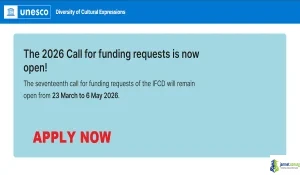
The global Creative Economy is a powerful driver of poverty reduction and social inclusion. The UNESCO 2026 Call for Funding Requests to the International Fund for Cultural Diversity (IFCD) is a landmark opportunity for developing nations to scale their cultural sectors.

Join our Telegram Channel for Instant Scholarship Updates
With a maximum grant of $100,000 per project, this 17th call aims to support initiatives that strengthen Cultural Entrepreneurship and facilitate access to new markets. Since 2010, the IFCD has invested over $13.6 million in 175 projects, reinforcing the participation of marginalized populations in the cultural life of 77 developing countries.
SECURE YOUR SPOT IN THE 2026 UNESCO IFCD FUNDING PROGRAM
Global 2026 UNESCO IFCD Call for Funding ($100,000 Grant) – Summary Table
| Detail | Value |
|---|---|
| Host Organization | UNESCO (IFCD) |
| Grant Amount | Up to $100,000 USD |
| Implementation Period | 12 to 24 Months |
| Focus Area | Cultural and Creative Sectors |
| Target Regions | Africa, Asia-Pacific, Latin America, Arab States |
| Eligibility | Public Institutions & Registered NGOs |
| Application Deadline | May 6, 2026 |
Global 2026 UNESCO IFCD Call for Funding ($100,000 Grant) – About the Initiative
The International Fund for Cultural Diversity (IFCD) is a multi-donor fund established under the 2005 Convention on the Protection and Promotion of the Diversity of Cultural Expressions. The 2026 initiative is designed to translate international normative instruments into concrete, local-level actions that foster dynamic cultural environments. The fund prioritizes projects that have a structural impact—meaning they don’t just provide a one-time event but rather build the Capacity Building frameworks and policies needed for a self-sustaining local market. By investing in the production and distribution of cultural goods, UNESCO aims to ensure that the diversity of cultural expressions remains protected in an increasingly digitalized global market.
Global 2026 UNESCO IFCD Call for Funding ($100,000 Grant) – Program Benefits
Winning projects receive significant resources and global validation from the United Nations system:
- Substantial Financial Grant: Access to up to $100,000 USD in non-dilutive funding to execute high-impact cultural projects.
- Structural Development: Support for the elaboration of policies that protect the local Creative Industry.
- Market Access: Funding specifically targeted at helping local cultural goods reach regional and international markets.
- Institutional Strengthening: Resources to train staff in public institutions and civil society organizations on sustainable cultural management.
- Global Recognition: Inclusion in a prestigious roster of 175+ successfully funded UNESCO projects.
- Network Expansion: Opportunities to connect with other cultural leaders across the 77 developing countries supported by the IFCD.
Global 2026 UNESCO IFCD Call for Funding ($100,000 Grant) – Eligibility Requirements
The IFCD 2026 call is highly specific regarding the types of organizations and projects it supports:
- Eligible Organizations: * Public authorities and institutions from developing countries that are Parties to the 2005 Convention.
- Non-governmental organizations (NGOs) registered in eligible developing countries.
- International non-governmental organizations (INGOs) registered in countries that are Parties to the 2005 Convention.
- Regional Eligibility: Must be based in an eligible country within Africa (e.g., Nigeria, Kenya, South Africa), Latin America/Caribbean, Asia-Pacific, Europe (select countries like Ukraine/Serbia), or Arab States.
- Project Scope: The proposal must demonstrate a direct impact on the creation, production, distribution, and access to cultural goods and services.
- Feasibility: Applicants must show high financial management capacity and a clear implementation roadmap for 12–24 months.
Global 2026 UNESCO IFCD Call for Funding ($100,000 Grant) – Step-by-Step Application Guide
Phase 1: Eligibility and Country Verification
- Check the List: Confirm that your country is a Party to the 2005 Convention and listed as an eligible developing nation.
- Entity Status: Ensure your NGO or institution is legally registered and has the mandate to operate in the cultural sector.
Phase 2: Project Conceptualization and Design
- Structural Impact: Design a project that moves beyond “one-off” festivals. Focus on Policy Advocacy or market infrastructure.
- Budgeting: Draft a detailed budget that does not exceed $100,000 and aligns with the 12–24 month implementation period.
Phase 3: Online Application Submission
- Portal Registration: Access the UNESCO IFCD online application platform.
- Upload Requirements: Prepare your project proposal, budget breakdown, and organizational proof of registration in the required languages (English or French).
Phase 4: Technical Evaluation and Peer Review
- Relevance Check: Applications are initially screened for administrative compliance.
- Panel Review: A panel of international experts evaluates the proposal based on feasibility and expected socio-economic results.
Phase 5: National Commission and Final Approval
- National Endorsement: In many cases, applications are reviewed by National Commissions for UNESCO in the respective countries.
- Notification: Successful applicants will be notified and enter the contract phase for the disbursement of funds.
Jamnet.com.ng Expert Advice for Applicants
- Focus on “Structural Change”: UNESCO prefers projects that change the “rules of the game” (e.g., creating a new copyright law or a national music distribution system) over simple workshops.
- Demonstrate Financial Maturity: Since the grant is large ($100,000), your organization must prove it has handled similar Financial Management responsibilities in the past.
- Align with the 2005 Convention: Read the objectives of the 2005 Convention. Use their terminology (e.g., “Diversity of Cultural Expressions”) to show your project fits the global mission.
- Sustainability Plan: Clearly explain how the project will continue to function once the UNESCO funding ends after 24 months.
CLICK HERE TO APPLY
Global 2026 UNESCO IFCD Call for Funding ($100,000 Grant) – Frequently Asked Questions (FAQ)
Q1: What is the maximum amount I can request from the IFCD? The maximum funding request per project is $100,000 USD.
Q2: Can an individual artist apply for this funding? No, the IFCD only funds public institutions, NGOs, and INGOs. Individuals are not eligible.
Q3: How long should the project last? The implementation period must be between a minimum of 12 months and a maximum of 24 months.
Q4: Which countries in Africa are eligible for the 2026 call? Eligible countries include Nigeria, Kenya, Ethiopia, Ghana, South Africa, Senegal, Rwanda, and many others listed in the IFCD registry.
Q5: Is the application available in languages other than English? Applications can be submitted in either English or French, which are the working languages of the UNESCO Secretariat.
Q6: What does “structural impact” mean? It refers to projects that create lasting change in the cultural infrastructure, such as new laws, market systems, or institutional capacities.
Q7: Can an NGO from a developed country apply? Only if they are an International Non-Governmental Organization (INGO) with a project that specifically benefits developing countries that are Parties to the Convention.
Q8: When is the final deadline for the 17th call? The application deadline is May 6, 2026.
Q9: Does UNESCO provide feedback on rejected applications? Due to the high volume of requests, UNESCO typically only contacts shortlisted and successful candidates.
Q10: What are the main criteria for evaluation? Projects are judged on relevance to the 2005 Convention, feasibility, financial management capacity, and the sustainability of results.