Securing sustainable funding for advanced social science research in East Africa is a complex challenge, often complicated by the personal financial pressures of Debt Consolidation Loans that many early-career scholars face. For postdoctoral researchers, the transition from thesis defense to independent fieldwork requires significant Asset Planning and capital that traditional university stipends rarely cover. Without dedicated fieldwork support, innovative projects on food systems risk Business Interruption due to a lack of mobility and institutional backing.

Join our Telegram Channel for Instant Scholarship Updates
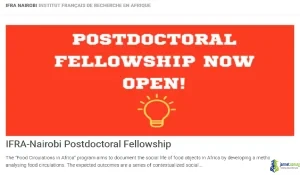
The 2026 IFRA-Nairobi Food Circulations in Africa Postdoctoral Fellowship, powered by the Institut Français de Recherche en Afrique, is a dedicated academic support program designed to advance interdisciplinary food studies. By providing a monthly fieldwork grant and professional research integration, IFRA ensures that brilliant scholars can focus on documenting the social biographies of food rather than their Personal Loan Refinancing options.
IFRA-Nairobi Fellowship Summary Table
| Detail | Value |
|---|---|
| Host Organization | IFRA-Nairobi |
| Target Audience | Postdoctoral Researchers (Social Sciences/Humanities) |
| Primary Benefit | 800 Euros Monthly Fieldwork Grant |
| Program Type | Research Fellowship (3–6 Months) |
| Gender Focus | Equal Opportunity (All qualified PhD holders) |
| Application Deadline | June 26, 2026 |
About the 2026 IFRA Nairobi Postdoctoral Fellowship (Food Circulations in Africa)
The IFRA-Nairobi Food Circulations in Africa fellowship is more than just a grant; it is an intellectual invitation to re-examine the movement of food objects across East African borders. In an era where global supply chains face constant threats, understanding the “biographies” of food—from its cultural heritage to its political economy—is vital for regional Risk Management Compliance. This initiative supports researchers who “follow the thing,” tracing how food objects navigate social, economic, and geographical spaces in Kenya, Uganda, Tanzania, and beyond.
Benefits of the IFRA Nairobi Fellowship 2026
- Financial Fieldwork Support: A monthly grant of 800 Euros to facilitate travel, interviews, and data collection.
- Academic Integration: Direct affiliation with IFRA-Nairobi and its network of international scholars.
- Research Visibility: Opportunities to contribute to regional and international academic discussions and publications.
- Methodological Training: Guidance on “Follow the Thing” and spatial biography methodologies to avoid Business Interruption Insurance issues in research design.
- Regional Networking: Connections with peers in Rwanda, Burundi, and the DRC to strengthen East African academic ties.
Eligibility & Requirements for the 2026 IFRA Nairobi Postdoctoral Fellowship (Food Circulations in Africa)
- Academic Record: Must have defended a PhD in social sciences or humanities after January 1, 2020.
- Residency Requirement: Applicants must currently reside in an East African country (Kenya, Uganda, Tanzania, Rwanda, Burundi, or Eastern DRC).
- Age Limit: Applicants must be under 45 years old.
- Disciplinary Focus: Research must fall under Geography, Anthropology, Political Science, History, or related fields.
- Compliance: Must adhere to ethical Risk Management Compliance protocols for human-subject research.
Step-by-Step Application Guide for 2026 IFRA-Nairobi Postdoctoral Fellowship (Food Circulations in Africa)
Phase 1: Research Conceptualization and Proposal
- Draft a detailed research proposal (max 3 pages) focusing on food mobility or “Follow the Thing” methodologies.
- Ensure your methodology accounts for local Risk Management and fieldwork logistics in East Africa.
- Prepare the proposal in both PDF and Word formats as required.
Phase 2: Documentation Assembly
- Update your Curriculum Vitae (CV) to include all publications and research experience post-PhD.
- Draft a 2-page cover letter that includes a 15–20 line summary of your project.
- Clearly mention any other Financial Services or institutional support you are receiving.
Phase 3: Supervisor and Institutional Verification
- Contact your Master’s or PhD supervisors to confirm their contact information for the application.
- Align your research timeline (3 to 6 months) with the academic calendar of 2026.
- Review your proposal to ensure it meets the spatial biography focus of the IFRA-Nairobi mandate.
Phase 4: Quality Control and Formatting
- Convert your Cover Letter and CV into PDF format.
- Check that your Research Proposal is available in both Word and PDF.
- Verify that all documents mention your current residency in East Africa.
Phase 5: Email Submission
- Send your complete application package via email to info@ifra-nairobi.net.
- Ensure the subject line clearly identifies the “Food Circulations Postdoctoral Fellowship.”
- Submit before the hard deadline of June 26, 2026.
Jamnet Expert Advice (STAR/SMART Methods)
- Use the SMART Method: Ensure your fieldwork timeline is Specific to your chosen location and Time-bound within the 3–6 month fellowship window.
- Apply the STAR Technique: In your cover letter, describe a Situation where your previous research faced a Task (challenge), the Action you took using social science methods, and the Result (publication or impact).
- Emphasis: Focus heavily on the “biography” of a specific food object—the more unique your focus, the more you stand out to the selection committee.
- Proactive Tip: Start your proposal by April. High-quality ethnographic research requires rigorous Asset Planning to ensure your 800 Euro stipend covers all fieldwork contingencies.
Deadline: June 26, 2026
HOW TO APPLY
Applications should be submitted via email to: info@ifra-nairobi.net
Frequently Asked Questions (FAQ) About the 2026 IFRA-Nairobi Postdoctoral Fellowship (Food Circulations in Africa)
1. Can I apply if I live in West Africa? No, you must reside in one of the specified East African countries (Kenya, Uganda, Tanzania, Rwanda, Burundi, or Eastern DRC).
2. Is the €800 grant separate from a salary? It is intended specifically as a fieldwork grant to cover research expenses.
3. I defended my PhD in 2019, am I eligible? No, eligibility is restricted to those who defended after January 1, 2020.
4. What disciplines are preferred? Anthropology, Geography, History, and Political Science are prioritized.
5. Can the fellowship help with my Debt Consolidation Loans? While the grant is for research, the fellowship enhances your career profile, making you eligible for higher-tier academic roles to manage your personal finances.
6. Do I need to be a French citizen? No, the program is open to African researchers residing in the East African region.
7. Is there a specific format for the bibliography? Use a standard academic format (APA or Harvard) and ensure it is included in your 3-page proposal.
8. What is “Follow the Thing” methodology? It is a research approach that traces the global or regional movement and social life of a specific commodity or object.
9. Can I use the grant for Personal Loan Refinancing? No, the funds are strictly monitored for Risk Management Compliance and fieldwork-related activities.
10. Who do I contact for technical issues? All inquiries should be directed to info@ifra-nairobi.net.