For many scholars in the Global South, the academic world often feels dominated by colonial and Eurocentric frameworks that ignore local wisdom and history. Breaking through these structural inequities is difficult because access to international scholarly exchange and structured research is often limited by geography and funding. Without a dedicated platform for South-to-South Epistemological Experimentation, many transformative ideas in the humanities remain on the fringes of global academic debate.

Join our Telegram Channel for Instant Scholarship Updates
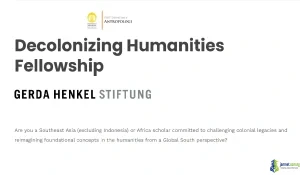
The 2026 Decolonizing Humanities Fellowship, hosted by Universitas Indonesia (UI) and supported by Gerda Henkel Stiftung, is a bold initiative designed to change this. This fellowship provides a world-class environment for African and Southeast Asian scholars to challenge colonial legacies and reimagine foundational concepts in the humanities. By providing a Monthly Stipend, child support grants, and international travel reimbursement, the program ensures that researchers can focus entirely on leading conceptual interventions that advance Educational Equity and global knowledge.
2026 Decolonizing Humanities Fellowship Summary Table
| Detail | Value |
|---|---|
| Host Institution | Universitas Indonesia (UI) |
| Supporting Partner | Gerda Henkel Stiftung |
| Target Audience | African & SE Asian Scholars (Excl. Indonesia) |
| Primary Benefit | Monthly Stipend & Child Support Grants |
| Program Type | Research Fellowship & Residency |
| Focus Area | Decolonizing Humanities |
| Application Deadline | April 30 2026 |
About the Initiative 2026
The Decolonizing Humanities Fellowship is a critical response to the persistent dominance of Western frameworks in global scholarship. Based in the Department of Anthropology at Universitas Indonesia, the program acts as a technical hub for scholars committed to Decolonial Scholarship. Fellows are integrated into the academic life of UI, delivering colloquiums and collaborating on interdisciplinary research projects. This initiative is explicitly designed to counter structural limitations by mainstreaming Global South perspectives through academic journals, digital media, and public events.
Core Objectives of the Program
- To challenge colonial legacies and reimagine foundational humanities concepts
- To foster South-to-South collaboration among African and Southeast Asian scholars
- To produce high-quality working papers and collaborative research projects
Benefits of the 2026 Decolonizing Humanities Fellowship
- Monthly Stipend: A regular allowance to cover all living costs in Indonesia
- Travel Support: Reimbursement for international flights to and from Indonesia
- Family Support: Grant support for the first child and each additional child under 18
- Research Materials: Reimbursement for necessary research supplies and materials
- Administrative Support: Full assistance with visa fees and research stay permits
- Academic Integration: Opportunity to deliver guest lectures and lead course seminars
Eligibility and Requirements for the 2026 Decolonizing Humanities Fellowship
- Region: Open to scholars from Africa or Southeast Asia (excluding Indonesia)
- Mission: Must be committed to challenging colonial legacies from a Global South perspective
- Academic Output: Ability to produce at least one working paper draft by the end of the program
- Collaboration: Willingness to work in interdisciplinary teams and engage with UI students
- Communication: Ability to share insights through academic journals and digital media
- Residency: Must be available to stay in Indonesia for the full duration of the fellowship
Step-by-Step Application Guide for the 2026 Decolonizing Humanities Fellowship
Phase 1: Research Proposal Development
- Draft a concise Research Proposal (maximum 5 pages) outlining your project
- Clearly define your research objectives, key questions, and methodological approach
- Explain how your project contributes to “Decolonizing Humanities” and Global South scholarship
- List your expected scholarly outputs, such as working papers or teaching modules
Phase 2: Document Preparation
- Update your Curriculum Vitae (CV) to include your current institutional affiliation
- Detail your research experience, publications, and relevant academic activities in the CV
- Select a recent publication or manuscript to serve as an optional (but encouraged) Writing Sample
- Ensure all documents are saved in a professional PDF format
Phase 3: Email Submission Process
- Combine all your application materials (CV, Proposal, Writing Sample) into a single email
- Use the mandatory subject line: Application – Decolonizing Humanities Fellowship – [Your Full Name]
- Address the email to the official coordinator: maria.rosari11@ui.ac.id
- Double-check that you have met the April 30 2026 deadline for submission
Phase 4: Interview and Selection
- Shortlisted applicants may be invited to a virtual interview with the UI faculty
- Be prepared to discuss your epistemological framework and your plan for collaborative research
- Ensure you can explain how your work addresses “Structural Inequities” in the humanities
- Monitor your email for updates from the Department of Anthropology at Universitas Indonesia
Phase 5: Fellowship Integration
- Once selected, begin the visa and research permit process with UI’s administrative support
- Plan your travel to Indonesia to attend the first closed colloquium in month one
- Prepare to integrate into host department courses through seminars and workshops
- Start collaborating with peers to design projects that challenge Eurocentric frameworks
Jamnet Expert Advice
- Use the SMART Method: Be Specific about your decolonial intervention, ensure your outputs are Measurable, and keep your proposal Relevant to the Global South.
- Apply the STAR Technique: When describing your research background, talk about the Situation of colonial dominance you noticed, the Task you set, the Action you took, and the Resulting academic impact.
- Key Emphasis: Focus heavily on “South-to-South Epistemological Experimentation”—the foundation wants to see how you connect Africa and Southeast Asia.
- Proactive Tip: Ensure your research proposal clearly links to the “Foundational Concepts” of the humanities; judges look for deep theoretical reimagining.
Deadline: April 30 2026
HOW TO APPLY
Applicants are required to submit their application materials via email to maria.rosari11@ui.ac.id with the subject line: Application – Decolonizing Humanities Fellowship – Full Name
Frequently Asked Questions (FAQ) About the 2026 Decolonizing Humanities Fellowship
- Can Indonesian scholars apply? No, the fellowship is specifically for scholars from other Southeast Asian countries and Africa.
- Is there an age limit? No, the program is open to scholars at various stages of their academic careers.
- What does the child grant cover? It provides additional financial support for the fellow’s children under the age of 18.
- Do I need to speak Indonesian (Bahasa)? While helpful for daily life, the primary focus is on scholarly exchange in the humanities.
- Is the flight cost paid upfront? No, travel costs for international flights are reimbursed up to a specific limit.
- What is a “Colloquium”? It is a formal academic meeting where you present your research to faculty and peers for discussion.
- How many papers must I write? You are expected to produce at least one working paper draft by the end of the fellowship.
- Can I apply if I work in a different field? The fellowship is for the Humanities, specifically those who can engage with the Department of Anthropology.
- Who supports the funding? The program is supported by the Gerda Henkel Stiftung.
- How do I submit my writing sample? You should include it as part of your single email submission to the provided email address.