Securing a high impact postdoctoral research position is a major milestone for early career scientists aiming to establish themselves as leaders in evolutionary biology and wildlife conservation. For many doctoral graduates, finding a fellowship that offers both state of the art laboratory resources and direct, multi institutional mentoring is a persistent struggle. Navigating the competitive landscape of genomics research grants can be incredibly tough without a structured project that connects academic research directly with major conservation agencies.

Join our Telegram Channel for Instant Scholarship Updates
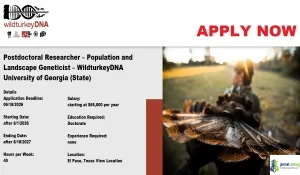
The 2026 Wild Turkey DNA Postdoctoral Fellowship, hosted by the University of Texas El Paso and the University of Georgia, is a dedicated scientific support initiative designed to cultivate world class researchers. By providing a competitive starting salary of sixty five thousand dollars per year and full employee benefits, this fellowship ensures that passionate geneticists can focus entirely on managing massive genomic datasets and modeling wildlife population structures without financial worry.
2026 University of Georgia Postdoctoral Fellowship Summary Table
| Detail | Value |
|---|---|
| Host Organization | University of Texas at El Paso and University of Georgia |
| Target Audience | Doctorate Degree Holders in Genetics or Ecology |
| Primary Benefit | Starting Salary of Sixty Five Thousand Dollars per Year |
| Program Type | Postdoctoral Research Fellowship |
| Gender Focus | All Genders Welcome |
| Application Deadline | Open Until Filled |
About the 2026 University of Georgia Postdoctoral Fellowship
The Wild Turkey DNA Postdoctoral Fellowship represents far more than a basic academic appointment; it serves as a premier launchpad for bioinformatics research careers and global land stewardship. Launched as a collaborative partnership in 2025, the project connects the Lavretsky Lab at UTEP, the Wild Turkey Lab at UGA, and leading conservation groups such as Ducks Unlimited and the Low Country Game Bird Foundation. Selected fellows will lead the scientific execution of the largest and most comprehensive genetic dataset ever collected for wild turkeys. Based at the UTEP campus in El Paso, Texas, the researcher will manage genomic sequencing pipelines, conduct advanced spatial modeling, and write high impact papers that directly guide national wildlife management policies.
Core Objectives of the Program
- To support doctoral graduates by providing competitive wildlife ecology fellowships and professional project resources.
- To evaluate population structure, standing genetic diversity, and translocation hybridization levels across multiple wild turkey subspecies.
- To foster collaborative research by co designing genomics pipelines and mentoring undergraduate and graduate science students.
Benefits of the 2026 University of Georgia Postdoctoral Fellowship
- A competitive starting salary of sixty five thousand dollars per year with full employee benefits.
- Direct and comprehensive coverage of all travel expenses for periodic research trips to Athens, Georgia.
- Full access to high performance computing clusters and genomic sequencing facilities at UTEP.
- Direct mentoring from internationally recognized principal investigators Dr. Philip Lavretsky and Dr. Michael Chamberlain.
- Outstanding opportunities to coauthor multiple peer reviewed publications in top tier evolutionary biology journals.
- Valuable professional networking with state and federal wildlife agencies and non governmental conservation groups.
Eligibility and Requirements of the 2026 University of Georgia Postdoctoral Fellowship
- Educational Level: You must hold a completed PhD in genetics, conservation genetics, or a closely related STEM discipline.
- Technical Skills: Proven experience in managing large genomic datasets and using bioinformatic pipelines is mandatory.
- Software Literacy: Familiarity with population processing tools such as ADMIXTURE, vcftools, bcftools, and Plink is required.
- Teamwork Ability: Strong communication and organizational skills to coordinate day to day research tasks across multiple universities.
- Preferred Qualifications: A solid understanding of landscape ecology, quantitative spatial modeling, and public scientific communication.
- Legal Status: Employment is subject to a standard background check and verification of legal eligibility to work in the United States.
Step by Step Application Guide for the 2026 University of Georgia Postdoctoral Fellowship
Phase 1: Research Project and Lab Group Review
- Visit the official Wild Turkey DNA platform to study the active research goals and current datasets.
- Review recent scientific publications from the Lavretsky Lab at UTEP and the Wild Turkey Lab at UGA.
- Assess how your doctoral research in bioinformatics or wildlife genomics aligns with population structure analysis.
- Confirm that you can relocate to El Paso, Texas, and are available for periodic travel to Athens, Georgia.
Phase 2: Compiling Your Academic and Research Portfolio
- Update your Curriculum Vitae to highlight your peer reviewed publications, programming proficiency, and lab skills.
- Select writing samples or published manuscripts that demonstrate your ability to manage large genomic datasets.
- Gather official contact information, including emails and telephone numbers, for three professional references.
- Save all your personal application materials as separate, high quality PDF files.
Phase 3: Drafting the Tailored Cover Letter
- Write a professional cover letter explaining your specific interest in the Wild Turkey DNA project.
- Detail your experience with bioinformatics software such as Plink, ADMIXTURE, and vcftools.
- Outline your interest in mentoring undergraduate students and communicating scientific findings to the public.
- Proofread the letter carefully to make sure the English is simple, engaging, and completely hyphen free.
Phase 4: Emailing the Dual Selection Panel
- Open a new email addressed to both plavretsky@utep.edu and mchamb@uga.edu.
- Use the precise email subject line Wild Turkey Postdoc Application to ensure rapid routing.
- Attach your cover letter, updated resume or CV, and reference list as separate PDF documents.
- Submit your completed package early, as applications are reviewed on a rolling basis until the position is filled.
Phase 5: Interview and Onboarding Preparation
- Save copies of your submitted application and write down notes on your preferred research topics.
- Monitor your email inbox regularly for invitations to present a virtual seminar on your previous work.
- Research UTEP employee benefits, housing options in El Paso, and travel guidelines for Georgia.
- Prepare to begin your full time postdoctoral research appointment shortly after receiving your official offer letter.
Jamnet Expert Advice (STAR/SMART Methods)
- Use the SMART Method: Be Specific about the genetic markers you want to map, ensure your bioinformatic workflows are Measurable, and keep your goals Relevant to wild turkey conservation.
- Apply the STAR Technique: In your cover letter and interview, describe a challenging genomic processing Situation, the specific analytical Task, the Action you took in Python or R, and the positive Result.
- Emphasis: Focus heavily on demonstrating your ability to communicate complex science to both academic peers and the general public through popular media.
- Proactive Tip: Highlight any experience you have working with non governmental organizations or state agencies, as the project steering committee places immense value on collaborative conservation relationships.
Deadline: Open Until Filled (Apply as Early as Possible)
HOW TO APPLY
Email a cover letter, current resume or CV, and contact information for 3 references to both Dr. Philip Lavretsky (plavretsky@utep.edu) and Dr. Michael Chamberlain (mchamb@uga.edu).
Frequently Asked Questions (FAQ) About the Postdoc Fellowship
- What is the starting salary for this position? The position offers a starting salary of sixty five thousand dollars per year plus full benefits.
- Where is the primary location of the researcher? The fellow will be located in El Paso, Texas, and housed at the UTEP Department of Biological Sciences.
- Is travel to Georgia required? Yes periodic travel to Athens, Georgia will be required, and all travel expenses are fully covered by the project.
- What is the duration of the fellowship? The position is evaluated annually with the potential for up to three years of total funding.
- What are the key technical software requirements? Experience with genomics software such as ADMIXTURE, Plink, vcftools, and bcftools is highly required.
- Do I need prior experience with wild turkeys to apply? No but a strong understanding of landscape ecology, wildlife biology, and quantitative modeling is preferred.
- Who are the primary mentors for this fellowship? The fellow will be mentored by Dr. Philip Lavretsky at UTEP and co mentored by Dr. Michael Chamberlain at UGA.
- Are there teaching or mentoring duties? The fellow will have ample opportunity to mentor undergraduate and graduate students as part of the Lavretsky Lab.
- What organizations partner on this project? Partners include UTEP, UGA, the National Wild Turkey Federation, Ducks Unlimited, and the Low Country Game Bird Foundation.
- How do I submit my application? You must email your cover letter, resume or CV, and three references to both PIs at their provided university email addresses.