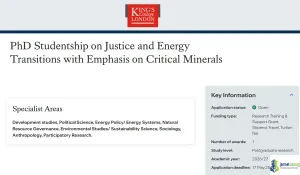
Global energy transitions are often discussed in boardrooms and policy papers, yet the community experiences and the “justice” of extracting critical minerals are frequently overlooked. For researchers passionate about social justice and environmental governance, finding a doctoral program that provides both world-class academic standing and deep, bottom-up community engagement is a rare challenge. Many talented scholars from the Global South and North alike find it difficult to secure full funding that supports interpretive, ethnographic research in the extractive sector.

Join our Telegram Channel for Instant Scholarship Updates
The 2026 King’s College London PhD Studentship on Justice and Energy Transitions is a prestigious solution to this gap. As part of the UKRI Future Leaders Fellowship, this fully funded position offers an exceptional £23,805 annual stipend and a research allowance. Hosted by the world-renowned African Leadership Centre (ALC) at KCL, the successful candidate will have the flexibility to shape their research on global energy transitions, with a particular focus on the lived experiences of communities in regions like Ghana, Chile, or Australia.
CLICK HERE TO APPLY
2026 King’s College London PhD Studentship Summary Table
| Detail | Value |
|---|---|
| Host Institution | King’s College London (KCL) |
| Research Hub | African Leadership Centre (ALC) |
| Target Audience | PhD Candidates (Master’s holders) |
| Primary Benefit | £23,805 Annual Stipend + Tuition |
| Research Theme | Justice, Critical Minerals, & Energy Transitions |
| Geographic Focus | Global (Preference for Ghana, Chile, Australia) |
| Application Deadline | May 17, 2026 |
About the Initiative 2026
This PhD studentship is integrated into the broader UKRI Future Leaders Fellowship project titled “Justice in Critical Minerals Governance and Energy Transitions.” The program aims to move beyond formal policy processes to foreground the “bottom-up” knowledge production of communities affected by mineral extraction. By joining the African Leadership Centre (ALC), the scholar becomes part of a globally recognized hub for leadership, security, and development research. The project encourages the use of interpretive and ethnographic methodologies to decode the symbols, narratives, and “silences” within global extractive politics.
Core Objectives of the Program
- To produce African-led and globally relevant knowledge on energy justice
- To analyze the impact of critical mineral extraction on local community governance
- To develop innovative, participatory methodologies for environmental research
Benefits of the 2026 King’s College London Studentship
- Competitive Annual Stipend: £23,805 per year (paid at the standard UKRI rate).
- Tuition Fees: Full coverage of £8,000 per year (adjusted for inflation).
- Research Allowance: £1,350 per year to support fieldwork and data collection.
- Academic Excellence: Access to King’s College London’s world-leading methodological training.
- Global Network: Integration into the ALC’s vibrant scholarly community and the UKRI fellowship network.
- Fieldwork Support: Opportunities for co-creation methodologies in global extractive regions.
Eligibility and Requirements for the KCL PhD Studentship
- Education: A completed (or near completion) Master’s degree in a relevant field (International Development, Geography, Law, Sociology, etc.).
- Research Interest: Strong focus on interpretive or community-centered research (ethnography, narrative analysis).
- Technical Skills: Proficiency in qualitative software like NVivo, Atlas.ti, or MAXQDA to code diverse data forms.
- Thematic Interest: Demonstrated passion for natural resource governance or extractive politics.
- Methodology: Potential to work with participatory or co-creation research designs.
- Communication: Excellent written and verbal communication skills (Desirable).
Step-by-Step Application Guide for the 2026 KCL PhD Studentship
Phase 1: Research Proposal Development
- Draft a detailed research proposal (3,000–5,000 words).
- Align your focus with the themes of justice, critical minerals, or socio-environmental transitions.
- While the study is global, consider comparative studies involving Ghana, Chile, or Australia for a stronger application.
- Clearly explain how you will use “bottom-up” or participatory methodologies.
Phase 2: Document Preparation
- Update your CV (strictly maximum 2 pages).
- Write a Cover Letter (1–2 pages) explaining your specific alignment with the UKRI project.
- Request your Academic Transcripts from your previous universities.
- Secure Two References, ensuring at least one is academic and can speak to your research potential.
Phase 3: Application Submission
- Ensure all files are in PDF format for professional presentation.
- Submit your full application package via the official King’s College London portal.
- Double-check that your research proposal reflects the “interpretive” approach requested by the ALC.
- Submit all materials before the deadline of May 17, 2026.
Phase 4: Interview and Video Submission (If applicable)
- Shortlisted candidates will be invited to discuss their research proposal with the Fellowship team.
- Be prepared to explain your experience with qualitative coding and ethnographic fieldnotes.
- Highlight any previous fieldwork experience in Africa, Latin America, or Australia.
- Join the Scholarship Region WhatsApp groups for updates on KCL selection timelines.
Phase 5: Enrollment and Research Commencement
- Successful applicants will receive an offer by late July 2026.
- Coordinate with the KCL international office for visa sponsorship (if applicable).
- Begin your doctoral journey as part of the 2026/2027 academic cohort.
Jamnet Expert Advice
- Use the SMART Method: Ensure your research proposal goals are Specific to critical minerals and the results are Measurable through qualitative data.
- Apply the STAR Technique: In your cover letter, describe a Situation where you conducted fieldwork or handled complex data, the Task, your Action, and the Result.
- Key Emphasis: Focus on “Bottom-up Knowledge”—KCL is specifically looking for scholars who can foreground voices often absent from formal policy.
- Proactive Tip: Familiarize yourself with the recent publications of the African Leadership Centre to ensure your proposal “speaks” to their current research culture.
Deadline: May 17, 2026
CLICK HERE TO APPLY
Frequently Asked Questions (FAQ)
- Do I need to be African to apply? No, the program is open to ambitious applicants of any nationality, though it is hosted at the African Leadership Centre.
- Is the stipend paid monthly? Yes, the £23,805 annual stipend is typically divided into monthly or quarterly installments at the UKRI rate.
- What is the research allowance for? It is intended to cover costs like fieldwork travel, software licenses, and research-related materials.
- Can I choose a country other than Ghana, Chile, or Australia? Yes, the project has global appeal, but these three are “favourably looked upon” for comparative reasons.
- Is the tuition fee covered for international students? The award specifies a tuition fee of £8,000; candidates should clarify if this covers the full international rate or the home rate.
- How long should the research proposal be? It must be between 3,000 and 5,000 words.
- Do I need to know how to use NVivo? Yes, experience with qualitative analysis software (NVivo, Atlas.ti, or MAXQDA) is an essential requirement.
- Is this scholarship for Master’s students? No, this is a PhD studentship for candidates who have already completed or are finishing a Master’s.
- When does the program start? The intake is for the 2026/2027 academic year.
- What is the application deadline? All materials must be submitted by May 17, 2026.