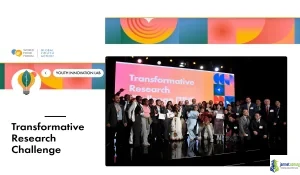
Turning a laboratory breakthrough into a scalable field solution requires more than just good data—it requires a strategic pathway to impact. The 2026 WFF Transformative Research Challenge (TRC) is a premier global competition designed to bridge the gap between “it works in the lab” and “it is ready to pilot.”
Join our Telegram Channel for Instant Scholarship Updates
By offering Biotechnology Research Grants and direct access to the FAO headquarters in Rome, the TRC empowers young innovators to transform the global agrifood system through evidence-based excellence and Sustainable Agriculture Consulting frameworks.
CLICK HERE TO CLAIM YOUR GLOBAL RESEARCH RECOGNITION NOW
2026 WFF TRC Summary Table
| Detail | Value |
|---|---|
| Host Organization | World Food Forum (WFF) / FAO |
| Target Audience | Young Researchers (Ages 18–35) |
| Funding Amount | Up to $20,000 in Total Prizes |
| Technology Readiness | TRL 3–5 (Lab Tested / Validated) |
| Location of Finals | FAO HQ, Rome, Italy |
| Application Deadline | May 9, 2026 |
About the WFF Transformative Research Challenge (TRC)
The TRC 2026 is a global call for youth-led teams to advance applied research toward real-world solutions. Collaborating with elite partners like Wageningen University and IFAD, the challenge has already funded over 80 projects with more than $650,000 in grants. This year, the focus is on moving projects from controlled experiments to “Research-to-Impact” proposals, providing a launchpad for AgTech Venture Capital interest and long-term scaling through the Youth Food Lab (YFL).
Key Benefits for Selected Research Teams of the 2026 WFF Research Challenge (Funding AI-Driven AgTech & Food System Innovations)
- Direct Funding: Winning teams receive up to $10,000 for validation, with an overall winner receiving an additional $10,000 ($20,000 total).
- Scientific Mentorship: Access to world-class experts from CGIAR and EIT Food to refine your methodology and evidence.
- Trip to Rome: Finalists pitch their prototypes live at the WFF flagship event in Rome, Italy, in October 2026.
- Capacity Development: Masterclasses on moving from research to commercialization and Environmental Impact Assessment.
- Global Visibility: Featured spots on WFF social media platforms and websites, reaching a global audience of partners and investors.
Eligibility and Selection Criteria for the 2026 WFF Research Challenge (Funding AI-Driven AgTech & Food System Innovations)
Your project is an ideal candidate for the 2026 TRC if it meets the following “Technology Readiness Levels” (TRL 3-5):
- Youth-Led: Teams must be led by individuals aged 18–35 with technical expertise.
- Proof of Concept: The project must have a tested prototype or lab-validated results.
- Evidence-Based: You must provide data or observations—purely theoretical papers will not be accepted.
- Methodological Rigor: The research must be scientifically sound and aimed at a real-world agrifood challenge.
What is NOT Eligible:
- Purely academic proposals without testing.
- Advocacy or awareness campaigns without a technical prototype.
- Projects that are already fully commercialized or scaling globally.
5 Phase Step-by-Step Application Guide for 2026 WFF Research Challenge (Funding AI-Driven AgTech & Food System Innovations)
Phase 1: Prototype Validation
Ensure your research has moved past the theory stage. Conduct lab tests or small-scale experiments to prove your “Proof of Concept.” This data is essential for attracting Biotechnology Research Grants.
Phase 2: Draft the 3-Page Concept Note
Summarize the problem you are solving, your technical prototype, and the existing evidence. Clearly outline your “Validation Objectives”—what exactly will you do with the funding to make the project pilot-ready?
Phase 3: Highlight the “Research-to-Impact” Pathway
Explain how your research contributes to Sustainable Agriculture Consulting. How will this move from the lab to a farmer’s field? The judges prioritize projects with a realistic pathway toward scaling.
Phase 4: Team Composition Check
Confirm all lead members are between 18 and 35 years old. Highlight your team’s collective research expertise to demonstrate that you have the skills to execute the proposed methodology.
Phase 5: Submission to WFF
Upload your 3-page proof of concept via the official World Food Forum application portal. Ensure you submit before the May 9, 2026 deadline to qualify for the semi-finalist mentorship phase.
Expert Advice for WFF Applicants
- Focus on TRL 3-5: Clearly state your Technology Readiness Level. Being specific about your “lab-tested” status shows professional maturity.
- Leverage the YFL: Mention your intent to transition into the Youth Food Lab for field piloting; this shows long-term vision.
- Data over Rhetoric: Use charts, measurable objectives, and clear methodology. The TRC is a “Research” challenge, so technical accuracy is paramount.
Deadline: May 9, 2026
CLICK HERE TO APPLY
Frequently Asked Questions (FAQ) About 2026 WFF Research Challenge (Funding AI-Driven AgTech & Food System Innovations)
- What is the age limit for applicants? The TRC is youth-led, meaning participants should be between 18 and 35 years old.
- How much funding can a winning team receive? Teams can receive up to $10,000, and the overall winner receives an additional $10,000.
- What is a “Research-to-Impact” proposal? It is a document produced during the challenge that outlines a realistic pathway to move your research into a real-world pilot.
- Do I need to travel to Rome? Finalists are invited to pitch at the FAO headquarters in Rome, Italy, in October 2026.
- Can I apply with just a policy idea? No, the TRC requires a technical prototype or applied research; purely theoretical or policy proposals are not eligible.
- What does TRL 3-5 mean? It refers to projects that have moved from basic research to lab testing or small-scale validation in controlled conditions.
- Who are the partner organizations? Partners include Wageningen University (WUR), IFAD, EIT Food, and CGIAR.
- Is there a limit to the application length? Yes, teams must submit a 3-page proof of concept summarizing their project.
- What is the Youth Food Lab (YFL)? It is an innovation pathway that TRC finalists are invited to join to help scale their validated prototypes.
- When is the application deadline? The deadline for the 2026 TRC is May 9, 2026.