The Asian Infrastructure Investment Bank (AIIB) is recruiting for a Quantitative Risk Analyst based at its headquarters in Beijing. the AIIB Quantitative Risk Analyst 2026 role is part of a two-year rotation program within the Risk Management Department, focusing on the development, calibration, and validation of sophisticated risk models (credit, market, and operational). Analysts will utilize advanced programming in Python and SQL to process large datasets, refine risk quantification methodologies, and explore machine learning/LLM techniques for model enhancement. Eligible candidates must hold a degree in a quantitative field such as Mathematics or Financial Engineering, with 1–3 years of relevant experience. Applications close on February 15, 2026, offering a prestigious entry point into international development finance.
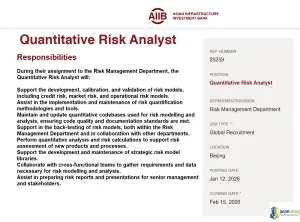
AIIB Quantitative Risk Analyst 2026 Summary Table
| Detail | Value |
|---|---|
| Host Institution | Asian Infrastructure Investment Bank (AIIB) |
| Location | Beijing, China |
| Department | Risk Management Department |
| Category | Quantitative Finance & Risk |
| Eligible Nationalities | All Members (Global Recruitment) |
| Reward | Global Salary Package & Professional Development |
| Application Deadline | February 15, 2026 |
AIIB Quantitative Risk Analyst 2026 Details
The AIIB Risk Management Stream is a premier professional development initiative designed to cultivate the next generation of quantitative experts in multilateral finance. Launched to support AIIB’s mission of financing “Infrastructure for Tomorrow,” the program offers a unique two-year rotation structure. Analysts gain hands-on experience by moving between the Risk Management Department and various client-facing departments.

Join our Telegram Channel for Instant Scholarship Updates
This immersive approach ensures that participants develop a 360-degree understanding of how global economic developments impact the Bank’s USD 100 billion capital base. The program emphasizes the integration of traditional financial engineering with cutting-edge technology, including Machine Learning and Large Language Models, to maintain the Bank’s AAA-rated financial stability.
Benefits of the AIIB Quantitative Risk Analyst 2026
The Quantitative Risk Analyst role is organized into a tiered system of rotation and technical specialization, designed to embed risk accountability and foster a strong risk culture throughout the Bank’s operations.
Tier 1: Advanced Model Development & Validation
- Core Modeling: Lead the development, calibration, and validation of critical risk models, covering credit, market, and operational risk sectors.
- Technological Innovation: Support the integration of machine learning, deep learning, and large language model (LLM) techniques into the Bank’s risk measurement frameworks.
Tier 2: Risk Quantification & Methodology Enhancement
- Algorithm Accuracy: Collaborate with internal departments to ensure risk calculation algorithms are robust, accurate, and aligned with industry best practices.
- Library Management: Develop and maintain strategic risk model libraries and quantitative codebases, ensuring high code quality and documentation standards via Git.
Tier 3: Analytics, Reporting & Compliance
- Back-Testing: Conduct rigorous back-testing of models to verify predictive power and compliance with the Bank’s risk appetite.
- Strategic Reporting: Perform quantitative analysis for new products and prepare risk presentations for senior management and global stakeholders.
Eligibility Requirements for AIIB Quantitative Risk Analyst 2026
- Academic/Leadership: Strong analytical skills with a Bachelor’s or Master’s degree in Mathematics, Statistics, Physics, Computer Science, or Financial Engineering.
- Study Status: Applicants must have completed their degree and demonstrate the ability to process large, complex datasets into meaningful financial information.
- Professional Experience: 2–3 years of experience (for Bachelor’s) or 1–2 years (for Master’s) in quantitative analysis or risk modeling within financial institutions.
- Program Admission: Proficiency in Python, SQL, VBA, or R is required. Experience with visualization tools like Power BI or Tableau is highly advantageous.
How to Apply for AIIB Quantitative Risk Analyst 2026 (Step by Step)
- Apply for Program: Complete the online application via the AIIB Career Portal by the February 15, 2026 deadline, citing Ref. Number 25259.
- Automatic Evaluation: Applications are screened based on quantitative credentials, programming proficiency, and relevant institutional experience.
- Eligibility Assessment: Shortlisted candidates will undergo technical assessments, including coding challenges and interviews with the Risk Management Stream.
- Notification of Award: Successful candidates will be notified of their selection and assigned a specific grade and job title based on their expertise.
Application Deadline: February 15, 2026
CLICK HERE TO APPLY
Frequently Asked Questions (FAQ)
1. What is the duration of the rotation program?
The Quantitative Risk Analyst will rotate through different departments over a two-year period.
2. What are the core programming languages required?
Strong skills in Python, SQL, VBA, and R are essential for this role.
3. Is experience with Machine Learning required?
While not mandatory, exposure to machine learning, deep learning, and LLM techniques is a significant plus.
4. Where is the position located?
The position is a Global Recruitment role based at the AIIB headquarters in Beijing, China.
5. What is the minimum educational requirement?
A Bachelor’s degree in a quantitative field like Mathematics or Statistics is the minimum requirement.
6. Are international students/professionals eligible?
Yes, AIIB is a multilateral institution and encourages applications from all member countries.
7. What types of risk will I be modeling?
The role covers credit risk, market risk, and operational risk models.
8. Does the role involve version control?
Yes, analysts are expected to be familiar with Git for maintaining quantitative codebases.
9. What is the application deadline for 2026?
The closing date for applications is February 15, 2026.
10. What determines the final job title and grade?
The successful applicant’s previous experience and specific qualifications will determine their entering grade.