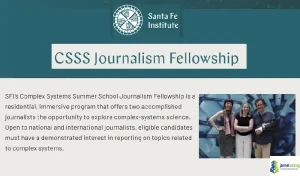
The Santa Fe Institute (SFI) has announced the 2026 Complex Systems Summer School Journalism Fellowship, a residential immersive program in Santa Fe, New Mexico. Open to national and international journalists with at least seven years of experience, the fellowship embeds two selected individuals into SFI’s iconic summer school to study complex-systems science through intensive lectures and labs. The program concludes with a self-directed week at SFI’s main campus for direct interaction with world-renowned faculty. Fellows receive a generous stipend, travel reimbursement, and provided housing. Applications require a résumé, a statement of goals, five relevant reporting clips, and one letter of recommendation, with a final submission deadline of February 4, 2026.
Fully Funded Santa Fe Institute Complex Systems Summer School Journalism Fellowship 2026 Summary Table
| Detail | Value |
|---|---|
| Host Institution | Santa Fe Institute (SFI) |
| Location | Santa Fe, New Mexico, USA |
| Program Type | Residential Journalism Fellowship |
| Number of Awards | Two (2) |
| Professional Req. | 7+ Years Journalism Experience |
| Application Deadline | February 4, 2026 |
Fully Funded Santa Fe Institute Complex Systems Summer School Journalism Fellowship 2026 Details
The SFI Complex Systems Summer School Journalism Fellowship is a high-level immersive opportunity designed for journalists who seek to master the science of complexity. By embedding fellows into an intensive academic environment, SFI aims to bridge the gap between complex scientific theory and public understanding, preparing reporters to better convey the interrelatedness of global challenges.

Join our Telegram Channel for Instant Scholarship Updates
Scholarship Details
This fellowship is divided into two phases: an intensive instructional phase within the Complex Systems Summer School (CSSS) and a subsequent self-directed week at SFI’s main campus. During the CSSS phase, fellows attend faculty-led lectures and participate in labs alongside global researchers, followed by a week of independent networking and deeper scientific inquiry.
Benefits of the Fully Funded Santa Fe Institute Complex Systems Summer School Journalism Fellowship 2026
The SFI Fellowship offers a tiered support system designed to ensure that the chosen journalists can focus entirely on their scientific immersion without financial burden.
Tier 1: Living Stipend and Financial Support
- Generous Professional Stipend: A substantial financial award provided to cover the duration of the fellowship, allowing journalists to take a hiatus from their regular duties.
- Travel Reimbursement: Full coverage or reimbursement for travel expenses incurred to and from Santa Fe, New Mexico.
Tier 2: Residential and Logistics Package
- Provided Housing: Fully arranged and funded housing in Santa Fe for the duration of the residency, ensuring proximity to the Institute and the CSSS site.
- Immersive Campus Access: Full access to SFI facilities, including the main campus for the final self-directed week of the program.
Tier 3: Academic and Networking Access
- Curriculum Enrollment: Full tuition and registration for the Complex Systems Summer School, including all labs and world-renowned faculty lectures.
- Scientific Mentorship: Direct access to interact with SFI’s iconic resident and external faculty to discuss specific reporting goals or scientific trends.
Eligibility Requirements for the Fully Funded Santa Fe Institute Complex Systems Summer School Journalism Fellowship 2026
- Academic/Leadership: Applicants must be accomplished journalists with a minimum of seven (7) years of professional experience and a demonstrated ability to report on complex scientific or technical topics.
- Study Status: This is a residential fellowship; applicants must be able to reside in Santa Fe for the full duration of the summer school and the self-directed week.
- Visa Status/Residency: The program is open to both national (USA) and international journalists. International fellows are responsible for securing necessary visas, though SFI provides support documentation.
- Program Admission: Candidates must provide a clear articulation of how the study of complexity science will specifically advance their future reporting and journalism goals.
How to Apply for the Fully Funded Santa Fe Institute Complex Systems Summer School Journalism Fellowship 2026(Step by Step)
- Apply for Program: Complete the online application through the SFI portal, providing biographical information and a current résumé.
- Automatic Evaluation: Applications are screened to ensure the 7-year experience threshold and the submission of all required documents (five clips and statement).
- Eligibility Assessment: A committee of SFI faculty and communications staff reviews the 2-page statement and clips to assess the candidate’s aptitude for complex systems reporting.
- Notification of Award: Selected fellows are typically notified in early spring to begin preparations for the summer residency in Santa Fe.
Application Deadline: February 4, 2026
CLICK HERE TO APPLY
Frequently Asked Questions (FAQ)
1. Is this fellowship open to freelance journalists?
Yes, as long as you have at least seven years of professional experience and can provide five relevant clips, freelancers are welcome to apply.
2. What exactly is “Complex Systems Science”?
It is an interdisciplinary field that studies how parts of a system give rise to collective behaviors and how the system interacts with its environment (e.g., climate change, economies, or neural networks).
3. Do I need a science degree to apply?
No, but you must demonstrate familiarity with complexity science and show an ability to report on sophisticated scientific topics.
4. Is the fellowship fully funded?
Yes, it covers a generous stipend, housing, and travel expenses for the duration of the residency.
5. Can international journalists apply?
Yes, the SFI Journalism Fellowship is open to journalists from all over the world.
6. What should be included in the two-page statement?
It should describe your journalism background, your specific interest in complex systems, and how the fellowship will help you achieve your professional goals.
7. How many fellows are selected each year?
The program is highly competitive, typically offering only two (2) fellowships per year.
8. What is the “self-directed week” at the end of the program?
It is a week where fellows move from the classroom setting to SFI’s main campus to conduct independent interviews and research with resident scientists.
9. Are the five clips required to be about complexity science?
They should demonstrate your ability to report on topics related to complex systems, such as science, technology, or large-scale social issues.
10. Who should write the letter of recommendation?
Ideally, an editor or a professional colleague who can speak to your experience, reporting ability, and how this fellowship would benefit your career.