The Nigeria Federal Government Youth Empowerment Initiative 2026, championed by the Federal Ministry of Youth Development, is a strategic, future-focused program aimed at tackling youth unemployment and climate change through the Circular Economy model. Operating under the mandate of President Bola Ahmed Tinubu, the initiative trains young Nigerians as Ecopreneurs through specialized, hands-on courses across six key sectors, including Waste Recycling, Renewable Energy (Waste to Energy), and Upscaling/Upcycling. The goal is to transform waste into valuable resources, create sustainable green jobs, mitigate environmental pollution, and foster economic growth, with specialized tracks in Ecopreneurship, Bio Mass, and Electronic Waste management.
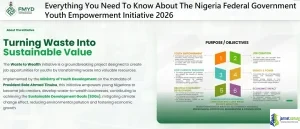
The Federal Government of Nigeria, through the Federal Ministry of Youth Development, is championing a massive, future-focused initiative to tackle youth unemployment, climate change, and environmental pollution simultaneously. Dubbed the “Waste to Wealth, Waste to Energy…” initiative, this program represents a groundbreaking approach to youth empowerment by anchoring it within the principles of the Circular Economy and the urgent need for Climate Action.

Join our Telegram Channel for Instant Scholarship Updates
Set for significant scale and impact, this program is designed not just to provide jobs, but to transform the mindset of young Nigerians from job seekers into Ecopreneurs and innovators, ensuring a sustainable future for the nation.
About The Nigeria Federal Government Youth Empowerment Initiative 2026
This Youth Empowerment Initiative is a groundbreaking national project designed to create sustainable job opportunities for thousands of Nigerian youths by transforming what is currently considered waste into valuable resources.
The Mandate
Implemented by the Ministry of Youth Development, the initiative operates under the direct mandate of President Bola Ahmed Tinubu, signaling a high-level commitment to addressing both economic and environmental challenges through youth engagement.
The Core Goal
The central ambition is simple yet profound: Creating jobs, transforming waste into eco-friendly items and valuable resources for a sustainable future.
The initiative empowers young Nigerians to:
- Become job creators rather than just job seekers.
- Develop viable and sustainable waste-to-wealth businesses.
- Contribute directly to achieving the Sustainable Development Goals (SDGs).
- Mitigate the effects of climate change and reduce environmental pollution.
- Foster robust national economic growth.
Key Sectors of the Circular Economy
The initiative’s extensive training component is a cornerstone of its success. It offers specialized, hands-on training grouped into key, high-demand sectors of the circular economy, preparing participants for immediate impact and business development.
1. Waste Recycling
This sector focuses on processing common waste materials back into raw materials for production, significantly reducing the demand for virgin resources and minimizing landfill waste. Courses include:
- Plastic Recycling
- Paper Recycling
- Wood Recycling
- Metal & Scraps Recycling
- Glass Recycling
2. Upscaling & Upcycling
Moving beyond simple recycling, this area teaches participants how to creatively repurpose discarded items into products of higher quality or environmental value.
- Textiles & Craft training focuses on turning used garments and materials into new fashion, home décor, or craft items, promoting artistic expression and sustainable consumption.
3. Energy & Community Renewable Solution
Addressing Nigeria’s energy deficit is a key focus. This track trains youths in the development and deployment of clean, decentralized energy sources derived from waste and natural resources. Courses cover:
- Solar Energy installation and maintenance.
- Biodegradable Energy production (biogas).
- Wind Turbines technology.
- Waste to Fertilizers & Feed production, turning organic waste into agricultural inputs.
- Solar Stoves fabrication and distribution.
- Maintenance and repair of Electric Vehicles & Tricycles, preparing for a future of sustainable transportation.
4. Ecopreneurship
Recognizing that technical skill must be paired with business acumen, the Ecopreneurship track equips participants with the necessary knowledge to run successful, sustainable businesses. Courses include:
- Capacity Building in business management.
- Financial Literacy for securing capital and managing profits.
- Waste Exportation procedures and markets.
- Eco Literacy to understand environmental regulations and ethical practices.
- Product Trading and marketing strategies.
- Reuse & Repair business models to extend product lifespan.
5. Bio Mass
Focused on reversing deforestation and promoting ecological stability, the Bio Mass sector trains youths in natural resource management.
- Afforestation & Reforestation techniques for environmental protection and carbon capture.
6. Electronic Waste (E-Waste)
As technology adoption rises, so does the volume of electronic waste. This crucial sector trains participants in the safe and profitable disposal, dismantling, and material recovery from discarded electronics, preventing toxic substances from polluting the environment.
Impact: A Triple Bottom Line Success
The Nigeria Federal Government Youth Empowerment Initiative is positioned to deliver a ‘triple bottom line’ impact—People, Planet, and Profit—by achieving several national objectives:
- Economic Empowerment: By creating a new class of ecopreneurs, the initiative stimulates local economic activity, reduces dependency on imported goods, and formalizes the informal waste collection sector.
- Climate Action and SDGs: The “Waste to Energy” focus directly contributes to Goal 7 (Affordable and Clean Energy) and Goal 13 (Climate Action). Converting waste into useful products drastically reduces methane emissions from landfills, a potent greenhouse gas, and aligns with the Paris Agreement targets.
- Environmental Health: Training in proper waste management, recycling, and upcycling leads to a significant reduction in environmental pollution, clearing streets and waterways of refuse, and improving public health outcomes.
- Innovation and Skill Development: The specialized nature of the training ensures that Nigerian youth acquire future-proof skills that are globally relevant, fostering a culture of innovation and resourcefulness.
In conclusion, the initiative stands as a blueprint for how a nation can leverage its greatest assets. Its youth and its resources (even the ones we discard)—to build a truly sustainable, resilient, and prosperous future.
15 Essential FAQs for Federal Government Youth Empowerment Initiative 2026 Applicants
1. What is the official name of the initiative, and which Ministry oversees it? The initiative is officially the Circular Economy Youth Empowerment Initiative for Climate Action (CEYEI), also known as “Waste to Wealth.” It is implemented by the Federal Ministry of Youth Development on the mandate of President Bola Ahmed Tinubu.
2. How does the Circular Economy model benefit me as a participant? The Circular Economy model ensures sustainability by training you to view and use waste (plastic, e-waste, biomass) as a continuous, low-cost raw material. This transforms you into a resource creator rather than a consumer, significantly reducing your business’s operating costs while contributing directly to environmental cleanup.
3. What are the primary national goals the program is trying to achieve? The program is focused on a triple objective: Job Creation for youth, Mitigating Climate Change effects (by reducing landfill emissions), and Fostering Economic Growth by creating a new sector of sustainable businesses.
4. How will the practical ‘Energy & Community Renewable Solution’ training (e.g., Solar) be delivered to ensure competence? Training is specialized and hands-on. It’s delivered in collaboration with technical partners to ensure participants gain practical, certified skills necessary for the immediate installation, maintenance, and fabrication of green technologies.
5. Will the program provide any form of post-training certification? Yes. Upon successful completion of the training, graduates will receive a certificate from the Federal Ministry of Youth Development, validating their expertise as a certified Ecopreneur in their chosen sector (e.g., Waste Recycling, Solar Energy, etc.).
6. Is it possible for a participant to enroll in courses from multiple sectors, like ‘Plastic Recycling’ and ‘Financial Literacy’? Yes, it is highly encouraged. The program is designed to be comprehensive, urging participants to pair a technical skill (like Waste Recycling) with the Ecopreneurship track (which includes Financial Literacy and Capacity Building) to ensure the technical skill is turned into a viable business.
7. How does the E-Waste (Electronic Waste) training differ from regular Plastic/Metal Recycling? E-Waste training is highly specialized and dangerous if done improperly. It focuses on the safe and complex dismantling of electronics to recover high-value precious metals (e.g., gold, copper) and safely disposing of or neutralizing hazardous components.
8. Where do I register and access the application form for the initiative? Registration and official updates are primarily managed via the dedicated Waste to Wealth online platform and the Ministry’s central Youth Activities Dashboard (YAD). You should regularly check the official Ministry of Youth Development channels for the application window.
9. Are there any eligibility restrictions for youths in rural or marginalized areas? No. The initiative is implemented nationwide across all 36 states and 774 local government areas, with inclusivity at its core. Specific efforts are made to ensure equal access to training and resources for youths in marginalized and rural communities.
10. I currently run a small, non-registered recycling operation. Can I still apply? Yes, you can. The program welcomes both new entrants and existing small entrepreneurs. You can apply to leverage the Ecopreneurship track for capacity building, business formalization, and accessing funding to upscale your current operation.
11. Will the Ministry provide seed funding or guaranteed access to low-interest loans for starting my business after graduation? The program does not guarantee a grant, but successful graduates are given preferential and structured access to the complementary Youth Cred Scheme and other federal credit facilities (loans) for young entrepreneurs to secure seed funding for their startups.
12. How will the Ministry help my business find customers and buyers for the recycled products? The dedicated Waste to Wealth online platform is being launched as a market linkage hub. It will connect your business directly with local industries that need recycled raw materials (off-takers) and provide opportunities to showcase your products internationally.
13. Does the program include any post-training mentorship to help with business launch challenges? Yes. A structured system of mentorship, incubation support, and post-training engagement is built into the CEYEI to guide new ecopreneurs through the first crucial 6-12 months of business establishment.
14. Since the program is for Climate Action, will I be trained on calculating carbon credits? The program’s advanced modules will train you on quantifying your business’s environmental impact (e.g., volume of waste diverted, energy saved). This data is essential for leveraging future green finance opportunities and participating in Nigeria’s emerging carbon credit market.
15. Who are the key partners involved in this initiative that validate its credibility? Key partners include the Recyclers Association of Nigeria (RAN), the UN’s UNFPA (which supports the Ministry’s youth database), and various private sector players, all lending technical and institutional credibility to the program.