The Earth Journalism Network (EJN), supported by the Oak Foundation, is offering five story grants of $1,500 USD each to journalists from coastal countries. The EJN Story Grants on Fisheries Transparency program aims to improve media coverage of fisheries transparency, focusing on issues such as illegal fishing, lack of government reporting, and technological innovations in vessel tracking. This grant is strictly for marine (not freshwater) fisheries and requires a working knowledge of English. Applicants must provide a letter of support from an editor and commit to publishing their stories by October 31, 2026. Use of generative AI in proposals must be disclosed.
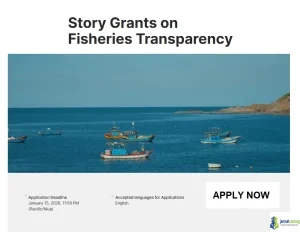
EJN Story Grants on Fisheries Transparency 2026 Summary Table
| Detail | Value |
|---|---|
| Organization | Earth Journalism Network (EJN) / Internews |
| Grant Amount | $1,500 USD (5 grants total) |
| Eligible Countries | Any coastal country |
| Focus | Marine Fisheries Transparency (No freshwater) |
| Application Language | English |
| Application Deadline | January 15, 2026 |
| Publication Deadline | October 31, 2026 |
EJN Story Grants on Fisheries Transparency 2026
The Earth Journalism Network is seeking high-impact story proposals that expose the “dark side” of the global fishing industry. With industrial fishing often occurring far from the public eye, transparency is the primary tool for ensuring environmental sustainability and social justice.

Join our Telegram Channel for Instant Scholarship Updates
Thematic Focus Areas for the EJN Story Grants on Fisheries Transparency 2026
Applicants should tailor their story ideas to one or more of the following themes:
- Fisheries Management: Reporting on non-disclosure of catch volumes, government secrecy regarding fishing agreements, and the impact of subsidies.
- Vessel Activities at Sea: Investigating illegal trawling, “dark” vessels (AIS disabled), transshipment (transferring fish between ships), and complex ownership structures.
- Supply Chain Integrity: Tracking seafood from the ocean to the plate and auditing the validity of “sustainable” seafood certifications.
- Technological Innovations: Exploring how AI, satellite tracking (VMS/AIS), and DNA testing are being used to identify species origin and verify fishing locations.
- Policy & Global Frameworks: Analyzing the effectiveness of national and international laws (like the Fisheries Transparency Initiative Charter) in forcing government accountability.
Eligibility Criteria EJN Story Grants on Fisheries Transparency 2026
- Location: Open to journalists (staff or freelance) from any coastal country.
- Media Type: Online, print, television, or radio.
- Language: Applications must be in English. Mentorship and communication with EJN will also be in English.
- Collaborations: Cross-border and transboundary group applications are highly encouraged, though one lead journalist must represent the group.
- Experience: Both early-career and experienced reporters are welcome, provided they have a track record or strong interest in ocean issues.
Judging Criteria for the EJN Story Grants on Fisheries Transparency 2026
- Relevance: Does the story address the “transparency” aspect specifically?
- Fresh Angle: Does the proposal offer a new perspective on a known issue or uncover a hidden story?
- Reach: Will the story be published in an outlet with a significant audience? (Non-paywalled outlets are preferred).
- Impact: Does the story have the potential to trigger policy change or public debate?
- Innovation: Use of data visualization, multimedia, and creative storytelling is a plus.
Important Requirements for the EJN Story Grants on Fisheries Transparency 2026
- AI Disclosure: If you use generative AI to help draft your proposal, you must disclose this. Submitting AI-generated content as your own work is grounds for disqualification.
- Editor’s Support: A letter from an editor must be included, confirming that the outlet will publish your story by the October 2026 deadline.
- Mentorship: Successful applicants will be paired with an experienced EJN mentor to refine their story and ensure technical accuracy.
Application Deadline: January 15, 2026
CLICK HERE TO APPLY
For More Information Click Here
Frequently Asked Questions (FAQ)
1. Can I report on inland lake fisheries?
No. This specific grant call is limited to marine fisheries. Freshwater or inland fishing stories will not be considered.
2. Can a group of journalists apply?
Yes, EJN encourages collaborative and cross-border reporting. However, one person must be the “Lead Applicant” to manage the budget and communication.
3. What does the $1,500 budget cover?
The grant is meant to cover reporting costs, including travel, data sets, translation, and your time (stipend).
4. Do I need to be a full-time journalist?
No. Freelancers are eligible, but you must have a letter of commitment from a media outlet to publish your work.
5. What if my English isn’t perfect?
You must have a working understanding of English to communicate with your mentor, or have a translator available to assist you throughout the process.
6. Can I use AI to write my story?
EJN requires transparency. While tools can assist in research or editing, the core reporting and writing must be your own original work.
7. Does the story have to be published by a specific date?
Yes, all stories supported by this grant must be published by October 31, 2026.
8. What is “transshipment”?
It is the practice of transferring fish from a fishing vessel to a refrigerated cargo ship at sea, which is often used to hide illegal catches.
9. Are there any specific coastal countries excluded?
No, as long as the country has a coastline and the story focuses on marine fisheries transparency.
10. When will I hear back?
Typically, EJN notifies applicants within 4-6 weeks after the deadline.