Internews’ Earth Journalism Network (EJN), supported by Sida, has launched a fellowship for journalists based in the Philippines to investigate accountability regarding extreme weather (EJN Extreme Weather Philippines Fellowship). Up to 12 fellows will receive P118,000 each, a three-day investigative workshop, and expert mentorship. The program focuses on tracing public funds (DRRM), scrutinizing infrastructure like sea walls, and linking environmental degradation (mining/deforestation) to disaster severity. Applicants need at least two years of experience and a signed letter of commitment from a publisher. Stories must be published by May 31, 2026.
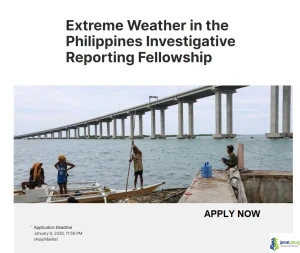
EJN Extreme Weather Philippines Fellowship 2026
| Detail | Value |
|---|---|
| Organization | EJN / Internews (Supported by Sida) |
| Fellowship Grant | P118,000 per fellow (Up to 12 slots) |
| Target Audience | Journalists based in the Philippines |
| Core Components | Workshop + Story Grant + Mentorship |
| Experience Req. | Minimum 2 years professional journalism |
| Application Deadline | January 9, 2026 |
| Publication Deadline | May 31, 2026 (No extensions) |
EJN Extreme Weather in the Philippines Fellowship 2026 Details
This initiative is designed to move beyond “disaster porn” and reactive reporting. It empowers Filipino journalists to investigate the root causes of vulnerability and hold power to account for how public funds are used (or misused) in the face of the climate crisis.

Join our Telegram Channel for Instant Scholarship Updates
Key Investigative Themes for the EJN Extreme Weather Philippines Fellowship 2026
Proposals must focus on accountability and can fall under these four categories:
- Financial Accountability: Tracking the Disaster Risk Reduction and Management (DRRM) Funds. Are local and national governments spending this money on actual resilience, or is it being diverted?
- Infrastructure Effectiveness: Scrutinizing multi-million peso “climate-resilient” projects. Do the sea walls and flood controls actually work during typhoons, or are they victims of sub-standard engineering and corruption?
- Preparedness & Policy Gaps: Investigating why official “Climate Action Plans” often fail during real-world implementation. This looks at cross-agency coordination and bureaucratic bottlenecks.
- Ecosystem Collapse: Proving the link between human activity and disaster severity. For example: How does illegal mining or mangrove destruction in a specific province lead to deadlier landslides or storm surges?
Eligibility Requirements EJN Extreme Weather Philippines Fellowship 2026
- Base: Must be currently based in the Philippines.
- Experience: At least 2 years of professional journalism experience.
- Track Record: Must show prior experience reporting on environment, climate, or governance.
- Medium: Open to print, online, radio, and TV journalists (Staff or Freelance).
- Commitment: Must attend a mandatory three-day investigative workshop (dates to be announced).
How to Apply for the EJN Extreme Weather Philippines Fellowship 2026
- Investigative Proposal: A clear, original plan that outlines how you will uncover accountability issues and what “positive change” you hope to drive.
- Letter of Commitment: A signed letter from your editor/publisher promising to air or publish the story.
- AI Disclosure: You must state if you used generative AI to draft the proposal.
Timeline & Deadlines
- Application Deadline: January 9, 2026.
- Workshop & Mentorship: Begins shortly after selection.
- Publication Deadline: May 31, 2026. Note: EJN has stated that no extensions will be granted for this deadline.
CLICK HERE TO APPLY
For More Information Click Here
Frequently Asked Questions (FAQ)
1. Is the P118,000 a salary?
It is a story grant intended to cover the costs of your investigation (travel, data requests, research, etc.) and as a stipend for your professional work.
2. Is the workshop mandatory?
Yes. The three-day investigative reporting workshop is a core part of the fellowship benefits and capacity building.
3. Can I report on a local issue in my province?
Absolutely. EJN encourages applications from local and community-based media, as long as the story has a strong investigative and accountability angle.
4. What happens if I miss the May 31 publication deadline?
EJN has explicitly stated that no extensions will be granted. Failure to publish on time may affect your grant disbursement.
5. Can I apply if I am a student?
Generally, no. The fellowship requires at least two years of professional journalism experience.
6. Do I need to be an investigative reporter already?
While investigative experience is a plus, the program is designed to strengthen your capacity, so journalists with a strong climate background looking to move into investigative work are encouraged to apply.
7. What kind of “accountability” are they looking for?
They want to see stories that ask “Why did this fail?” or “Where did the money go?” rather than just “What happened during the storm?”
8. Can I submit a proposal about a recent typhoon?
Yes, as long as the focus is on the preparedness and funding related to that event or future events.
9. Can I work with a partner?
The fellowship is typically awarded to individuals, but you can mention collaboration in your proposal. However, the P118,000 is usually per fellowship slot.
10. Can I use AI to write the final story?
No. While you must disclose AI use in the proposal, submitting an AI-generated investigative story as your own work is considered unethical conduct and is grounds for disqualification.