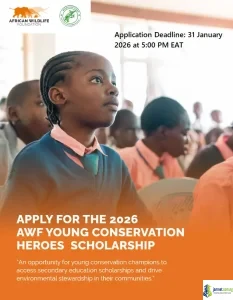
The 2026 African Wildlife Foundation (AWF) Young Conservation Heroes Scholarship, in partnership with WCK, is open to five former Grade 9 learners from 137 specific primary schools within 10 km of the Tsavo protected areas in Kenya (Tana River, Kwale, Kilifi, Kitui, Makueni, Taita Taveta, and Kajiado counties). Applicants must submit a printable form and two handwritten essays detailing a conservation or community development project and their volunteer/leadership experience. The deadline is January 31, 2026, at 5:00 PM EAT.
AWF Young Conservation Heroes Scholarship 2026 Summary Table
| Detail | Value |
|---|---|
| Host Organization | African Wildlife Foundation (AWF) & Wildlife Clubs of Kenya (WCK) |
| Program Focus | Nurturing Conservation Leadership & Education |
| Category | Targeted Educational Scholarship |
| Eligible Applicants | Former Grade 9 Learners in the Tsavo Landscape, Kenya |
| Program Duration | Part of the four-year Young Conservation Heroes Project (Launched 2024) |
| Max Financial Award | Scholarship coverage for studies (Specific value not detailed) |
| Number of Awards | Five (5) Students |
| Application Deadline | January 31, 2026, 5:00 PM EAT |
African Wildlife Foundation (AWF) Young Conservation Heroes Scholarship 2026 Details
The 2026 African Wildlife Foundation (AWF) Young Conservation Heroes Scholarship is a targeted educational opportunity implemented in partnership with the Wildlife Clubs of Kenya (WCK). This scholarship is part of the larger Young Conservation Heroes Project, a four-year initiative launched in 2024 with support from Bob and Emmy King.

Join our Telegram Channel for Instant Scholarship Updates
The project’s broad aim is to inspire and nurture a strong conservation movement among approximately 83,000 learners in the Tsavo Landscape, Kenya, by equipping them with essential conservation knowledge and skills. This scholarship specifically targets promising young learners from within this critical ecosystem who demonstrate a commitment to conservation and community impact.
Benefits and Specific Awards of the AWF Scholarship
The scholarship focuses on providing educational funding and support to exceptional students who will become future stewards of the Tsavo Landscape.
Tier 1: Educational Funding (Scholarship Coverage)
- Academic Support: The scholarship is designed to support the educational pursuits of the recipients (specific financial amounts are not detailed, but cover study costs).
- Targeted Awards: Only five (5) students will be selected for this highly competitive, area-specific scholarship.
Tier 2: Conservation and Project Development
- Project Experience: The application process encourages the development of a proposed community development or conservation project, offering a path for the student to pursue real-world impact.
- Skill Nurturing: The program aims to nurture strong conservation skills and leadership potential among the scholars, directly contributing to the future protection of the Tsavo protected areas.
Tier 3: Networking and Visibility
- Partnership Access: Scholars benefit from the network and expertise of both the African Wildlife Foundation (AWF) and the Wildlife Clubs of Kenya (WCK).
- Leadership Recognition: The scholarship recognizes and rewards past involvement in conservation, volunteering, and leadership roles, providing formal acknowledgment of the student’s existing dedication.
Eligibility Requirements for the AWF Scholarship 2026
The eligibility criteria are highly specific and geographically focused, ensuring the scholarship supports students directly connected to the Tsavo protected areas.
- Academic Status: Must be a former Grade 9 learner (meaning students who have completed Grade 9).
- School Affiliation: Must be from one of the 137 primary schools supported by the Young Conservation Heroes Project.
- Geographical Location: The schools must be located within 10 km of the Tsavo protected areas in the following seven Kenyan counties:
- Tana River
- Kwale
- Kilifi
- Kitui
- Makueni
- Taita Taveta
- Kajiado
- Prior Participation: Applicants must have been part of the broader conservation movement inspired by the AWF/WCK project.
How to Apply for the AWF Scholarship 2026 (Step by Step)
The application process is unique, requiring a combination of a traditional printable form and handwritten, narrative essays to assess the applicant’s passion and commitment.
- Obtain Application Form: Acquire the printable application form from the designated locations indicated in the form (likely the participating schools or WCK offices).
- Draft Essays: Write two (2) handwritten essays focusing on specific areas of interest and experience:
- Essay 1: Outline a community development or conservation project they wish to pursue.
- Essay 2: Provide a summary of their volunteer experience, conservation involvement, and leadership roles.
- Parental/Patron Support: Seek support from parents, guardians, or wildlife club patrons for the application process.
- Submit Application: Submit the completed printable form and the two handwritten essays to the designated submission locations as indicated on the application form.
Application Deadline: 31 January 2026 at 5:00 PM EAT
CLICK HERE TO APPLY
For more Information Click Here
Frequently Asked Questions (FAQ)
1. What is the application deadline for the AWF Young Conservation Heroes Scholarship 2026?
The application deadline is 31 January 2026, at 5:00 PM EAT (East Africa Time).
2. Who are the partner organizations implementing the Young Conservation Heroes Project?
The project is implemented collaboratively by the African Wildlife Foundation (AWF) and the Wildlife Clubs of Kenya (WCK).
3. How many scholarships are awarded in the 2026 cohort?
The scholarship is highly competitive, and only five (5) students will be selected for the 2026 cohort.
4. What is the primary academic requirement for applicants?
Applicants must be former Grade 9 learners from one of the 137 primary schools supported by the project.
5. What are the two types of essays applicants must submit?
Applicants must submit two handwritten essays: one outlining a proposed community development or conservation project, and the other summarizing their volunteer experience, conservation involvement, and leadership roles.
6. Where are the eligible schools geographically located in relation to the Tsavo protected areas?
The schools must be located within 10 km of the Tsavo protected areas in the specified counties.
7. Name three of the seven Kenyan counties covered by the project eligibility criteria.
The eligible counties include Tana River, Kwale, Kilifi, Kitui, Makueni, Taita Taveta, and Kajiado. (Any three of these are correct.)
8. What is the role of the parents, guardians, or wildlife club patrons in the application process?
Learners are required to submit their applications with support from their parents, guardians, or wildlife club patrons.
9. Who provides the support for the larger Young Conservation Heroes Project?
The broader four-year project, which includes this scholarship, is supported by Bob and Emmy King.
10. What is the overall goal of the Young Conservation Heroes Project in the Tsavo Landscape?
The project aims to inspire and nurture a strong conservation movement among learners by equipping them with essential conservation knowledge and skills.