The 2026 AAAS American Association for the Advancement of Science and The World Academy of Sciences (TWAS) Science Diplomacy summer course will be held in person in Trieste, Italy, from July 20-23, 2026. This training program aims to equip scientists and decisionmakers with the skills and concepts necessary for careers at the intersection of science and diplomacy. Applications must be submitted in “participant pairs” (one Early-Career Scientist and one Decisionmaker). Priority for full financial support (covering all expenses) is given to pairs from a specified list of developing countries. The application deadline is 29 January 2026.
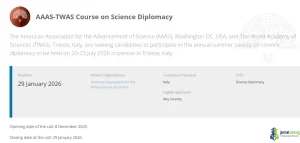
AAAS American Association for the Advancement of Science TWAS Science Diplomacy Summer Course 2026 Summary Table
| Feature | Detail |
|---|---|
| Host Institution | AAAS (Washington DC, USA) and TWAS (Trieste, Italy) |
| Sponsor | AAAS and TWAS |
| Academic Level | Professional/Post-PhD Training and Diplomacy |
| Eligible Countries | Open to all, but financial support priority for specific developing countries (listed below) |
| Target Group | Participant Pairs (Early-Career Scientist and Decisionmaker) |
| Reward | Fully Funded attendance (for priority countries) or Self-Supported attendance |
| Location | Trieste, Italy (In-Person Workshop) |
| Duration | 20-23 July 2026 |
| Deadline | 29 January 2026 |
AAAS-TWAS Science Diplomacy Training
Established in 2014, the AAAS-TWAS Science Diplomacy training program offers an intensive summer course dedicated to bridging the gap between scientific research and international policymaking.

Join our Telegram Channel for Instant Scholarship Updates
The course aims to expose a diverse cohort of scientists, policymakers, and diplomats to core science diplomacy concepts, explore key contemporary international issues related to science, technology, environment, and health, and build the critical skillset needed for career success at the interface of these two critical domains.
The 2026 workshop will take place in Trieste, Italy, across four days, structured as follows:
- 20 July (Monday): Welcome dinner.
- 21-23 July (Tuesday – Thursday): Core workshop sessions.
- 24 July (Friday): Participants return to their home countries.
Financial and Support Benefits
The benefits are tiered based on the applicant pair’s country of origin, with priority given to underrepresented nations.
Tier 1: Fully Funded Financial Support (Priority Countries)
Financial support from the organizers is limited exclusively to successful applicant pairs from the following list of priority countries. For these pairs, organizers will cover all related expenses:
- Full Coverage: Transportation (flights), accommodation, visa processing fees, meals, and incidentals throughout the duration of the course.
Priority Countries (where funding is available)
- Afghanistan,
- Albania,
- Algeria,
- Antigua and Barbuda,
- Aruba,
- Azerbaijan,
- Bahamas,
- Bahrain,
- Barbados,
- Belarus,
- Belize,
- Benin,
- Bhutan,
- Bosnia and Herzegovina,
- Botswana,
- Brunei Darussalam,
- Burkina Faso,
- Burundi,
- Cabo Verde,
- Central African Rep.,
- Chad,
- Chile,
- China,
- Comoros,
- Congo Rep.,
- Côte d’Ivoire,
- Cuba,
- Congo DRC,
- Djibouti,
- Dominica,
- Dominican Republic,
- El Salvador,
- Equatorial Guinea,
- Eritrea,
- Eswatini,
- Fiji,
- Gabon,
- Gambia,
- Grenada,
- Guadeloupe,
- Guinea,
- Guinea-Bissau,
- Guyana,
- Haiti,
- Honduras,
- Iran,
- Iraq,
- Jordan,
- Kazakhstan,
- Kiribati,
- Kuwait,
- Kyrgyzstan,
- Lao People’s Democratic Rep.,
- Lebanon,
- Lesotho,
- Liberia,
- Libya,
- Malawi,
- Maldives,
- Mali,
- Mauritania,
- Mexico,
- Micronesia (Federated States of),
- Mongolia,
- Montenegro,
- Morocco,
- Myanmar,
- Namibia,
- Nicaragua,
- North Macedonia,
- Oman,
- Palau,
- Papua New Guinea,
- Paraguay,
- Qatar,
- Türkiye (Turkey),
- Rwanda,
- Saint Vincent and the Grenadines,
- Samoa,
- Sao Tome and Principe,
- Saudi Arabia,
- Senegal,
- Seychelles,
- Sierra Leone,
- Solomon Islands,
- Somalia,
- South Africa,
- South Sudan,
- State of Palestine,
- Suriname,
- Syrian Arab Rep.,
- Taiwan (China),
- Tajikistan,
- Timor-Leste,
- Tonga,
- Trinidad and Tobago,
- Turkmenistan,
- Tuvalu,
- United Arab Emirates,
- Uruguay,
- Uzbekistan,
- Vanuatu,
- Venezuela,
- Viet Nam,
- Yemen
- Zambia.
Tier 2: Self-Supported Attendance (All Countries)
A small number of self-supported participant pairs, including those from high-income countries, may be selected to attend.
- Organizers’ Contribution: Meals and transportation within Trieste are covered by the organizers.
- Participant Responsibility: These participants are responsible for covering all other costs connected to their attendance, including international transportation, accommodation, and visa fees.
Tier 3: Skill Development and Networking
All selected participants benefit from the core offerings of the workshop:
- Training: Exposure to science diplomacy concepts and policy issues related to science, technology, environment, and health.
- Networking: Opportunities to connect with scientists, decisionmakers, diplomats, and international organization staff.
Eligibility Requirements for AAAS-TWAS Science Diplomacy Course 2026
The call is open to applicants from all countries, but due to the course’s structure, the primary requirement is the submission of a “participant pair.”
- Submission Format: The application must be submitted as a pair of applicants, consisting of one Early-Career Scientist (ECS) and one Decisionmaker (DM).
- Participant 1: Early-Career Scientist (ECS) Requirements:
- Age: Preferably 40 years or below.
- Education: Must have earned a PhD degree.
- Focus: Their research and broader engagement should have clear international policymaking implications or applications.
- Participant 2: Decisionmaker (DM) Requirements:
- Age/Education: No age limit and no PhD degree requirement.
- Role: Must be currently working in the policymaking arena on science, technology, and innovation-related matters.
- Acceptable Categories: Must belong to one of the following policy-related categories: a local or national government official, a policymaker, a diplomat, a civil servant, a representative of a research funding institution, or staff/expert working for an international organization (e.g., UN).
- Financial Support Eligibility: Only successful pairs from the priority country list are eligible for full financial support.
How to Apply for AAAS-TWAS Science Diplomacy Course 2026 (Step by Step)
The application process requires a coordinated submission from both members of the “participant pair.”
- Form the Pair: Identify and secure a partnership with a qualified Early-Career Scientist (ECS) and a Decisionmaker (DM) who meet the respective eligibility criteria.
- Prepare Documentation: Coordinate all required documentation and statements from both the ECS and the DM, ensuring the application clearly demonstrates how their collaborative work has or could have international policymaking implications.
- Submit Application: Complete and submit the application form on the official TWAS/AAAS portal before the deadline. Note that both applicants must be part of the same submission.
- Await Notification: Decisions are made based on the strength of the pair’s profiles and their home country status (for funding priority). Successful applicants will be notified following the evaluation process.
Application Deadline: 29 January 2026
CLICK HERE TO APPLY
For more Information Click HERE
Contact email for inquiries: sciencediplomacy@twas.org
Frequently Asked Questions (FAQ)
1. What is the composition of the required “participant pair”?
The required “participant pair” must include one Early-Career Scientist (ECS), who must have a PhD and be preferably under 40, and one Decisionmaker (DM), who works in the policy arena and has no age or PhD requirement.
2. Is full financial support available to all applicants?
No. Full financial support, covering transportation, accommodation, and incidentals, is strictly limited and prioritized for successful participant pairs from the extensive list of countries specified in the eligibility section.
3. What is the deadline to submit the application for the course?
The final application deadline is 29 January 2026. Submissions must be completed before this date.
4. Is the course held online or in person?
The 2026 AAAS-TWAS course will be held in person in Trieste, Italy.
5. Does the Early-Career Scientist applicant need a PhD?
Yes, the Early-Career Scientist (ECS) must have earned a PhD degree to be considered for the course.
6. What roles qualify a person as a Decisionmaker (DM)?
A Decisionmaker can be a local or national government official, a policymaker, a diplomat, a civil servant, a representative of a research funding institution, or an expert/staff member of an international organization (e.g., UN).
7. If I am from a high-income country, can I still attend the course?
Yes, a small number of self-supported participant pairs, including those from high-income countries, may be selected. However, you will be responsible for covering most of your costs (flights, accommodation, visa fees).
8. What expenses are covered by the organizers for self-supported attendees?
For self-supported attendees, the organizers will cover only meals and local transportation within Trieste during the workshop dates.
9. What is the date range for the workshop sessions?
The core workshop sessions run from Tuesday, 21 July, to Thursday, 23 July 2026.
10. Where should I direct any further questions about the course?
Further inquiries should be sent via email to the official contact address: sciencediplomacy@twas.org.