
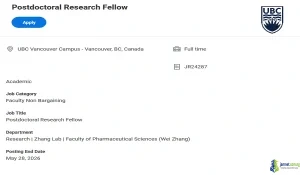
Securing an independent academic appointment at a globally renowned research institution is a major milestone for early career scientists aiming to influence international healthcare systems. For many ambitious doctoral graduates, finding a fellowship that offers both an outstanding salary and access to a vibrant multidisciplinary network remains a persistent struggle. Navigating the competitive space of Canadian postdoctoral grants is often difficult because it is tough to find a position that combines advanced economic modeling with direct clinical and pharmaceutical translation.

Join our Telegram Channel for Instant Scholarship Updates
The 2026 University of British Columbia Postdoctoral Research Fellowship, hosted by the Faculty of Pharmaceutical Sciences in Vancouver, Canada, is a premier academic opportunity designed to solve these professional challenges. By providing an attractive starting salary of up to CAD $90,000 per year, a comprehensive employee benefits package, and direct integration into the innovative Zhang Lab, UBC ensures that brilliant young researchers can focus entirely on advancing health economics and shaping global health policy without financial worry.
UBC Postdoctoral Fellowship Summary Table
| Detail | Value |
|---|---|
| Host Organization | University of British Columbia |
| Target Audience | Recent PhD Graduates and Health Economists |
| Primary Benefit | Annual Salary from CAD $70,000 to CAD $90,000 plus Benefits |
| Program Type | Full Time Postdoctoral Research Fellowship |
| Location | Vancouver British Columbia Canada |
| Application Deadline | May 28 2026 |
About the Initiative 2026
The Postdoctoral Research Fellow position at UBC represents far more than a basic laboratory job; it serves as a prestigious launchpad for advanced pharmaceutical sciences research funding and global health policy careers. Based within the state of the art Faculty of Pharmaceutical Sciences at the Vancouver campus, the selected fellow will work under the direct supervision and mentorship of Dr. Wei Zhang within the Zhang Lab.
The program is designed to address complex, real world challenges in health economics, pharmaceutical outcomes, and clinical resource allocation. Selected fellows are treated as key scientific collaborators, gaining the freedom to lead peer reviewed publications, co-author major international grant proposals, and supervise graduate and undergraduate science students in a highly supportive environment.
Core Objectives of the Program
- To support early career researchers by providing high value health economics fellowships and competitive compensation packages.
- To advance global health policy by developing robust, data driven economic models that evaluate pharmaceutical outcomes and clinical cost effectiveness.
- To foster inclusive academic excellence by recruiting diverse global scholars and underrepresented voices to lead scientific discoveries.
Benefits of the 2026 UBC Postdoctoral Fellowship
- A highly competitive annual salary ranging between CAD $70,000 and CAD $90,000.
- A comprehensive university employee benefits package, including health, dental, and professional support services.
- Access to world class research infrastructure, high performance computing, and extensive clinical databases.
- Valuable opportunities to lead and coauthor publications in high impact peer reviewed health economics journals.
- Guaranteed funding support for a one year term, with strong possibilities for annual renewal based on performance and budget availability.
- Direct, personalized mentoring and career guidance from principal investigator Dr. Wei Zhang.
- Entry into a globally respected academic network that bridges the gap between research and corporate pharmaceutical sectors.
- Active career development through specialized university workshops, leadership training, and scientific presentation forums.
Research Methodology and Key Responsibilities
The selected postdoctoral fellow will lead multiple analytical and collaborative projects, including:
- Economic Modeling: Developing and validating advanced statistical and econometric models to measure the value of pharmaceutical interventions.
- Policy Analysis: Analyzing national and international health policies to evaluate their impact on patient outcomes and clinical access.
- Manuscript Publication: Drafting and polishing high quality scientific manuscripts for publication in leading international journals.
- Grant Development: Assisting in the preparation and submission of research proposals to national funding bodies such as the Canadian Institutes of Health Research.
- Student Mentorship: Providing guidance and supervising Master and PhD level students in research design and data processing.
Eligibility and Requirements for Applicants
- Educational Credentials: Applicants must hold a completed PhD, terminal doctoral degree, or equivalent in health economics, economics, biostatistics, public health, or a closely related quantitative field.
- Technical Skills: Proven experience in quantitative research, spatial data analysis, or advanced econometric modeling.
- Analytical Software: High level of proficiency using statistical software such as R, Python, SAS, or Stata is highly valued.
- Research Record: A solid track record of peer reviewed publications and academic conference presentations.
- Communication Excellence: Outstanding written and verbal communication skills in professional English.
- Personal Attributes: Strong critical thinking abilities, a highly collaborative spirit, and a deep interest in interdisciplinary healthcare innovation.
- Diversity and Inclusion: UBC is committed to equity and welcomes applications from underrepresented and marginalized communities globally.
Step by Step Application Guide for the UBC Fellowship
Phase 1: Research Focus and Lab Alignment
- Visit the official UBC Faculty of Pharmaceutical Sciences portal to study the active work of the Zhang Lab.
- Read recent publications from Dr. Wei Zhang to understand the lab focus on health economics and clinical outcomes.
- Verify that your doctoral background in economics, statistics, or public health aligns with the program requirements.
- Confirm your availability to relocate to Vancouver, Canada, and begin work on September 1 2026.
Phase 2: Compiling Your Academic and Research Portfolio
- Request official transcripts from your doctoral degree granting institution.
- Update your Curriculum Vitae to highlight your peer reviewed publications, modeling skills, and funding awards.
- Gather the names, institutions, and current contact details of three professional or academic references.
- Save your CV, transcripts, and list of publications as separate, high quality PDF files.
Phase 3: Drafting Your Tailored Cover Letter and Research Statement
- Write a professional cover letter explaining your specific motivation for wanting to work in the Zhang Lab.
- Highlight your previous experience with quantitative research, economic modeling, or policy analysis.
- Draft a clear research statement outlining your future academic goals and how this fellowship helps you reach them.
- Proofread your written drafts carefully to ensure the English is simple, engaging, and completely hyphen free.
Phase 4: Submitting Through the Official UBC Portal
- Access the official University of British Columbia careers platform online.
- Search for Job Requisition ID JR24287 to locate the Postdoctoral Research Fellow in Health Economics posting.
- Complete the online registration forms with your correct personal, contact, and residency details.
- Upload your resume, cover letter, research statement, transcripts, and list of reference contacts.
- Submit your completed application package before the absolute deadline of May 28 2026.
Phase 5: Interview Coaching and Relocation Prep
- Save a digital confirmation of your submitted application and all uploaded files for your records.
- Monitor your professional email account regularly for any screening updates or interview invitations.
- Prepare for a technical discussion by practicing how to explain complex econometric methods to interdisciplinary panels.
- Coordinate with the university human resources department to begin visa and immigration processing upon selection.
Jamnet Expert Advice (STAR/SMART Methods)
- Use the SMART Method: Be Specific about the economic questions you want to solve, ensure your modeling results are Measurable, and keep your goals Relevant to global health policy.
- Apply the STAR Technique: In your cover letter and interviews, describe a challenging data analysis Situation, the precise Task, the Action you took using statistical software, and the positive Result.
- Emphasis: Focus heavily on your ability to work productively in multidisciplinary teams and your desire to publish original, high impact research.
- Proactive Tip: Submit your application several days before the May deadline to ensure the recruitment team has ample time to assess your portfolio, as late submissions are strictly not considered.
Deadline: May 28 2026
Frequently Asked Questions (FAQ) About the UBC Fellowship
- What is the annual salary for this postdoctoral position? The fellowship offers a highly competitive annual salary ranging between CAD $70,000 and CAD $90,000 plus benefits.
- Who is the supervising principal investigator? The selected fellow will work under the direct supervision of Dr. Wei Zhang in the Zhang Lab.
- Where is the fellowship physically located? The position is based at the Vancouver campus of the University of British Columbia in Canada.
- What is the duration of the fellowship? The initial contract is for a one year term, with possibilities for annual renewal based on performance and funding.
- What is the application deadline? All application materials must be successfully uploaded to the portal on or before May 28 2026.
- Do I need to be a Canadian citizen to apply? No international applicants are highly encouraged to apply, and UBC supports visa processes for successful candidates.
- What is the Job Requisition ID? The official job search code for this position on the UBC portal is JR24287.
- What academic fields are eligible? PhD graduates in health economics, economics, biostatistics, public health, health policy, or related quantitative fields.
- Is teaching required as part of the fellowship? Teaching is not mandatory, but fellows may gain valuable experience by supervising graduate and undergraduate research students.
- Are employee benefits included? Yes the position comes with a comprehensive university employee benefits package, including health and dental coverage.