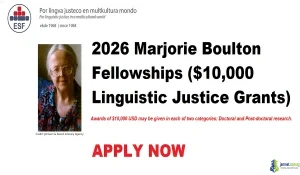
Advancing research in the humanities and social sciences is a major milestone for scholars aiming to foster international cooperation and cultural understanding. For many ambitious researchers focusing on language barriers, finding the necessary resources to investigate linguistic equity remains a persistent struggle. Navigating the competitive space of global humanities grants is often difficult because it is tough to find a dedicated program that supports both doctoral dissertation work and post doctoral academic publishing.

Join our Telegram Channel for Instant Scholarship Updates
The 2026 Marjorie Boulton Fellowships, powered by the Esperantic Studies Foundation, is a premium academic support program designed to solve these exact challenges. By offering ten thousand dollar research awards for doctoral and post doctoral researchers worldwide, ESF ensures that promising minds can focus entirely on linguistic justice, intercultural communication, and interlinguistics without financial strain.
CLICK HERE TO APPLY
Marjorie Boulton Fellowships Summary Table
| Detail | Value |
|---|---|
| Host Organization | Esperantic Studies Foundation |
| Target Audience | Doctoral Candidates and Recent PhD Graduates |
| Primary Benefit | Ten Thousand Dollar Research Grant |
| Program Type | Dissertation and Post Doctoral Research Fellowship |
| Gender Focus | All Genders Welcome |
| Application Deadline | June 1 2026 |
About the Initiative 2026
The Marjorie Boulton Fellowships serve as a prestigious launchpad for advanced interlinguistics research funding and global academic mobility. This international competition honors the enduring legacy of the late Marjorie Boulton, an exceptionally prolific author of poetry, plays, and prose in Esperanto, as well as the primary biographer of L L Zamenhof. Administered by the Esperantic Studies Foundation, a leading non profit organization dedicated to promoting language equity, the program welcomes interdisciplinary research spanning linguistics, sociology, history, anthropology, communication, and media studies.
Core Objectives of the Program
- To support graduate students and early career scholars by providing valuable linguistic justice grants and stipend funding.
- To advance global scholarship in Esperanto studies, intercultural communication, and the social dynamics of language.
- To foster academic diversity by prioritizing applications from researchers based in North America and the global south.
Benefits of the 2026 Boulton Fellowships
- A substantial, direct research award of ten thousand dollars to support your academic studies.
- Complete flexibility to hold the fellowship concurrently with other university awards or grants.
- Freedom from geographical restrictions, allowing candidates from any country to participate.
- Enhanced global visibility and credibility within prestigious international linguistic societies.
- Practical opportunities to contribute original findings to the literature on global linguistic justice.
- Dedicated institutional support to help transition doctoral dissertations into peer reviewed publications.
Fellowship Categories and Eligibility
The program offers funding across two distinct academic categories:
Category 1: Doctoral Research
This track supports students who are actively engaged in or preparing to begin their doctoral dissertations:
- Applicants must be formally admitted to candidacy for a research doctoral degree at an accredited university.
- Candidates must be in good academic standing within their respective graduate programs.
- The proposed dissertation must represent an original research project making a significant contribution to the field.
Category 2: Post Doctoral Research
This track supports scholars who have recently completed their dissertations to help them expand their research and publish findings:
- Applicants must be no more than five years beyond receiving their PhD degree.
- The proposed project must be an original and significant research program.
- The project can represent either a direct extension of the dissertation or an entirely new line of inquiry.
Application Materials and Requirements
To be considered for the 2026 competition, candidates must submit the following materials through the online portal:
- Research Proposal: A detailed overview of your project, up to fifteen hundred words, written in English or Esperanto.
- Curriculum Vitae: A comprehensive academic resume that must include a detailed list of your graduate coursework.
- Writing Sample: A brief sample of previous academic writing, up to ten pages total, double spaced, including notes. A cover page indicating the sample’s relationship to the proposed project must be included.
- Recommendation Letters: Two letters of recommendation, including at least one from a faculty member at your home institution who knows your work well. ESF will solicit these letters directly from your referees once your application is filed.
Selection and Evaluation Criteria
The ESF advisory committee evaluates all complete applications based on the following academic standards:
- The potential of the proposed project to make a highly significant contribution to the candidate’s field of study.
- The clarity and pertinence of the research proposal, demonstrating robust methodology and solid grounding in relevant literature.
- A proven record of academic success alongside outstanding recommendation letters indicating strong scholarly promise.
Step by Step Application Guide for the Boulton Fellowships
Phase 1: Research Design and Literature Review
- Visit the official Esperantic Studies Foundation platform to study their core mission of promoting linguistic justice.
- Review previous fellowship awards to understand the typical scope of successful interlinguistics projects.
- Ensure your research questions address Esperanto, language equity, or intercultural communication.
- Confirm whether you qualify for the doctoral candidacy track or the post doctoral researcher track.
Phase 2: Compiling Your Academic Portfolio
- Update your Curriculum Vitae to include your recent publications, presentations, and a list of graduate coursework.
- Select a high quality academic writing sample of ten pages or less, ensuring it is double spaced.
- Write a clear cover page explaining how your writing sample connects with your proposed fellowship project.
- Gather the professional email addresses of two academic referees who have agreed to write recommendations.
Phase 3: Drafting the Fifteen Hundred Word Proposal
- Write your research proposal in either English or Esperanto, ensuring it outlines your scope and methodology.
- Clearly detail how your project grounds itself in the relevant humanities or social science literature.
- Highlight how the ten thousand dollar award will help you complete your dissertation or post doctoral publishing goals.
- Proofread your entire text to ensure the English is simple, engaging, and completely hyphen free.
Phase 4: Submitting Through the Online Portal
- Access the official Esperantic Studies Foundation application and recruitment portal online.
- Complete the online registration forms with your correct personal, contact, and university data.
- Upload your fifteen hundred word research proposal, academic CV, and writing sample as separate PDF files.
- Submit your completed application package before the absolute deadline of June 1 2026.
Phase 5: Referee Tracking and Interview Preparation
- Save a digital confirmation of your submitted portal application and reference numbers.
- Notify your academic referees immediately so they are ready to upload their letters when solicited by ESF.
- Monitor your professional email account regularly for any updates from the selection board.
- Prepare to discuss your research methodology and linguistic objectives with the ESF advisory committee.
Jamnet Expert Advice (STAR/SMART Methods)
- Use the SMART Method: Be Specific about your interlinguistics objectives, ensure your publication goals are Measurable, and keep your thesis Relevant to global linguistic justice.
- Apply the STAR Technique: In your research proposal narrative, describe a challenging sociolinguistic Situation, the precise analytical Task, the Action you will execute, and the expected positive Result.
- Emphasis: Focus heavily on explaining how your project addresses the linguistic and cultural needs of underrepresented communities or the global south.
- Proactive Tip: Submit your application several weeks before the June deadline to allow ESF ample time to solicit and receive your recommendation letters before the final review.
Deadline: June 1 2026
CLICK HERE TO APPLY
Frequently Asked Questions (FAQ) About the Boulton Fellowships
- Who is eligible to apply for these fellowships? Doctoral candidates at accredited universities and post doctoral scholars within five years of receiving their PhD.
- What is the value of the fellowship award? Successful applicants receive a one time research grant of ten thousand dollars.
- Are there geographical restrictions on eligibility? No the fellowships are open to candidates worldwide, with a preference for North America and the global south.
- What language must the research proposal be written in? The proposal itself must be written in either English or Esperanto.
- Can supporting materials be in other languages? Yes supporting materials can be in English, Esperanto, or the intended language of the doctoral thesis.
- Is the fellowship award renewable? No the Marjorie Boulton research fellowships are non renewable.
- What is the word limit for the research proposal? The research proposal must be up to fifteen hundred words in length.
- What formatting is required for the writing sample? The writing sample must be no more than ten pages total, double spaced, including notes and a cover page.
- How are the recommendation letters submitted? ESF will solicit the two letters of recommendation directly from your referees after you file your application.
- When is the final application deadline? All application materials must be uploaded to the official portal on or before June 1 2026.