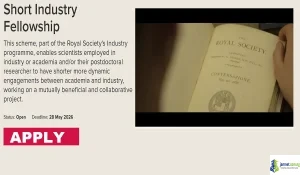
Breaking the silo between laboratory research and commercial deployment is often hindered by “the valley of death”—the financial gap where high-potential innovation lacks the funding to transition into a market-ready prototype. The 2026 Royal Society Short Industry Fellowships act as a strategic bridge, offering a robust financial mechanism for researchers to migrate between sectors without losing their institutional security.

Join our Telegram Channel for Instant Scholarship Updates
Unlike standard grants that focus solely on project equipment, this fellowship prioritizes human capital by providing full salary support for UK researchers and Postdoctoral R&D Grants. This ensures that academic pioneers can embed themselves within industrial frameworks to solve real-world problems, while industrial scientists can access high-spec academic labs to refine their IP. In an era where STEM Innovation Fellowships are becoming the gold standard for career progression, the Royal Society provides the liquidity needed to make these high-stakes professional moves seamless and risk-free.
CLICK HERE TO APPLY
Short Industry Fellowships Summary Table
| Detail | Value |
|---|---|
| Host Organization | The Royal Society |
| Target Audience | UK-based Scientists and Engineers |
| Primary Benefit | 100% Basic Salary Support & Expenses |
| Program Type | Professional Knowledge Transfer / Secondment |
| Sector Focus | Natural Sciences & Engineering |
| Application Deadline | May 28, 2026 |
About the Initiative: 2026 Royal Society Short Industry Fellowships
The 2026 iteration of the Short Industry Fellowship is a refined response to the UK’s growing need for a “Science Superpower” workforce. It moves beyond simple networking, functioning instead as a Venture Capital Research Funding model for intellectual talent. By funding “Back-fill” costs—the salary of a temporary researcher to cover the applicant’s duties—the program removes the administrative burden that usually prevents senior academics from pursuing industrial secondments.
This initiative recognizes that the most valuable Knowledge Transfer Partnerships (KTP) are those where personal immersion occurs. Whether it is an AI researcher moving into a Fintech startup or a materials scientist working with a sustainable energy manufacturer, the fellowship facilitates a deep-tissue exchange of methodology and culture. This dual-directional flow ensures that academia stays relevant to the market, and industry maintains a competitive edge through rigorous scientific validation.
Benefits of the Short Industry Fellowships
- Full Salary Indemnity: Covers the applicant’s basic salary, ensuring no financial loss during the transition.
- Strategic Research Buy-out: Provides funds for a replacement researcher to maintain your lab’s productivity while you are away.
- Enhanced STEM Innovation: Access to proprietary industrial datasets or high-performance academic computing clusters.
- Career Pivot Potential: Building a dual-sector profile that is highly attractive for Industrial PhD Funding supervision roles.
- Travel and Subsistence: Additional financial support for relocation or commuting costs associated with the host site.
Eligibility & Requirements of the Short Industry Fellowships
- Professional Standing: Applicants must hold a Ph.D. or have equivalent professional research experience in a relevant field.
- Scientific Remit: The project must be rooted in the natural sciences (including biological research, chemistry, physics, and engineering).
- Institutional Link: You must be a permanent employee of a UK university, research institute, or a UK-based commercial organization.
- Partnership Status: A cross-sector partner (Industry for Academics; Academia for Industrialists) must be confirmed prior to submission.
- Project Duration: Typically ranges from six months to two years on a full-time or part-time basis.
Step-by-Step Application Guide for the Short Industry Fellowships
Phase 1: Strategic Matchmaking & Scoping
- Identify a Host Partner: Academics must find a UK-based industrial partner, while industrial researchers must secure an academic host.
- Define the IP Framework: Negotiate intellectual property rights early to ensure both parties are protected.
- Draft the Technical Remit: Ensure the project solves a specific technical bottleneck that justifies the secondment.
Phase 2: Financial Planning & Buy-out Strategy
- Calculate Salary Scales: Work with your HR department to get exact figures for your basic salary and on-costs.
- Identify Back-fill Personnel: Start scouting for the postdoc or researcher who will cover your current duties.
- Justify the Budget: Clearly outline why the relocation or travel costs are necessary for project success.
Phase 3: Drafting the Case for Support
- Write the Technical Narrative: Focus on the “Knowledge Exchange”—what will you learn and what will you teach?
- Evidence the Impact: Use data to show how this fellowship will accelerate the commercialization of your research.
- Address the “Valley of Death”: Explain how this move helps transition a concept into a tangible industrial application.
Phase 4: Compliance & Institutional Approval
- Secure Head of Department Support: Obtain a formal letter of support from your current employer.
- Verification of Host Facilities: Ensure the host organization provides a letter confirming you will have full access to their equipment and data.
- Flexi-Grant Registration: Create your profile on the Royal Society’s portal and invite your collaborators to sign off.
Phase 5: Final Review & Submission
- Internal Peer Review: Have a colleague review the proposal for scientific rigor and clarity.
- Check Against Remit: Double-check that the project doesn’t fall into “clinical medicine,” which is a common reason for rejection.
- Submit Early: Hit the submit button 48 hours before the deadline to avoid technical glitches.
Jamnet Expert Advice (STAR/SMART Methods)
- Use the SMART Method: Ensure your “Measurable” goals include specific KPIs like “Developing 1 new patent filing” or “Training 5 staff in new microscopy techniques.”
- Apply the STAR Technique: In your personal statement, describe a Situation where a lack of sector-cross-over hindered progress, the Task you identified, the Action (this fellowship), and the expected Result (market disruption).
- Emphasis: Prioritize “Two-Way Learning.” The Royal Society wants to see that both the host and the applicant evolve through this partnership.
- Proactive Tip: Use LinkedIn to find previous RS Fellows; their insights on the “interview” phase (if applicable) are invaluable.
Deadline: May 28, 2026
CLICK HERE TO APPLY
Frequently Asked Questions (FAQ) About the Short Industry Fellowships
- Does this fellowship cover my full pension contributions? Yes, the grant typically covers basic salary plus employer’s national insurance and superannuation.
- Can a small startup be my industrial partner? Yes, as long as they are UK-based and have a physical presence for the secondment.
- Is there an age limit for applicants? No, the program is open to researchers at any career stage post-PhD.
- Can I work part-time on the fellowship? Yes, the fellowship is flexible and can be spread over a longer period at a lower FTE percentage.
- What research areas are excluded? Clinical medical research (e.g., drug trials) is excluded, though basic biomedical science is often accepted.
- Do I need to be a British citizen? No, but you must be working in the UK and have a valid visa for the duration of the fellowship.
- Can I use the funds for lab consumables? The primary focus is salary, but a small contribution toward research expenses is sometimes permitted.
- Who pays for the “Back-fill” postdoc? The Royal Society provides funding to cover the costs of a replacement researcher.
- How many fellowships are awarded annually? It varies, but it is a competitive scheme based on scientific excellence.
- Can I apply if my partner is an overseas company? No, the host organization must be based in the United Kingdom.