The 2026 Department of Sport, Arts and Culture (DSAC Heritage) Bursary programme in South Africa is open to citizens under 40 pursuing heritage-related studies at accredited tertiary institutions. The maximum value is R110,000, covering fees, books, and allowances for accommodation, meals, transport, and electronic devices. Applicants must have a minimum 65% academic average and adhere to a strict R130,000 annual gross salary limit if employed. The deadline is January 31, 2026.
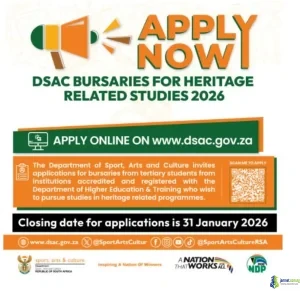
DSAC Heritage Bursaries 2026 Summary Table
| Detail | Value |
|---|---|
| Host Institution | Department of Sport, Arts and Culture (DSAC) |
| Host Country | South Africa |
| Category | Domestic Bursary (Undergraduate & Postgraduate) |
| Eligible Applicants | South African Citizens $\le 40$ Years |
| Academic Requirement | Minimum 65% Academic Threshold |
| Max Financial Award | R110,000 per student (Payable to institution) |
| Application Deadline | January 31, 2026 |
Department of Sport, Arts and Culture (DSAC) Bursaries 2026 Details
The Department of Sport, Arts and Culture (DSAC) Bursary programme for 2026 is an initiative designed to foster skills development and support academic pursuits in specialized heritage-related programmes in South Africa. The bursaries are available for full-time registered students at both the undergraduate and postgraduate levels at institutions accredited and registered with the Department of Higher Education and Training.

Join our Telegram Channel for Instant Scholarship Updates
The goal of the program is to ensure the preservation, promotion, and management of South Africa’s diverse cultural and historical heritage by investing in the next generation of specialists across fields like Archaeology, Conservation, Museum Studies, and Indigenous Knowledge Systems.
Bursary Value and Specific Awards Benefits
The DSAC Bursary offers substantial financial support, with a maximum value of R110,000 per student. Funds are paid directly to the higher institution of learning, ensuring expenses are covered efficiently.
Tier 1: Core Academic Costs (Full Coverage)
- Study Fees: The total amount of study fees for the registered heritage-related programme will be covered.
- Books: The total amount of prescribed books required for the course of study will be covered.
Tier 2: Living and Ancillary Allowances (Maximum Amounts)
- Accommodation: A maximum amount of R50,000 is provided for accommodation (where applicable).
- Meals: A maximum amount of R18,500 is provided for meals (where applicable).
- Transportation: A maximum amount of R10,000 is provided for transportation (where applicable).
- Electronic Devices: An allowance for electronic devices is provided, not costing more than R10,000 (where applicable).
Tier 3: Priority Fields of Study
The bursary targets a wide array of heritage disciplines, prioritizing niche and specialized areas, particularly at the postgraduate level:
- Archaeology: Including Physical and Biological Anthropology, Archeology (Maritime and Underwater Cultural Heritage), and Digital Archaeology.
- Conservation & Preservation: Conservation of the built environment, preventive conservation (Postgraduates specializing in Conservation), and Heritage Conservation and Preservation.
- Information & Management: Archives and Records management, Library and Information sciences, Heritage and Museum studies (Management, Curatorship, and Preservation), and Digitization of heritage resources.
- Specialized Heritage: Palaeontology, Indigenous Knowledge Systems (IKS), History, Geography and Geomatic sciences (Postgraduates specializing in Cartography and GIS), and International Studies.
Required Application Documents Checklist
To be considered, candidates must attach all the following required documents (certified copies must not be older than three months):
- Certified copy of a valid South African identity document.
- Letter of Provisional Acceptance or Proof of Registration written on the institution’s letterhead and signed (No screenshots).
- Certified copy of senior national certificate (Matric).
- Certified copy of latest academic results or progress report (for post-graduate students).
- Certified proof of parent’s or guardian’s household income.
- Certified latest payslip (not older than three months) if employed (proof of applicant’s income).
- Affidavit confirming that the salary advice/payment slips of parents/guardians are authentic.
- Proof of disability (if applicable to the applicant).
Eligibility Requirements for DSAC Bursaries 2026
Applicants must satisfy strict academic, financial, and citizenship requirements to be considered for this heritage scholarship.
- Citizenship & Age: Must hold South African citizenship and be not older than forty (40) years at the time of application.
- Academic Performance: Must demonstrate outstanding/satisfactory academic performance, meeting an Academic Threshold of 65% (minimum average).
- Study Field: The field of study must be heritage related, falling within the specified list of disciplines. Applications will be rejected if the study field is not on the list.
- Study Status: Applicants must be full-time students admitted for the 2026 academic year.
- Financial Status (Employed): If employed, the annual gross salary must not exceed R130,000 per annum. Employment must not be full-time by government, state agencies, or the private sector.
- Other Funding: Students who are beneficiaries of other bursaries and donors will not qualify to receive this DSAC bursary.
How to Apply for DSAC Heritage Bursaries 2026 (Step by Step)
To apply, candidates must ensure they have secured provisional admission to an approved heritage program and meticulously compile and certify all required supporting documentation before the deadline.
- Confirm Eligibility: Verify that you meet all eligibility criteria, especially the 65% academic threshold, age limit (40 years), South African citizenship, and that your qualification falls within the specified heritage-related fields of study.
- Secure Admission: Ensure you have been provisionally admitted or are already registered to study in the 2026 academic year at an accredited institution.
- Gather Documents: Collect all required documents. Ensure all certified copies are not older than three (3) months and that proof of acceptance is on the institution’s letterhead and signed (no screenshots).
- Proof of Income/Affidavit: Gather certified proof of parents’/guardian’s household income. If employed, submit certified latest payslip (not older than three months). An affidavit confirming the authenticity of the salary advice/payment slips of parents/guardians is mandatory.
- Submit Application: Submit the complete application form and all required documentation via the designated DSAC application channel (not specified in the text, but typically online or via post as per government standards).
Application Deadline: January 31, 2026
CLICK HERE TO APPLY
For more Information Click Here
Frequently Asked Questions (FAQ)
1. What is the deadline for applying for the 2026 DSAC Heritage Bursaries?
The application deadline is January 31, 2026.
2. What is the maximum financial value of the bursary awarded to a student?
The maximum value of the bursary is R110,000 per student, payable directly to the higher institution of learning.
3. What is the minimum academic performance required to be eligible?
Applicants must demonstrate outstanding/satisfactory academic performance, meeting an Academic Threshold of 65%.
4. What are the age and citizenship requirements for applicants?
Applicants must hold South African citizenship and be not older than forty (40) years at the time of application.
5. What are three examples of heritage-related fields of study covered by the bursary?
Examples include Archaeology, Archives and Records management, Conservation of the built environment, Palaeontology, Indigenous Knowledge Systems (IKS), and Heritage and Museum studies.
6. If an applicant is employed, what is the maximum allowable annual gross salary?
If employed, the annual gross salary must not exceed R130,000 per annum.
7. What is the maximum amount allocated for accommodation under this bursary?
The maximum amount allocated for accommodation is R50,000 (where applicable).
8. Can students receiving funding from other donors also apply for this bursary?
No, students who are beneficiaries of other bursaries and donors will not qualify to receive the DSAC bursary.
9. What is the time limit for certified copies of documents submitted with the application?
Any certified copy of documents attached must not be older than three (3) months at the time of application.
10. What document is required to confirm the authenticity of income proof for parents/guardians?
Applicants must provide an affidavit confirming the authenticity of the salary advice/payment slips of parents/guardians.