Launching a high impact scientific career at the intersection of artificial intelligence and wildlife conservation is a major milestone for early career ecologists. For many ambitious biology graduates, finding a fully funded master of science program that provides advanced computational training alongside ecological fieldwork is a persistent struggle. Navigating the competitive landscape of bioacoustics research funding is often difficult because it is tough to find a position that combines high performance computing with direct community outreach.

Join our Telegram Channel for Instant Scholarship Updates
The 2026 UTRGV Bioacoustics and Avian Migration Graduate Assistantship, hosted by the Contina Lab at the University of Texas Rio Grande Valley, is a dedicated scientific support program designed to solve these professional hurdles. By offering a competitive, negotiable salary and comprehensive training in data science, this assistantship ensures that talented graduate students can focus entirely on analyzing nocturnal flight calls and modeling species resilience without financial worry.
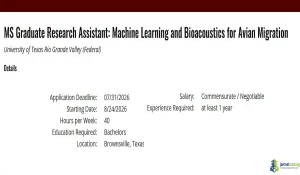
2026 UTRGV Bioacoustics Graduate Assistantship Summary Table
| Detail | Value |
|---|---|
| Host Organization | University of Texas Rio Grande Valley |
| Target Audience | Recent Biology and Ecology Bachelors Graduates |
| Primary Benefit | Negotiable Graduate Salary and Research Training |
| Program Type | Master of Science Graduate Research Assistantship |
| Gender Focus | All Genders Welcome |
| Application Deadline | July 31 2026 |
About the 2026 UTRGV Bioacoustics Graduate Assistantship
The Bioacoustics and Avian Migration Graduate Assistantship represents far more than a basic university research role; it serves as a prestigious launchpad for avian migration fellowships and machine learning ecology. Located in Brownsville, Texas, at the heart of a globally recognized biodiversity hotspot, the Contina Lab focuses on the ecological mechanisms underlying species resilience with particular emphasis on migratory populations. Selected scholars will develop their own unique research questions while mastering cutting edge techniques in stable isotope analysis, predictive modeling, and large scale acoustic monitoring.
Core Objectives of the Program
- To support graduate students by providing specialized quantitative wildlife biology funding and research resources.
- To advance global conservation science by deploying machine learning algorithms to analyze avian nocturnal flight calls.
- To foster community engagement and public awareness on the critical role of data science in environmental policy.
Benefits of the 2026 UTRGV Bioacoustics Graduate Assistantship
- Competitive monthly salary that is negotiable based on candidate experience.
- Comprehensive technical training in bioacoustics, data science, and high performance computing.
- Hands on experience conducting field research across multiple national wildlife refuges and reserves.
- Opportunity to lead and coauthor publications in high impact peer reviewed ecological journals.
- Guaranteed funding support for one year, with a strong expectation of second year renewal.
- Direct, personalized academic mentoring from internationally recognized principal investigator Dr. Andrea Contina.
Eligibility and Requirements of the 2026 UTRGV Bioacoustics Graduate Assistantship
- Educational Background: You must hold a bachelors degree in biology, ecology, wildlife conservation, or a related field.
- Academic Performance: An undergraduate GPA of at least 3.0 on a 4.0 scale is required; GRE scores are not necessary.
- Programming Skills: A high level of proficiency in either R or Python programming is a mandatory requirement.
- Field Experience: Prior experience in mist netting, bird identification, and point counts is highly valued.
- Work Authorization: The selected candidate must be eligible to work in the United States at the start of the contract.
- Driving Credentials: A valid United States driver license is required for field operations.
Lower Rio Grande Valley: A Biodiversity Hotspot
The research is set in one of the most ecologically diverse regions in North America. Lying at the confluence of desert, temperate, and tropical biomes, the Lower Rio Grande Valley boasts more than half of all bird species in the United States and over forty five endangered species. This unique setting provides graduate students with a natural laboratory consisting of multiple state parks, wildlife refuges, and private sanctuaries, even as urbanization and industrialization continue to fragment the local landscape.
Step by Step Application Guide for the UTRGV Assistantship
Phase 1: Research Evaluation and Alignment
- Visit the official Contina Lab publications website to study their previous research papers.
- Review the core research themes including stable isotopes, spatial modeling, and bioacoustics.
- Assess your current coding skills in R or Python to ensure you can manage large scale data analysis.
- Confirm your willingness to relocate to Brownsville, Texas, for the duration of the graduate degree.
Phase 2: Compiling Your Academic and Field Records
- Request official or unofficial copies of all post secondary transcripts from your university registrar.
- Verify that your cumulative undergraduate GPA meets the minimum requirement of 3.0.
- Update your professional Curriculum Vitae to highlight your computer programming and field biology experience.
- Gather the names and current contact information of three academic or professional references.
Phase 3: Drafting the Specialized Cover Letter
- Write a precise one page cover letter addressing your interest in the Contina Lab.
- Highlight your specific skills in bioacoustics, R, or Python programming, and ecological fieldwork.
- Explain your long term career goals in conservation science and quantitative wildlife biology.
- Proofread the letter carefully to make sure the English is simple, professional, and completely hyphen free.
Phase 4: Compiling and Submitting Your PDF
- Combine your cover letter, CV, reference list, and transcripts into a single, cohesive PDF document.
- Open a new email addressed directly to Dr. Andrea Contina at andrea.contina@utrgv.edu.
- Use the exact subject line Graduate Student Application to ensure your email is processed.
- Submit your complete PDF package before the rolling review process closes.
Phase 5: Interview and Onboarding Preparation
- Save a copy of your submitted application package and all confirmation records.
- Monitor your email inbox regularly for any interview invitations or requests for clarification.
- Review fundamental concepts in avian behavior, nocturnal flight calls, and statistical ecology.
- Prepare to begin your full time research assistantship and master level courses on August 24 2026.
Jamnet Expert Advice (STAR/SMART Methods)
- Use the SMART Method: Be Specific about the avian species you want to model, ensure your acoustic analysis is Measurable, and keep your thesis goals Relevant to conservation policy.
- Apply the STAR Technique: In your cover letter and interview, describe a challenging fieldwork Situation, the specific research Task, the Action you took using R or Python, and the positive Result.
- Emphasis: Focus heavily on demonstrating your ability to work independently in rugged field conditions and as an active member of a data team.
- Proactive Tip: Submit your application as early as possible on a rolling basis, as candidate evaluations begin immediately and slots are filled rapidly before the late summer start.
Deadline: July 31 2026
HOW TO APPLY
All materials should be compiled as a single PDF document and submitted to Dr. Andrea Contina (andrea.contina@utrgv.edu). Include ‘Graduate Student Application’ in the email subject line.
Frequently Asked Questions (FAQ) About the UTRGV Assistantship
- What is the deadline for this assistantship? Applications are reviewed on a rolling basis, but all materials should be sent before July 31 2026.
- Do I need to submit GRE scores? No GRE scores are not required for admission to this specific graduate program.
- What programming languages are required? You must have a high level of proficiency in either R or Python for database modeling.
- Is the graduate salary negotiable? Yes the monthly research assistant salary is commensurate with experience and negotiable.
- Is housing provided? No housing is not directly provided, but the university and surrounding Brownsville region offer many affordable options.
- What species will the selected candidate study? The research focuses on avian behavior, movement ecology, and nocturnal flight calls of migratory birds.
- Are international students eligible? Yes as long as they are fully eligible to work in the United States at the time of the appointment.
- What is the start date of the assistantship? The tentative start date for the contract and university courses is August 24 2026.
- How long is the program funding guaranteed? Funding is guaranteed for one year, with a second year renewal anticipated based on performance.
- What documents are required? A one page cover letter, a CV, contact info for three references, and copies of all post secondary transcripts.