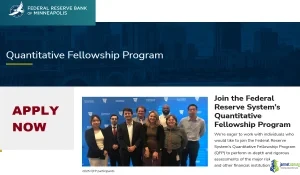
Securing a high impact professional role within the national central banking system is a major milestone for young quantitative analysts looking to shape the global economic future. For many ambitious master and doctoral graduates, finding an entry point that offers both rigorous technical training and direct exposure to systemic risk policy remains a persistent struggle. Navigating the competitive space of quantitative finance rotational programs is often difficult because it is tough to find a position that combines multi location office rotations with direct, hand on modeling of real world financial crises.

Join our Telegram Channel for Instant Scholarship Updates
The 2026 Federal Reserve System Quantitative Fellowship Program, hosted under the Supervision and Regulation function, is a premier career development initiative designed to solve these professional hurdles. By providing a structured two year rotational format and a pathway to a permanent career, the Federal Reserve Bank of Minneapolis ensures that brilliant young economists and data scientists can focus entirely on enhancing stress testing models and protecting national financial stability without administrative or financial worry.
2026 Federal Reserve Quantitative Fellowship Summary Table
| Detail | Value |
|---|---|
| Host Organization | Federal Reserve Bank of Minneapolis |
| Target Audience | Recent Master and PhD Graduates in Quantitative Fields |
| Primary Benefit | Two Year Rotational Training and Career Placement |
| Program Type | Highly Competitive Quantitative Fellowship |
| Location | Multiple US Federal Reserve Banks and Washington DC |
| Application Deadline | Fall 2026 Opening |
About the 2026 Federal Reserve Quantitative Fellowship
The Quantitative Fellowship Program is far more than a basic corporate training scheme; it serves as a prestigious launchpad for federal reserve quantitative careers and public sector risk modeling. Operating across the entire Federal Reserve System, the program is designed to build a strong pipeline of expert quantitative talent. Selected fellows spend fifty percent of their time at their home base location and fifty percent rotating through other regional reserve banks or the Board of Governors in Washington DC. This comprehensive, multi firm structure allows fellows to work directly with senior regulatory professionals, validating complex risk models and assessing the systemic vulnerabilities of the largest financial institutions in the United States.
Core Objectives of the Program
- To support young professionals by offering high value public sector risk modeling fellowships and career mentoring.
- To advance global and national financial stability by developing robust banking stress test models.
- To foster technical leadership by integrating advanced data science workshops into public financial regulation.
Program Structure and Rotational Design
The program is built around a highly structured, collaborative mobility model that balances local and cross regional experience:
- Home Base Assignment: Fellows spend approximately half of their fellowship duration working on site or in hybrid mode at their primary home reserve bank.
- Away Rotations: The remaining half is spent on active assignments at other Federal Reserve Banks or the Board of Governors in Washington DC.
- Operational Benefit: This dual structure exposes participants to diverse banking systems, distinct corporate cultures, and a wide variety of financial portfolio profiles.
Benefits of the 2026 Federal Reserve Quantitative Fellowship
- Competitive regional salary compensation tailored to your specific home base location.
- Fully supported travel and lodging allocations to cover all official program rotations.
- Direct and personalized mentorship from senior Federal Reserve quantitative experts and risk directors.
- Participation in two exclusive, annual QFP training symposiums and system wide quantitative forums.
- Access to premier national learning events including the Quant Skills Conference and the Model Risk Management Forum.
- Experiential learning opportunities such as the annual Crunch a thon data solving challenge.
- Outstanding prospects for transitioning into a permanent, full time quantitative analyst role upon completion.
Key Areas of Work and Responsibilities
Fellows apply their advanced mathematical and statistical skills to critical regulatory tasks, including:
- Stress Test Modeling: Designing and evaluating stress test models used to measure bank resilience under severe economic downturns.
- Portfolio Risk Analysis: Assessing credit, market, liquidity, and trading risks across major financial institutions.
- Model Risk Management: Conducting rigorous validation audits to ensure the mathematical integrity of regulatory tools.
- Systemic Risk Evaluation: Translating complex financial market indicators into actionable reports for supervisory decision makers.
Eligibility and Requirements for Applicants of the 2026 Federal Reserve Quantitative Fellowship
- Educational Level: Applicants must hold a completed Master degree or PhD by the program start date in July 2026.
- Field of Study: Academic degrees must be in economics, mathematics, statistics, engineering, quantitative finance, or data science.
- Programming Literacy: Strong, practical coding experience in Python, R, Matlab, SAS, or Stata is mandatory.
- Data Management: Proved ability to clean, manage, and analyze massive financial and economic datasets.
- Analytical Mindset: Outstanding critical thinking abilities, with a knack for simplifying complex technical findings for non technical policy leaders.
- Travel Flexibility: Willingness to travel and adapt to different working styles during the rotational phases.
- Legal Status: Applicants must meet the official Protected Individual definition under federal guidelines to access confidential supervisory information. This typically includes United States citizens, permanent residents, and eligible asylum holders.
Step by Step Application Guide for the Quantitative Fellowship
Phase 1: Academic and Eligibility Review
- Visit the official Federal Reserve careers platform to study the active work of the Supervision and Regulation function.
- Confirm that you meet the Protected Individual legal status required to access confidential banking data.
- Verify that your quantitative degree is scheduled for completion before the July 2026 start date.
- Assess your programming skills to ensure you are proficient in Python, R, or Matlab.
Phase 2: Compiling Your Quantitative Portfolio
- Request official transcripts from your Master or PhD granting university.
- Update your Curriculum Vitae to highlight your modeling projects, coding repos, and mathematical coursework.
- Gather academic papers or thesis abstracts that showcase your empirical research capabilities.
- Save all your personal and academic credentials as separate, professional PDF files.
Phase 3: Drafting Your Technical Cover Letter
- Write a professional cover letter explaining your specific motivation for joining the Federal Reserve.
- Detail your experience with statistical models, data cleaning, or financial stress testing.
- Highlight your willingness to relocate and participate in multi city rotational assignments.
- Proofread your written draft to ensure the English is simple, engaging, and completely hyphen free.
Phase 4: Navigating the Online Submission Portal
- Access the official Federal Reserve Bank of Minneapolis recruitment portal when the application opens.
- Complete the online registration forms with your correct personal, contact, and citizenship details.
- Upload your tailored CV, cover letter, transcripts, and technical portfolios in the designated fields.
- Submit your completed application package early to take advantage of the rolling recruitment reviews.
Phase 5: Preparing for Technical Assessments and Symposiums
- Save a digital confirmation of your submitted application and all uploaded files for your records.
- Monitor your email inbox regularly for invitations to complete coding tests or virtual quantitative interviews.
- Practice explaining complex statistical methodologies and econometric models clearly to non technical panels.
- Coordinate your personal logistics to relocate to your home base and begin your full time contract in July 2026.
Jamnet Expert Advice (STAR/SMART Methods)
- Use the SMART Method: Be Specific about the risk indicators you want to model, ensure your validation metrics are Measurable, and keep your goals Relevant to US financial stability.
- Apply the STAR Technique: In your cover letter and interviews, describe a challenging data processing Situation, the quantitative Task, the Action you took using Python or R, and the positive Result.
- Emphasis: Focus heavily on your ability to work productively across different regional teams and your commitment to public service.
- Proactive Tip: Submit your application as soon as the portal opens in the fall, as quantitative finance rotational programs are highly competitive and review files on a rolling basis.
Deadline: Applications Reviewed on a Rolling Basis
Frequently Asked Questions (FAQ) About the QFP
- What is the duration of this program? The Quantitative Fellowship Program is a structured, two year rotational initiative.
- Who administers the QFP? The program is officially hosted and managed by the Federal Reserve Bank of Minneapolis.
- Where will the selected fellows be located? Fellows are placed across multiple reserve banks, with potential rotations in Washington DC at the Board of Governors.
- Are international students on study visas eligible? No candidates must meet the Protected Individual requirement, which includes US citizens and permanent residents.
- What degrees are preferred? Master or PhD degrees in quantitative finance, economics, mathematics, statistics, data science, or engineering.
- What programming languages are used? Fellows primarily utilize Python, R, Matlab, SAS, and Stata for modeling.
- Is a permanent job guaranteed after the fellowship? While not guaranteed, the program is explicitly designed to transition fellows into full time quantitative analyst roles.
- Does the program cover travel costs? Yes all travel and lodging expenses incurred during official away rotations are fully supported.
- How are home base locations decided? Placement depends on institutional needs and candidate preferences, though a preferred city is not guaranteed.
- When does the next cohort begin? Selected fellows are scheduled to begin their full time rotational contracts in July 2026.